Best Portable Camping Stoves: 5 Picks for Van, RV, and Camp Cooking (2026)
A portable camping stove is the burner you carry to cook off-grid, on a van counter or tailgate, and the decision comes down to two numbers most listings bury: how many BTUs each burner makes, and what fuel it burns. Butane quits at 31 degrees, propane keeps going to 44 below, and that decides whether your stove lights on a cold morning. The other half is a line nobody prints loudly enough: every one of these stoves is labeled outdoor-use-only, because burning fuel in a sealed van or tent is how carbon monoxide kills. We read the gear-test labs, the van-life forums, and CDC and CPSC guidance, then verified every listing live on Amazon on June 13, 2026. The honest headlines: more BTU is not better cooking, simmer and wind matter more; the $230 Camp Chef Everest 2X out-boils the $450 pick most roundups crown; and the cheap no-name butane stoves are what the CPSC recalled by the hundred thousand.
- 01 Camp Chef Everest 2X (B09KNVRDNQ) , top pick, the van two-burner that out-cooks pricier stoves, 4.6/487, ~$230
- 02 Coleman Classic 2-Burner (B00005OU9D) , the $70 default, runs on canisters sold everywhere, 4.8/21,008
- 03 Gas One GS-3400P (B01HQRD8EO) , the value: dual-fuel single burner, solo and prepper favorite, 4.6/14,944, ~$30
- 04 MSR PocketRocket Deluxe (B07L5S65HR) , the ultralight canister stove for day hikes from the van, 4.8/830, ~$85
- 05 MSR WhisperLite International (B0CQRWR52Y) , the multi-fuel pick for cold, altitude, and far-off-grid travel, 4.6/521, ~$160
How they compare.
| Rank | Product | Best for | Price | Our score |
|---|---|---|---|---|
| 01 | Camp Chef Everest 2X (B09KNVRDNQ)
Top Pick
| best overall, the van and car-camping two-burner that wins on boil, wind, and simmer at once | $229.99
Buy → | 9.0/10 |
| 02 | Coleman Classic 2-Burner (B00005OU9D) | the budget default, deepest proof in the guide, runs on canisters sold everywhere | $69.99
Buy → | 8.6/10 |
| 03 | Gas One GS-3400P (B01HQRD8EO) | the value pick, dual-fuel single burner for solo rigs and emergency kits | $29.99
Buy → | 8.5/10 |
| 04 | MSR PocketRocket Deluxe (B07L5S65HR) | the ultralight canister stove for backpacking and day hikes from the van | $84.55
Buy → | 8.4/10 |
| 05 | MSR WhisperLite International (B0CQRWR52Y) | the multi-fuel specialist for cold, altitude, and international overland travel | $159.95
Buy → | 8.1/10 |
Prices are current Amazon prices at time of publication and can change. Scores reflect our editorial evaluation, not vendor input.
Our #1 pick: Camp Chef Everest 2X 2-Burner Portable Camping Stove, 40,000 BTUs, Two 20,000-BTU Burners, Propane, Matchless Ignition (ASIN B09KNVRDNQ).
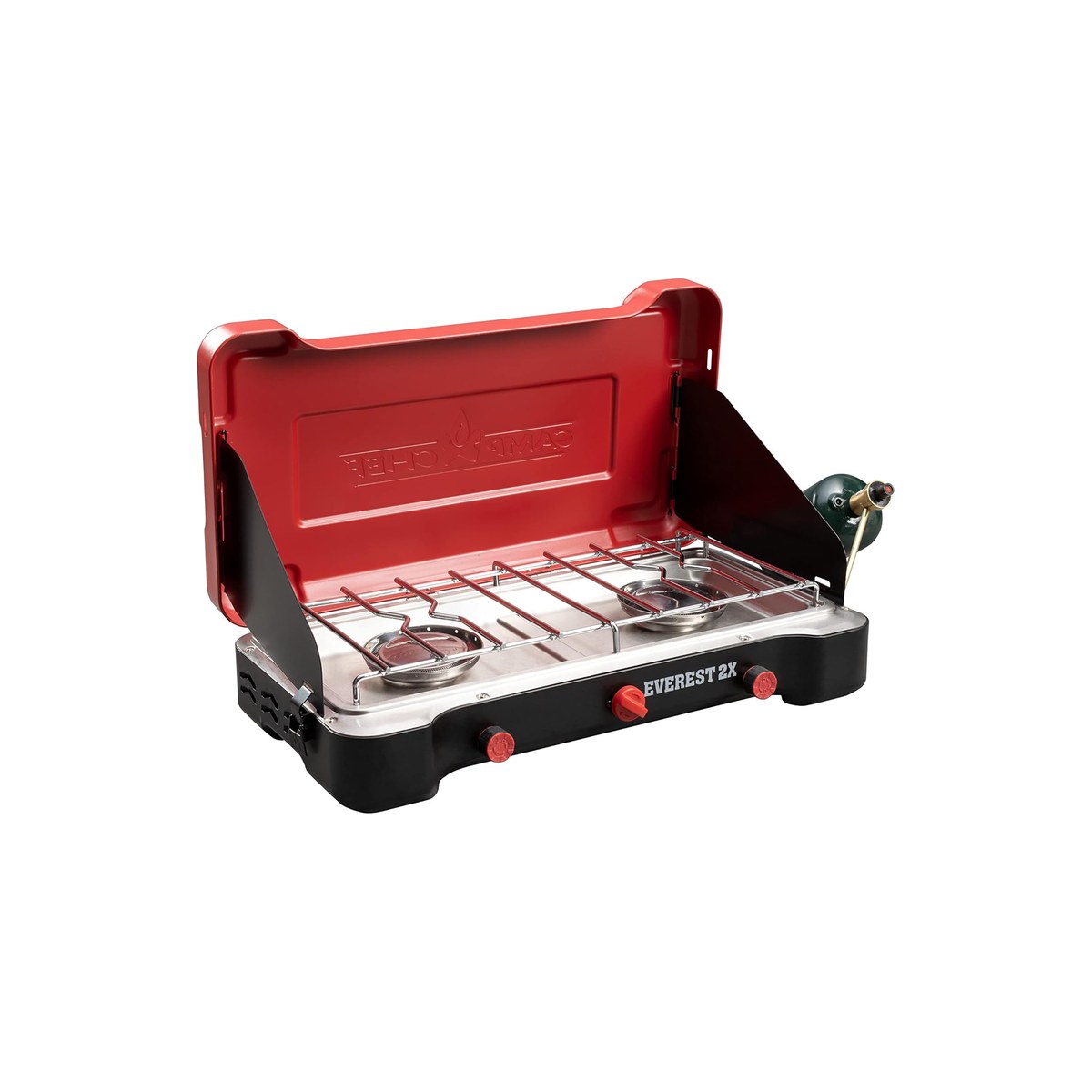
Camp Chef Everest 2X 2-Burner Portable Camping Stove, 40,000 BTUs, Two 20,000-BTU Burners, Propane, Matchless Ignition (ASIN B09KNVRDNQ)
The van two-burner that out-cooks pricier stoves, and folds under the counter.
Who it's for: The van, RV, or car-camping cook who wants one stove that does everything well, fast boils for coffee and pasta water, real simmer for eggs and sauces, and enough wind resistance to actually work at a breezy campsite. At four inches folded it slides under a van counter or onto a fridge slide, and it runs off a one-pound canister or, with a hose, a 20-pound tank.
What we found: The Everest 2X is the consensus number-one across the gear-test labs, and the live numbers back it up, 4.6 stars across nearly 500 Amazon reviews. Each of its two burners puts out 20,000 BTUs, 40,000 total, and it posted the fastest boil time in its class, around three to four minutes for a liter, while a three-sided design and a lid that doubles as a windscreen gave it the best wind performance in OutdoorGearLab's testing. The real surprise is the simmer: most high-output stoves cook hot or off, and this one holds a low flame well enough for pancakes and rice.
Bottom line: Buy the Everest 2X if you cook real meals on the road and want the stove that boils fastest, fights wind best, and still simmers, all in a package that stows under the counter. It costs more than a Coleman and burns propane faster at full tilt, but it is the one most van and car campers should own. Confirm the regulator date code if you buy it used, and run it outside or fully ventilated.
- + 20,000 BTUs per burner, 40,000 total, and the fastest boil time of any two-burner the gear labs tested, around three to four minutes for a liter of water
- + Three-sided wind blocking and a lid that doubles as a windscreen, the best wind performance in its class, plus a simmer good enough for eggs and rice
- + Folds to four inches tall to slide under a van counter or onto a fridge slide, and runs off a one-pound canister or a 20-pound tank with a hose; 4.6 stars across nearly 500 reviews
- × At $229.99 it is the priciest pick here except the multi-fuel MSR, and 40,000 BTUs burns through propane faster than a 10,000-BTU stove does
- × Heavier at around 12 to 14 pounds, this is a stay-in-camp two-burner, not a stove you backpack with
- × At full output it drains a one-pound propane canister fast, so for anything past a weekend you will want a hose adapter to a 20-pound tank, and like every stove here it is outdoor-use-only
Runner-up: Coleman Gas Camping Stove, Classic Propane Stove, 2 Burner, Adjustable Burners, Wind Baffles, 20,000 Total BTUs (ASIN B00005OU9D).
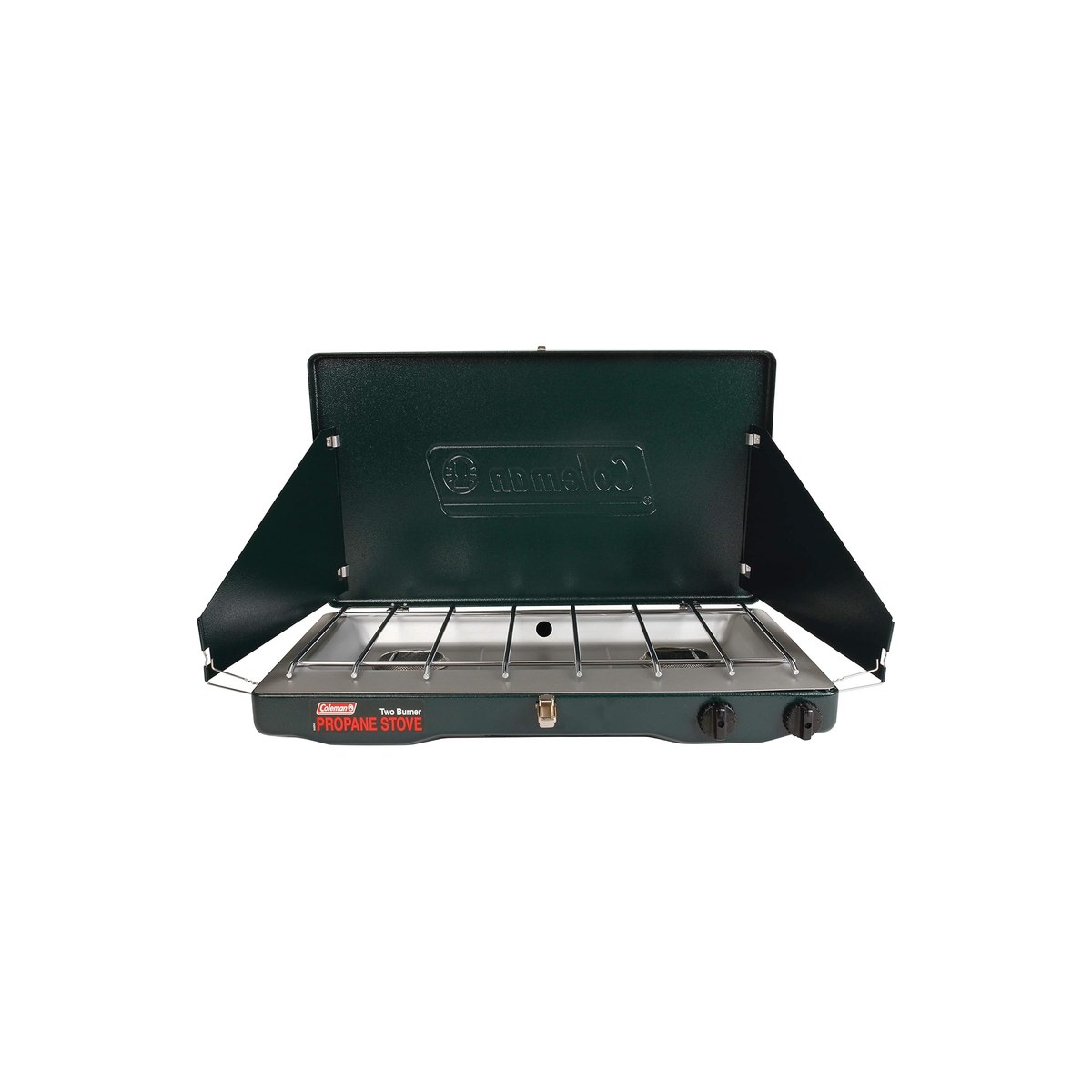
Coleman Gas Camping Stove, Classic Propane Stove, 2 Burner, Adjustable Burners, Wind Baffles, 20,000 Total BTUs (ASIN B00005OU9D)
The $70 two-burner that runs on canisters sold everywhere.
Who it's for: The camper who wants a proven two-burner that just works and costs about $70, and who values being able to buy fuel anywhere over lab-grade performance. The Coleman Classic is the stove most American campers learned on, it runs on the green one-pound propane canisters stocked at every gas station, and it folds into a briefcase that shrugs off a decade of tailgates and campsites.
What we found: This is the default for a reason, a 4.8-star rating across more than 21,000 reviews, the deepest proof of anything in this guide by a wide margin. Two 10,000-BTU burners, adjustable wind baffles, and a pressure regulator that holds a steady flame as the canister empties. The honest limit is cooking range: the gear labs rank its outright performance at the bottom of the test field, the low setting runs a little hot for delicate simmering, and the open burners struggle in real wind. For boiling water and one-pan meals, none of that matters, which is most of what most campers do.
Bottom line: Buy the Coleman Classic if you want a dependable two-burner at the lowest sensible price and the convenience of fuel you can find anywhere. It will not out-cook the Everest, and a windy ridge will test it, but for the campsite breakfast and the boil-water-and-go majority it is all the stove you need. Add a one-pound-to-20-pound adapter hose if you camp for more than a weekend and want cheaper fuel.
- + 4.8 stars across more than 21,000 reviews, the deepest proof of anything in this guide by a wide margin
- + Runs on the green one-pound propane canisters stocked at every gas station, hardware store, and big-box, with a regulator that holds a steady flame as the canister empties
- + Two 10,000-BTU burners and adjustable wind baffles in a briefcase-fold body that shrugs off years of tailgates, around $70
- × The gear labs score its outright cooking performance 63 out of 100, the lowest in the test field, and the low setting runs a little hot for delicate simmering
- × Open burners struggle in real wind, a windscreen helps on an exposed site
- × No push-button igniter, you light it with a match or lighter, and it is outdoor-use-only like the rest
Budget pick: Gas One GS-3400P Propane or Butane Stove Dual Fuel Portable Camping Stove, Single Burner, 8,000 BTU, with Carrying Case (ASIN B01HQRD8EO).
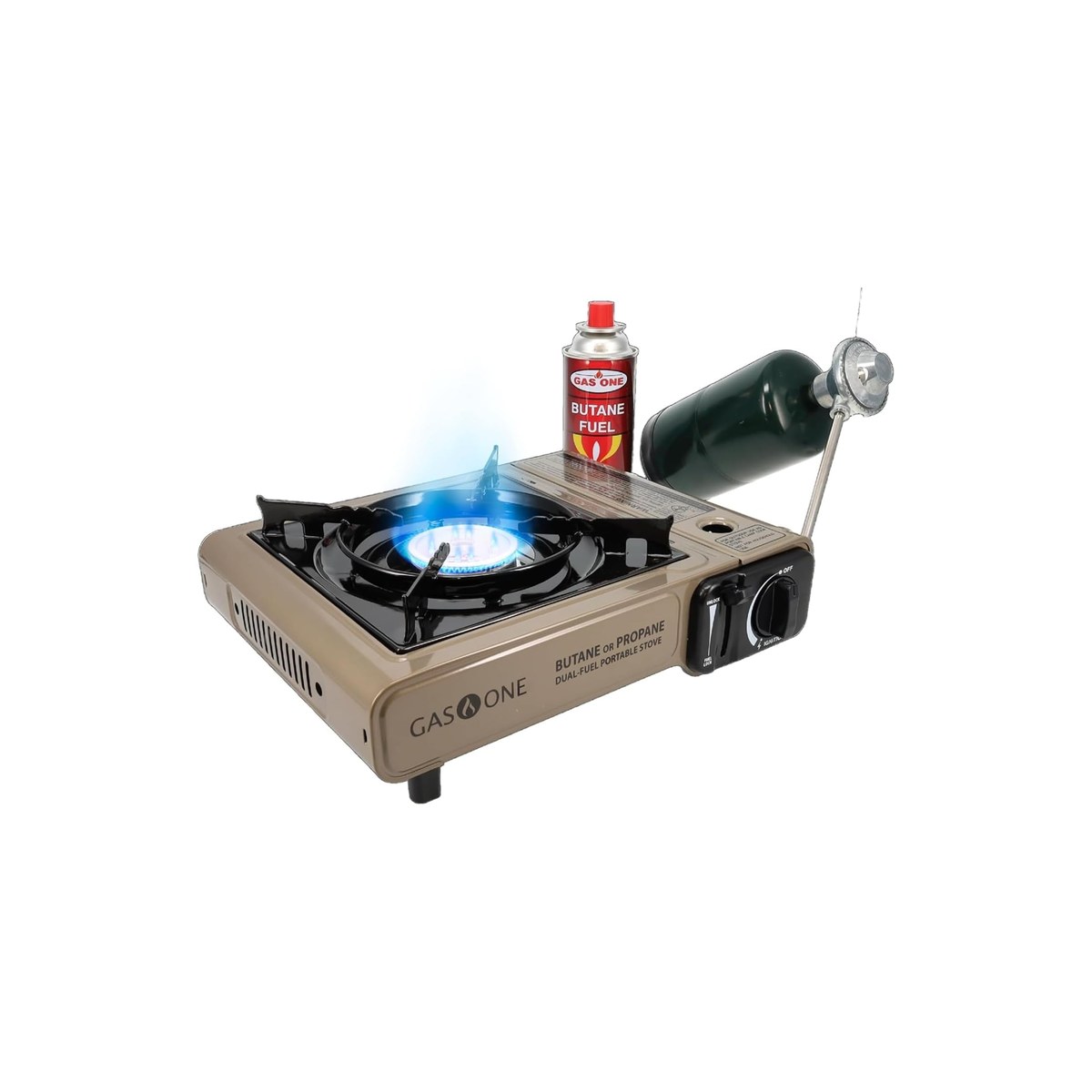
Gas One GS-3400P Propane or Butane Stove Dual Fuel Portable Camping Stove, Single Burner, 8,000 BTU, with Carrying Case (ASIN B01HQRD8EO)
Thirty dollars, dual-fuel, the solo-rig and emergency-kit single burner.
Who it's for: The solo van-lifer, the minimalist, and the emergency-kit builder who wants a capable burner for about $30. The Gas One GS-3400P is a single burner that runs on both 8-ounce butane cartridges and one-pound propane canisters, so you can grab whatever fuel is on the shelf, and it ships in a hard case that makes it the go-to power-outage and prepper stove.
What we found: For the price it is remarkable, a 4.6-star rating across nearly 15,000 reviews and a genuine dual-fuel design with a piezo igniter and a flame-supervision safety cutoff. The gear labs rate it the best value in their test field. The two real limits are inherent to what it is: it is a single burner, so one pot at a time, and on butane it loses flame as the temperature drops toward freezing, the testers watched it falter while simmering in the mid-30s. Run propane when it is cold and that problem goes away.
Bottom line: Buy the GS-3400P as a first stove, a backup, or an emergency-kit burner, and lean on the dual-fuel flexibility: butane on a calm, warm day, propane when it is cold or windy. It will not cook for a family and it is not a stay-in-camp kitchen, but as the cheapest competent stove here, with deep proof, it earns its place. Keep a spare canister and a lighter in case the piezo igniter quits, and run it outdoors like every stove in this guide.
- + A genuine dual-fuel design, runs on both 8-ounce butane cartridges and one-pound propane canisters, so you use whatever fuel is on the shelf
- + 4.6 stars across nearly 15,000 reviews and the gear labs' best-value pick, with a piezo igniter and a flame-supervision safety cutoff
- + Around $30 and ships in a hard carrying case, the go-to power-outage and prepper stove
- × A single burner, so one pot at a time, this is not a stove that cooks for a family
- × On butane it loses flame as the temperature drops toward freezing, testers watched it falter while simmering in the mid-30s; run propane when it is cold
- × Light-duty build, fine for a backup or solo use but not the stay-in-camp kitchen a two-burner is
Also worth considering.
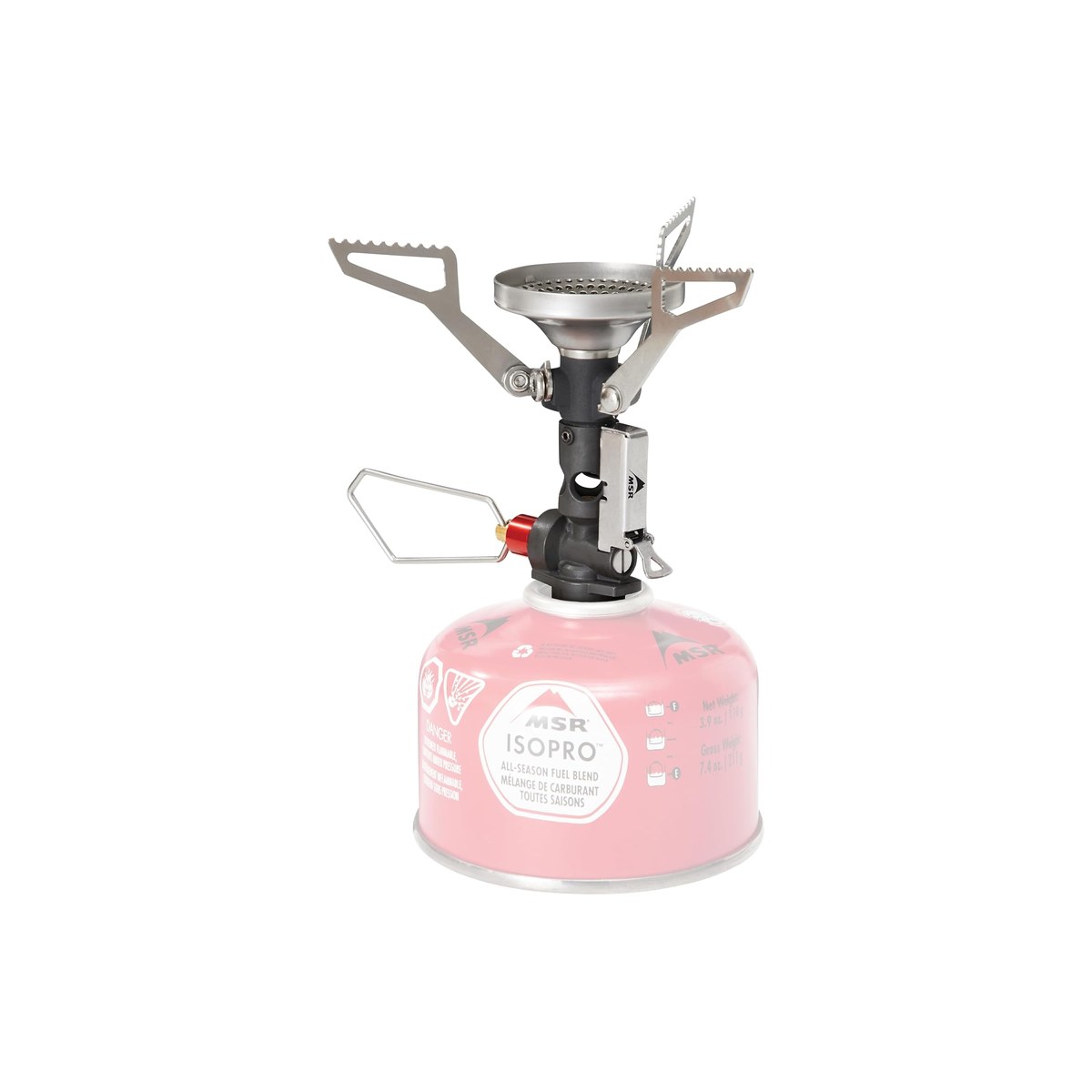
MSR PocketRocket Deluxe Ultralight Backpacking and Camping Stove, Isobutane Canister, Push-Button Igniter (ASIN B07L5S65HR)
The ultralight canister stove for day hikes from the van.
Who it's for: The van traveler who hikes, the backpacker, and anyone who wants a tiny, near-weightless burner for boiling water away from the rig. The MSR PocketRocket Deluxe weighs 3.3 ounces, screws onto an isobutane canister, and disappears into a jacket pocket, the stove you grab for a day hike from base camp or a fast cup on the trail.
What we found: It is a top-three backpacking stove across the gear labs, 4.8 stars across more than 800 reviews, and the Deluxe adds a pressure regulator that keeps output steady as the canister drains and in moderate cold, plus a push-button igniter and a broad burner head that simmers better than most canister stoves. It boils a half-liter in roughly three to four minutes. The limits are scope: it is a one-pot, isobutane-only stove with no wind protection of its own, so it is a backpacking and supplemental burner, not the van kitchen.
Bottom line: Buy the PocketRocket Deluxe as the stove that lives in your pack, not the one that cooks dinner for the family at camp. If your trips mix van nights with day hikes, it pairs perfectly with a two-burner back at the rig. Bring a windscreen for exposed sites, and remember that isobutane, like all canister gas, weakens as it empties and as the temperature drops toward freezing.
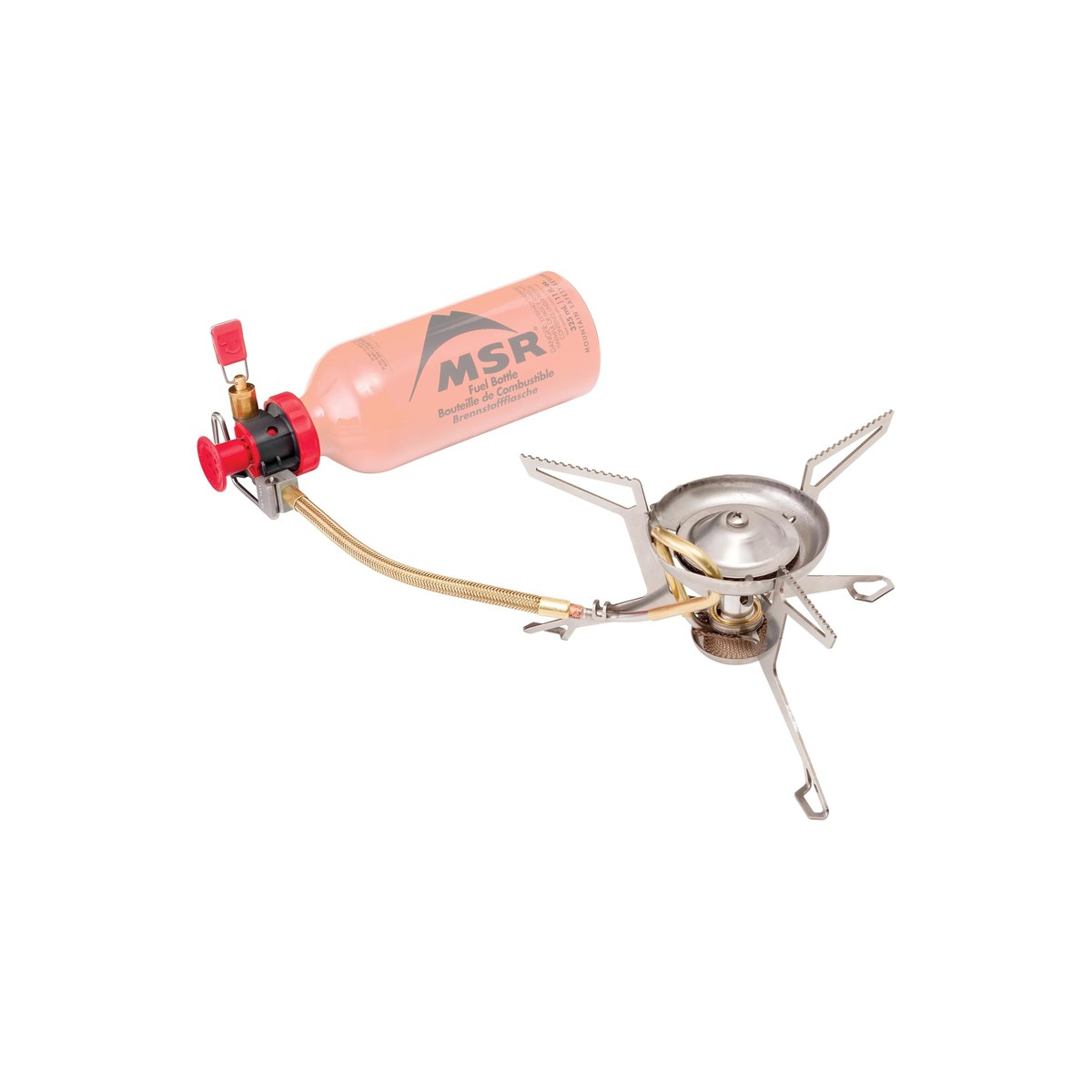
MSR WhisperLite International Compact Multi-Fuel Camping and Backpacking Stove, White Gas / Kerosene / Unleaded (ASIN B0CQRWR52Y)
The multi-fuel burner for cold, altitude, and far-off-grid travel.
Who it's for: The overlander, the winter camper, and the international traveler who needs a stove that runs when canisters fail or cannot be found. The MSR WhisperLite International burns white gas, kerosene, and even unleaded gasoline, the fuels you can buy almost anywhere on earth, and it keeps working in deep cold and at altitude where butane and isobutane quit.
What we found: It is the gear labs' top liquid-fuel pick, 4.6 stars across more than 500 reviews, field-repairable with a simple maintenance kit, and proven over decades of expedition use. White gas vaporizes well below 40 degrees under zero, so it is the cold-and-altitude answer the canister stoves cannot match. The trade-offs are real and worth naming: it must be primed before each use, it is fussier and louder than a canister stove, it does not simmer as gently, and this International model runs on liquid fuel only, not the isobutane canisters its discontinued Universal sibling also accepted.
Bottom line: Buy the WhisperLite International only if your travel genuinely demands it, sub-freezing trips, high altitude, or long routes where canister fuel is unreliable. For weekend van and car camping it is more stove than you need, and the priming ritual will annoy you. But for the expedition and cold-weather crowd, a multi-fuel stove that runs on gasoline in a pinch is the one that always lights.
Skip this guide if...
Skip a dedicated camping stove if your rig has a working built-in range and you only ever cook at the rig, or if you camp exclusively at full-hookup sites with an outdoor kitchen, the gear you already have does the job. And if you are thinking about cooking inside a closed van to dodge the weather, the honest answer is not a different stove, it is a different plan: either ventilate properly with a roof vent open to the outside and a carbon-monoxide detector, or step up to 12V electric induction, which makes no carbon monoxide but needs a serious battery and inverter to run.
Don't bother with.
- × Skip The $450 'premium' two-burner everyone ranks firstThe Jetboil Genesis Basecamp headlines most camping-stove roundups at around $450, and the testing does not support the price. CleverHiker measured its boil time at over seven minutes, the slowest in their field, and found it cooked unevenly, scorching the center of a pan while the edges stayed cool. It carries a 4.7-star rating across 262 reviews, so buyers do like it, but boil performance is what the high price claims to buy and that is where the testing went against it. It folds compactly and handles wind well, so it is not a bad stove, it is an overpriced one. The Camp Chef Everest 2X boils faster, simmers better, and costs roughly half. Buy the performance, not the marketing.
- × Skip Any no-name butane stove from the marketplace bargain binThe search results are full of $20 to $30 butane stoves from brands you have never heard of, and they are exactly the ones that get recalled. In 2025 the CPSC recalled 201,000 units of one Walmart-sold butane stove after 26 reports of stoves exploding or catching fire and 16 burn injuries, failures that happened under normal use. A butane stove holds a pressurized cartridge inches from a flame, so engineering and quality control genuinely matter. Buy from Gas One, Coleman, Camp Chef, MSR, Jetboil, or Primus, not a random three-letter Amazon seller.
- × Skip Refilling green one-pound propane canisters to save moneyThe disposable green one-pound propane canisters are DOT-39 cylinders, certified for single use only, and refilling one for transport is a federal violation, not just a warranty issue. The refill adapters sold online live in a legal gray zone, and the canisters were never built for repeated pressure cycling. If you want to stop throwing canisters away, and Americans discard an estimated 40 million a year, buy a DOT-certified refillable one-pound cylinder like the Flame King, or run a hose from a 20-pound tank, which is cheaper fuel anyway.
- × Skip Using a camping stove to heat the van or tentThis is the one that kills people. Every fuel-burning stove produces carbon monoxide, and using a cooking stove as a space heater in an enclosed space is the single most common cause of the camping carbon-monoxide deaths the CPSC tracks. The gas is invisible and odorless and you will not wake up. If you are cold, use a proper vented heater, more insulation, or a warmer sleeping system, never the stove, and put a carbon-monoxide detector low in any rig where you cook.
- × Skip Alcohol and wood stoves for van and RV cookingAlcohol stoves are ultralight and cheap to feed, and wood and rocket stoves run on free fuel, but neither fits portable van and RV cooking well. Both produce more carbon monoxide than a canister stove in enclosed-space testing, and a growing number of Western destinations ban open-flame stoves under fire restrictions while still allowing canister stoves you can switch off, California and Rocky Mountain National Park among them. For carry-along van and camp cooking, a propane or canister stove is the safer, more practical choice.
How we picked.
Sources we read and how we picked
We started where the buying mistakes start, with fuel type and BTU. We recorded each stove's fuel, output per burner, weight, and packed size, pulled the independent boil-time and simmer tests from the gear labs that actually run these stoves, OutdoorGearLab, CleverHiker, GearJunkie, and Outdoor Life, then read the van-life and overland forums for how the stoves hold up past the first season. Every listing was verified live on Amazon on June 13, 2026, price, rating, review count, and stock, because this category is thick with no-name marketplace clones, one of which the CPSC recalled in 2025.
Our filter, in order: does it light and cook reliably in the conditions you actually camp in, which means wind and cold, not lab-bench boil times; then real cooking range, simmer control over raw BTU; then proof in reviews and fit to how you travel. That order is why the Camp Chef Everest 2X leads at a 9.0 over cheaper and pricier stoves alike, it wins on boil, wind, simmer, and packability at once, and why the $70 Coleman Classic ranks as the default runner-up on its 21,000-review record and universal fuel availability despite a lab performance score that trails the field. We rank on fit for how people cook on the road, and we say so where the lab score and the buyer record diverge.
The fuel and BTU math that actually decides it
The single most useful number in this category is the temperature your fuel quits. n-Butane stops vaporizing at 31 degrees Fahrenheit, zero Celsius, which is why a cheap butane stove dies on a frosty morning. Isobutane, the upgraded canister blend, holds to about 12 degrees. Propane keeps flowing to 44 below zero, and white gas, the liquid fuel in the MSR WhisperLite, works past 40 below. There is a catch the canister makers do not advertise: a canister blend still holds a propane fraction that burns off first, so as the canister empties the remaining fuel gets heavier in butane and fades in the cold before it reaches that rating. For any cold-weather trip, run propane or liquid fuel, and on a near-freezing morning, warm the canister inside your jacket for ten minutes before you light it.
BTU is the number every listing shouts and the one that misleads most. More BTU means a faster boil and a thirstier appetite for fuel, nothing more. It does not mean better cooking, because real cooking is a simmer problem, not a boil problem, and the gear labs found no relationship between peak BTU and simmer control, the highest-output burners they tested scored among the worst on usability and wind. What actually separates a good camp stove from a frustrating one is wind performance and low-end flame control: the Camp Chef Everest 2X boils a liter in roughly three to four minutes and still simmers eggs without scorching, while the $450 Jetboil Genesis Basecamp that headlines many roundups took over seven minutes to boil and cooked unevenly in independent testing. Read the wind and simmer notes, not the BTU number.
The five kinds of camping stove, and who each is for
There are really five lanes. A high-output tabletop two-burner like the Camp Chef Everest 2X is the do-everything van and car-camping kitchen, fast and capable, the most stove most people need. A budget two-burner like the Coleman Classic does the same core job for a third the price, with weaker simmer and wind handling, and the unbeatable advantage of running on fuel sold everywhere. A dual-fuel single burner like the Gas One is the compact, cheap, fuel-flexible pick for solo rigs and emergency kits, one pot at a time. A backpacking canister stove like the MSR PocketRocket Deluxe is the ultralight burner for hikes away from the rig. And a liquid or multi-fuel stove like the MSR WhisperLite is the cold-weather, high-altitude, international specialist that runs when canisters cannot.
Choose by how you travel, not by the biggest BTU number. Weekend car campers and most van lifers are best served by a two-burner, the high-output Everest if you cook real meals, the budget Coleman if you mostly boil water. Solo and emergency-minded buyers want the dual-fuel single burner. Hikers add a canister stove. Only the cold-and-altitude crowd needs liquid fuel. One more option is coming up fast: 12V electric induction makes zero carbon monoxide and is genuinely usable inside a van, but it needs a serious lithium bank and inverter to run an 1,800-watt burner, the kind of power system our RV lithium battery and inverter guides cover, so it is a system decision, not a stove you just buy.
The safety rules: carbon monoxide, recalls, and fuel
Every stove in this guide is labeled outdoor-use-only, and the reason is carbon monoxide. The CDC records more than 400 unintentional carbon-monoxide deaths a year in the United States, and the CPSC has documented dozens tied specifically to camping stoves, lanterns, and heaters run inside tents, campers, and vehicles. The gas is colorless and odorless, and its early symptoms, headache, dizziness, nausea, read like the flu, so people lie down and do not wake up. The critical part the labels understate: the CPSC found that opening a window or a door is not enough to prevent a dangerous build-up in an enclosed space.
Plenty of van lifers cook inside anyway, and if you do, understand you are accepting a risk the labels warn against. The CPSC finding above is about a sealed space with a cracked window; real through-flow ventilation, a roof vent open to the outside drawing air past a cracked window, is different in kind, but it is still not zero risk. Run the stove only while you are awake and watching it, never use it to heat the van, which is the single most common way these accidents happen, and put a carbon-monoxide detector in the rig, because CO is invisible, odorless, and mixes through the air rather than pooling where you would expect. Two more safety lines: the cheap no-name butane stoves that flood the search results are the ones that get recalled, the CPSC pulled 201,000 of one Walmart model in 2025 after 26 reports of fire or explosion and 16 burn injuries, so buy a name brand; and the disposable green one-pound propane canisters are single-use by law, refilling them for transport is a federal violation, so use a DOT-certified refillable cylinder or run a hose off a 20-pound tank.
FAQs.
Q01 What is the best portable camping stove?
+
Q02 Butane or propane for a camping stove?
+
Q03 Can you use a camping stove indoors?
+
Q04 How many BTUs do I need in a camping stove?
+
Q05 What is the best camping stove for cold weather?
+
Q06 Can you refill a 1-pound propane canister?
+
If you, then this.
- IF you want the best all-around stove for van and car campingGET Camp Chef Everest 2X (B09KNVRDNQ; 40,000 BTU two-burner, fastest boil, best wind, folds to 4 in)$229.99 →
- IF you want a dependable two-burner for the least moneyGET Coleman Classic 2-Burner (B00005OU9D; runs on green propane canisters sold everywhere, 21,000+ reviews)$69.99 →
- IF you are solo, minimalist, or building an emergency kitGET Gas One GS-3400P (B01HQRD8EO; dual-fuel single burner, butane or propane, hard case)$29.99 →
- IF you hike from the van and want an ultralight burnerGET MSR PocketRocket Deluxe (B07L5S65HR; 3.3 oz isobutane canister stove, regulated, igniter)$84.55 →
- IF you camp in deep cold, at altitude, or off the grid abroadGET MSR WhisperLite International (B0CQRWR52Y; multi-fuel, white gas / kerosene / gasoline)$159.95 →
- IF you want to cook inside the van without carbon monoxideGET Not a flame stove: ventilate fully with a CO detector, or go 12V induction, which needs a big lithium bank our RV lithium battery guide can help you sizevaries →
RV & Van Gear: The Complete Guide
The whole-rig picture →Every system in a van, RV, or camper, organized in one place, with the safety and weight floor and the one guide we trust for each.
- Carbon Monoxide Poisoning: Prevention and 'never use a portable gas camp stove indoors' guidance, 400+ US deaths/year · CDC
- Camping Equipment / Portable Heater Safety Alert: CO deaths from stoves in enclosed spaces; opening a window is insufficient · CPSC
- Why does my canister stove fail in cold weather? Fuel vaporization thresholds (butane 31F, isobutane 11F, propane -44F) · AMC Outdoors
- Best Camping Stoves 2026: tested boil times, simmer and wind scores (Everest 2X #1, Coleman, Gas One value) · OutdoorGearLab
- Camp Chef Everest 2X and Jetboil Genesis Basecamp reviews: boil-time and even-cooking testing · CleverHiker