Best Portable Induction Cooktops: 5 Picks, and the Off-Grid Power Math (2026)
A portable induction cooktop is a countertop burner that heats the pan directly with a magnetic field, with zero flame or carbon monoxide, which is why van and RV cooks eye it as the propane alternative. Two questions decide whether it works for you, and most listings answer neither: will your pans work, because induction only heats magnetic cookware, and can your power system run it, because a typical 1,800-watt burner pulls about 150 amps at 12 volts. We pulled the power-draw measurements, read the off-grid build forums, and verified every listing live on Amazon on June 13, 2026. The honest headlines: induction is a shore-power and big-battery tool first, you need a 2,400-watt inverter and a 200-amp-hour lithium bank to cook freely off-grid; the cheap pans most campers own do not work; and the best portable induction cooktop for a power-limited rig is not the most powerful one, it is the 1,300-watt NuWave that runs on a smaller inverter.
- 01 Duxtop 9600LS (B01FLR0ET8) , top pick, best overall single burner, 20 levels, 4.4/8,676, ~$117 (wants a 2,400W inverter)
- 02 Duxtop 9100MC (B00GMCAM2G) , the value all-rounder, most-reviewed here at 9,315, full 1,800W, ~$85
- 03 NuWave Flex (B01AV7JW2S) , the off-grid pick: 1,300W runs on a 1,500W inverter, cheapest at ~$60, 4.5/4,575
- 04 Duxtop 9620LS Double (B07GB149V7) , the two-burner for bigger rigs, one zone at a time off-grid, ~$232
- 05 Dometic CI-21 (B08G5839YJ) , the built-in RV drop-in, 1,440W battery-friendly, thin reviews, ~$699
How they compare.
| Rank | Product | Best for | Price | Our score |
|---|---|---|---|---|
| 01 | Duxtop 9600LS (B01FLR0ET8)
Top Pick
| best overall, 20-level control and the deepest proof, if your power can feed 1,800 watts | $116.99
Buy → | 9.0/10 |
| 02 | Duxtop 9100MC (B00GMCAM2G) | the most-reviewed value all-rounder, full 1,800W and 15 levels for less | $84.99
Buy → | 8.5/10 |
| 03 | NuWave Flex (B01AV7JW2S) | the off-grid pick: 1,300W runs on a smaller inverter, and the cheapest here | $59.99
Buy → | 8.4/10 |
| 04 | Duxtop 9620LS Double (B07GB149V7) | two burners for bigger rigs and shore power, one zone at a time off-grid | $231.99
Buy → | 8.2/10 |
| 05 | Dometic CI-21 (B08G5839YJ) | the drop-in for a permanent RV install, battery-friendly 1,440W, thin review base | $699.00
Buy → | 7.6/10 |
Prices are current Amazon prices at time of publication and can change. Scores reflect our editorial evaluation, not vendor input.
Our #1 pick: Duxtop 9600LS BT-200DZ Portable Induction Cooktop, 1800-Watt Countertop Burner, LCD Sensor-Touch, 20 Power Levels (ASIN B01FLR0ET8).
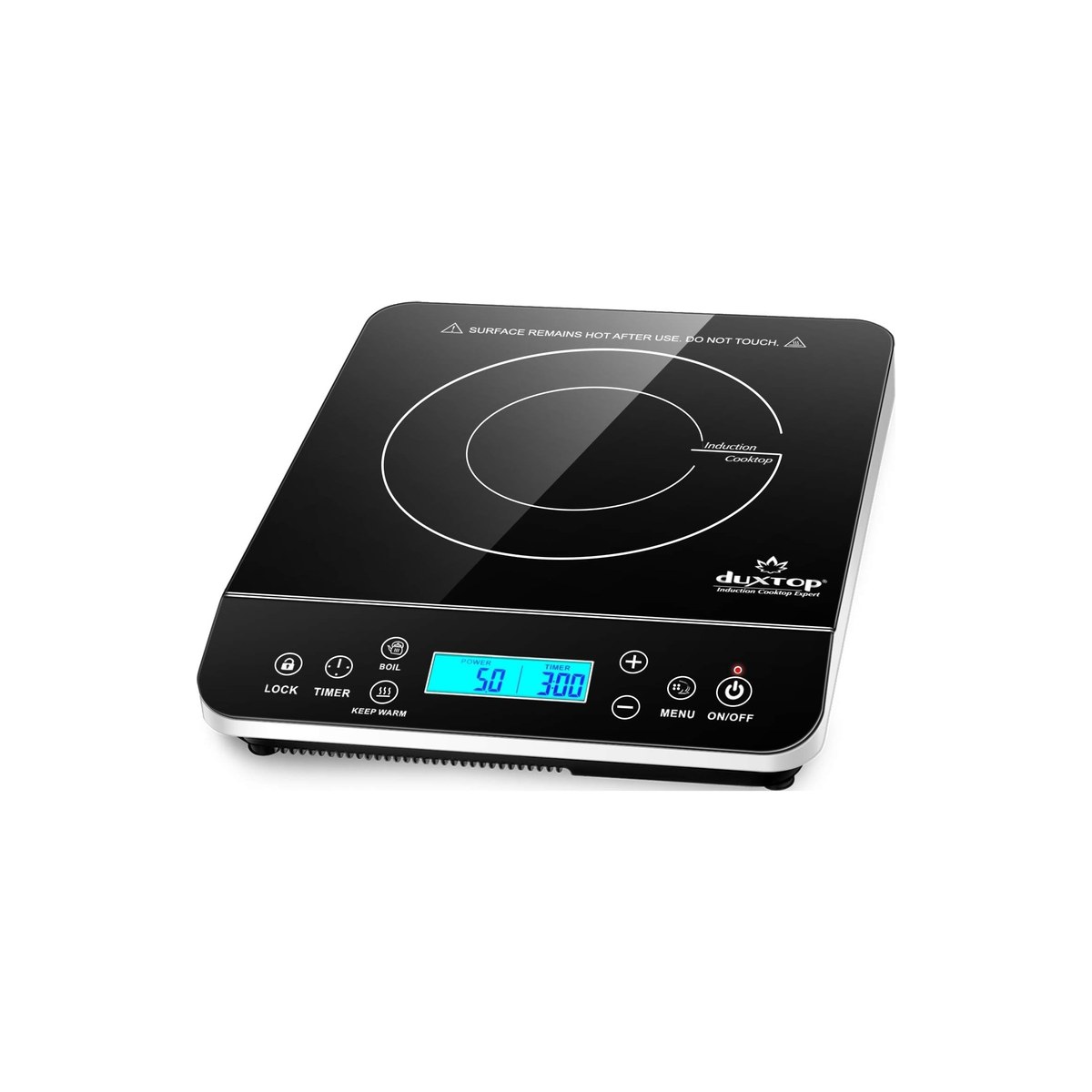
Duxtop 9600LS BT-200DZ Portable Induction Cooktop, 1800-Watt Countertop Burner, LCD Sensor-Touch, 20 Power Levels (ASIN B01FLR0ET8)
The best-proven portable induction burner, if your power can feed it.
Who it's for: The cook who wants the most capable, most-proven portable induction burner and either cooks on shore power or has built the battery and inverter to run it off-grid. The Duxtop 9600LS is the unit the gear-test sites and the van forums keep landing on, 20 levels of control, a clean LCD, and a magnetic-field burner that heats the pan and not the kitchen.
What we found: It earns the top slot on control and proof. Twenty power levels and twenty temperature settings give it the finest granularity among the picks here, and 8,676 reviews at 4.4 stars is the second-deepest record in this guide. It boils faster than gas and cleans up in seconds, with no flame and no carbon monoxide. The honest limits are power and the low end: it pulls the full 1,800 watts, roughly 150 amps at 12 volts, so off-grid it demands a 2,400-watt inverter and a real lithium bank, and its lowest setting pulses rather than holding a steady low flame.
Bottom line: Buy the 9600LS if you want the best portable induction cooktop and your power system can carry 1,800 watts, on shore power it is a clear winner, and off-grid it is excellent once the battery and inverter are sized. If your power is tight, drop to the 1,300-watt NuWave below instead. Bring at least one magnetic pan, and expect the fan to hum while you cook.
- + 20 power levels and 20 temperature settings, 100 to 460 degrees, the finest control among the picks here, with more than 8,600 reviews at 4.4 stars
- + Boils fast and cooks precisely with zero flame, zero carbon monoxide, and a surface that stays cool except under the pan, the safety win that makes induction worth it in a van
- + Slim and light at about 7.5 pounds, runs any magnetic pan, and is the all-around best portable induction cooktop if your power can feed it
- × Draws the full 1,800 watts, about 150 amps at 12 volts, so off-grid it needs a pure-sine inverter with headroom, a 2,000-watt unit is the floor and can trip at full power so size 2,400 watts or more, plus a 200-amp-hour lithium bank, this is not a small-battery appliance
- × The lowest setting is pulsed, not continuous, it cycles a higher wattage on and off, so a true gentle simmer can still scorch a delicate sauce
- × A cooling fan, measured around 56 decibels, runs whenever the burner is on, louder than a gas flame
Runner-up: Duxtop 9100MC BT-M20B 1800W Portable Induction Cooktop Countertop Burner, 15 Power and Temperature Settings (ASIN B00GMCAM2G).
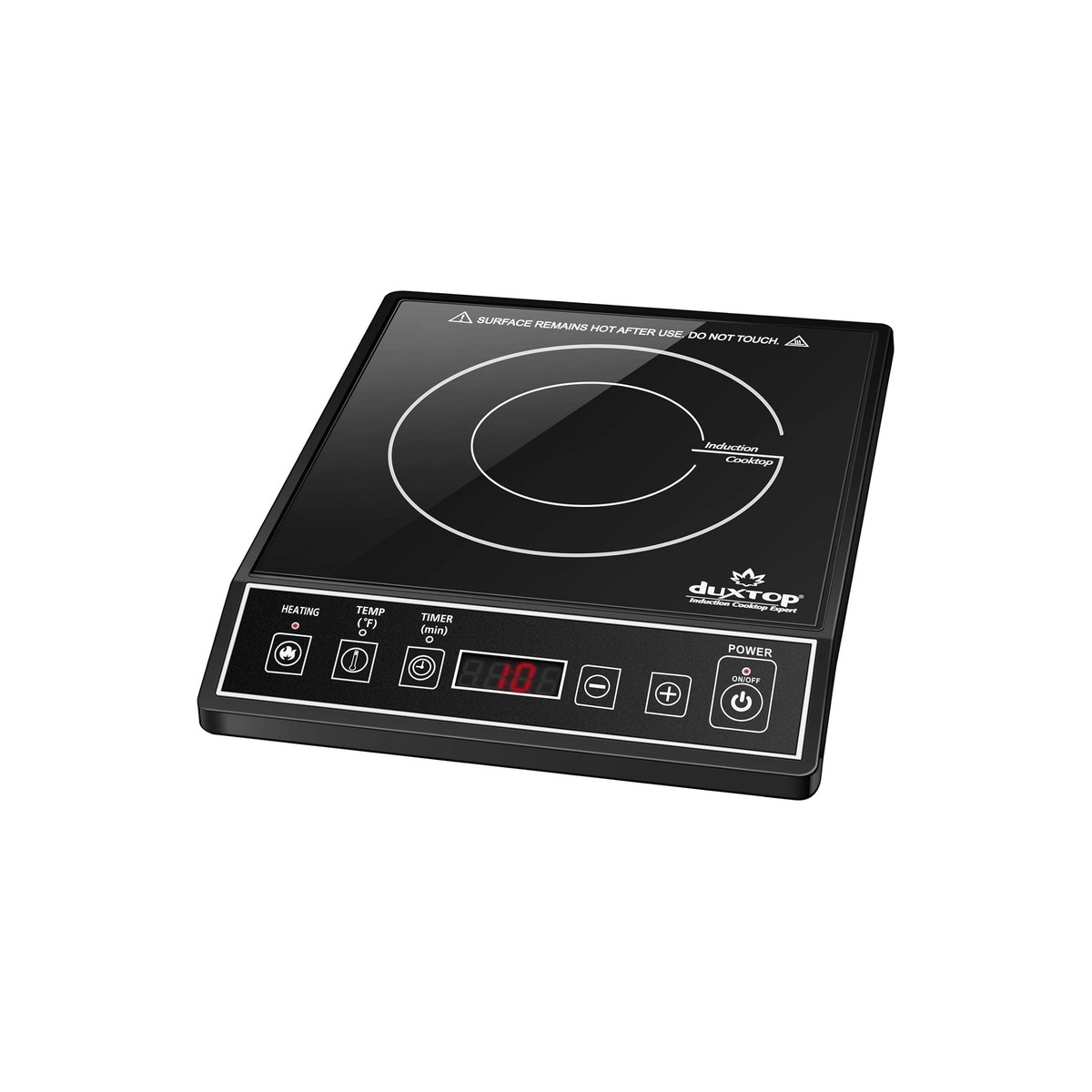
Duxtop 9100MC BT-M20B 1800W Portable Induction Cooktop Countertop Burner, 15 Power and Temperature Settings (ASIN B00GMCAM2G)
The most-reviewed Duxtop, full power for about thirty dollars less.
Who it's for: The cook who wants a Duxtop, the category's proven brand, but does not need the 9600LS's twenty-level granularity or its slimmer body, and would rather keep the $32. The 9100MC is the older, plainer, and most-reviewed Duxtop, the one that quietly does the same core job for less. It is the buy for the shopper who weighs proof and price over the LCD and the extra few power levels.
What we found: It is the value workhorse. The same full 1,800 watts as the top pick, 15 power and temperature levels instead of 20, and the deepest review base in this guide at more than 9,300 ratings, 4.4 stars. For boiling, frying, and everyday cooking the difference from the LS is hard to feel; you give up some low-end finesse and the LCD niceties. Crucially, it draws the same 1,800 watts, so it is no easier to power off-grid than the LS, the inverter and battery math is identical.
Bottom line: Buy the 9100MC if you want a proven full-power Duxtop at the lowest price and do not care about the LCD or the extra five levels. If you cook delicate things often, the 9600LS's finer control is worth the step up; if your power is limited, neither full-1,800-watt Duxtop is the answer, the NuWave below is. Bring a magnetic pan, same as any induction unit.
- + The most-reviewed unit in this guide, 9,300-plus ratings at 4.4 stars, the proven Duxtop workhorse for about $32 less than the 9600LS
- + Full 1,800 watts with 15 power and temperature levels, all the cooking range most people actually use
- + Same magnetic-pan compatibility and the same zero-flame, zero-carbon-monoxide safety as the top pick
- × 15 power levels with a 200-watt floor, five fewer than the 9600LS and a touch less low-end granularity, though for everyday cooking the gap is hard to feel
- × Same 1,800-watt draw, so the same 2,400-watt-plus inverter and big-battery requirement off-grid, no power savings over the LS
- × Larger and taller than the slim 9600LS, about 3.8 inches tall versus 2.5, a bit less ideal for a tight van counter
Budget pick: NuWave Flex Precision Portable Induction Cooktop, Single Burner, 3 Wattage Settings 600/900/1300W, 45 Temperatures (ASIN B01AV7JW2S).
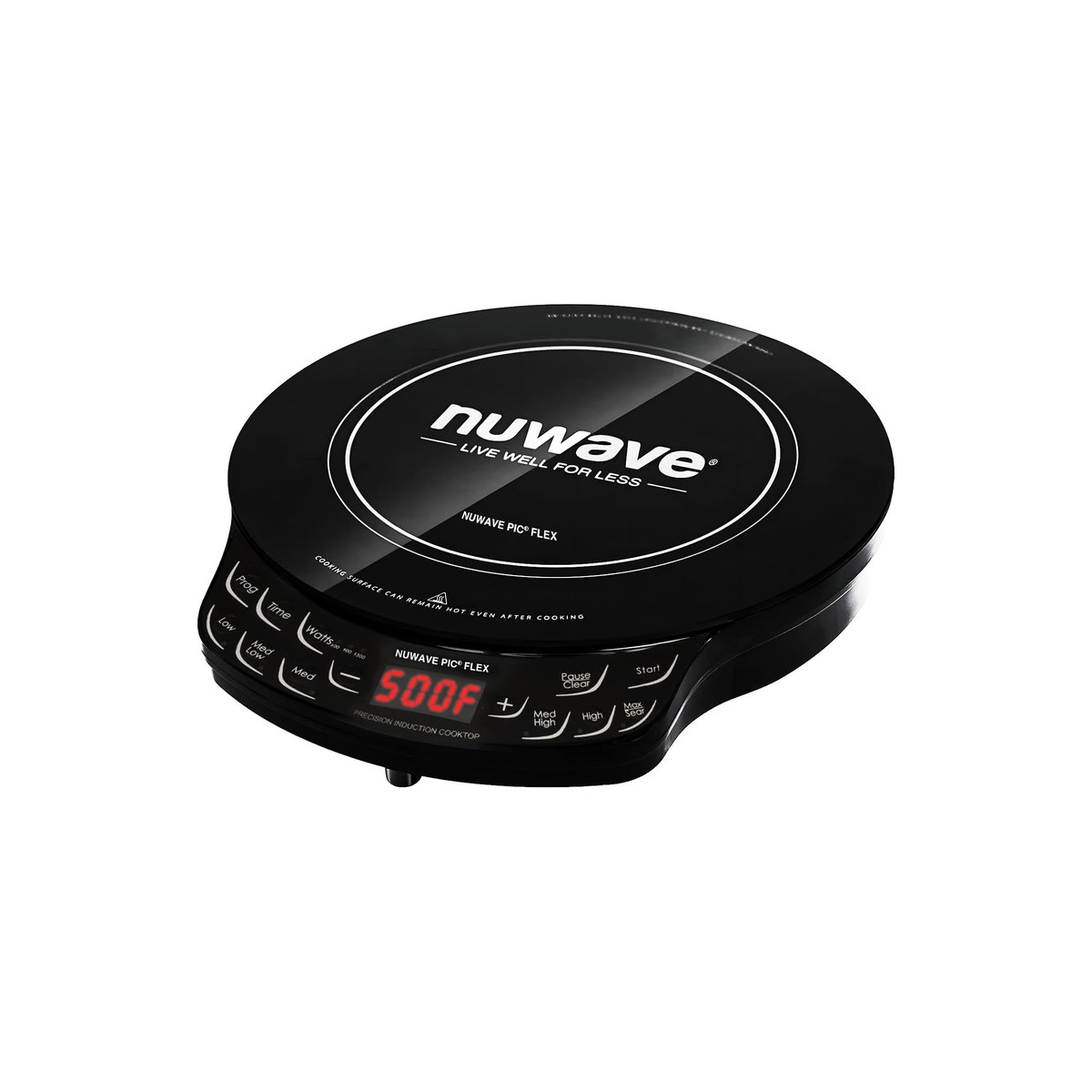
NuWave Flex Precision Portable Induction Cooktop, Single Burner, 3 Wattage Settings 600/900/1300W, 45 Temperatures (ASIN B01AV7JW2S)
The induction burner a modest van power system can actually run.
Who it's for: The van-lifer or off-grid cook whose battery and inverter are modest, and for whom the real question is not which induction burner cooks best but which one their power system can run at all. The NuWave Flex is the answer: it caps at 1,300 watts, low enough for a 1,500-watt inverter and a 100-to-200-amp-hour battery, enough for a meal or two before a recharge, and it is the cheapest pick here.
What we found: It is the honest off-grid induction pick. Three wattage steps, 600, 900, and 1,300, make power budgeting simple, and the 1,300-watt ceiling means a smaller, cheaper inverter runs it with margin, where every 1,800-watt unit needs a 2,400-watt inverter. At about $60 with a 4.5-star rating across 4,575 reviews and an included induction pan, it is also the easiest way to find out whether induction fits your rig before spending more. The trade is range: three fixed steps instead of a fine slider, a 600-watt floor, and slightly slower boils than a full-power unit.
Bottom line: Buy the NuWave Flex if you cook off-grid on a 100-to-200-amp-hour bank and want induction without rebuilding your electrical system, it is the pick that fits real van power. If you have shore power or a big battery and want maximum control, the Duxtops above cook better. Either way it still needs an inverter, no induction cooktop runs on 12 volts.
- + Caps at 1,300 watts across three settings, 600, 900, and 1,300, so it runs on a smaller 1,500-watt inverter and a 100-to-200-amp-hour bank, the easiest induction here to power off-grid
- + The cheapest pick at about $60, 4.5 stars across 4,575 reviews, and it ships with an induction-ready pan to start
- + Compact 10-inch footprint and light, the right size for a van galley, with 45 temperature steps to 500 degrees
- × Only three fixed wattage steps, not a fine slider, and 1,300 watts boils a little slower than an 1,800-watt unit
- × The 600-watt floor is its lowest, fine for most cooking but not a true gentle simmer
- × Still needs a pure-sine inverter, like every induction cooktop here, there is no 12-volt version of any of them
Also worth considering.
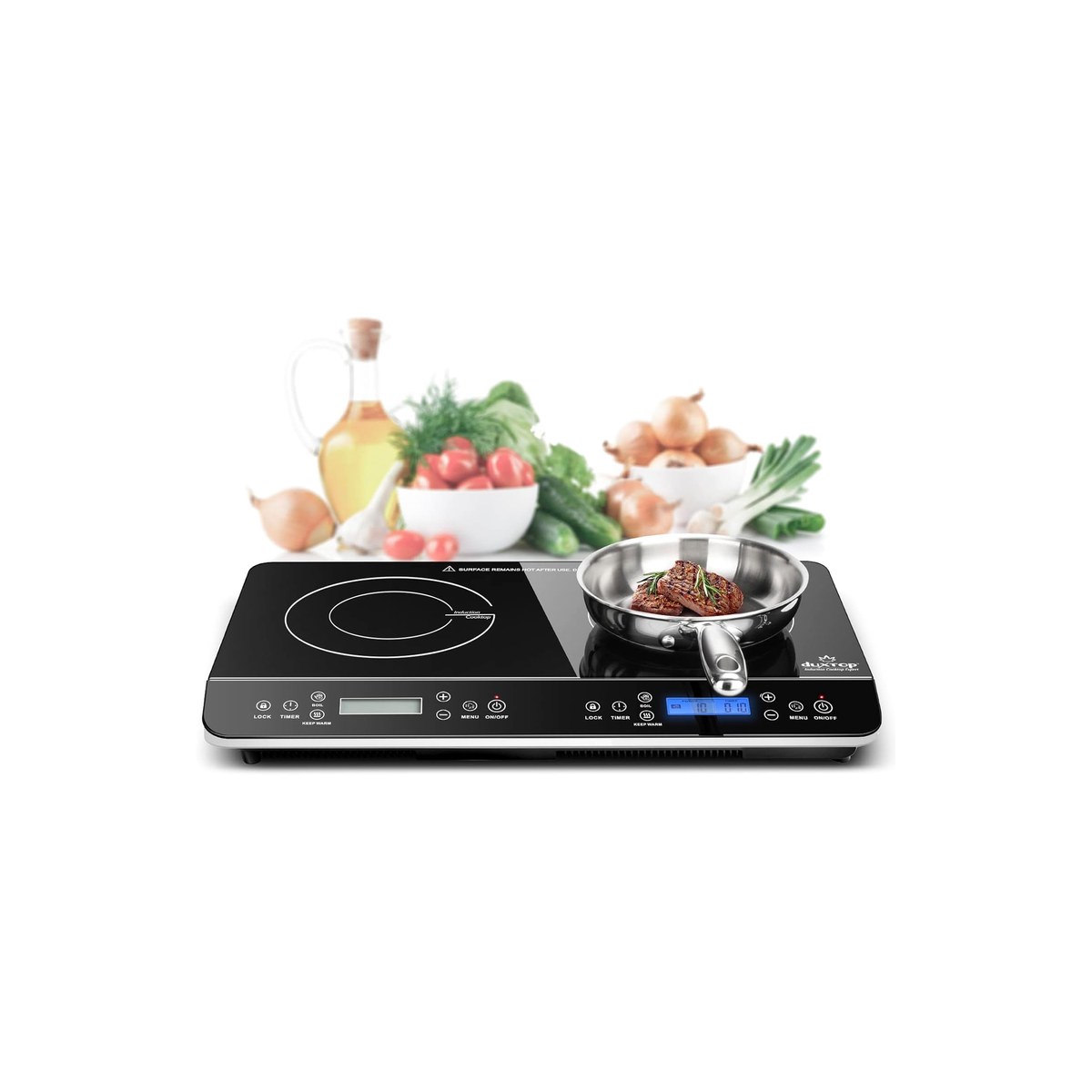
Duxtop 9620LS BT-350DZ Portable Double Induction Cooktop, Two-Burner 1800W Countertop Burner, LCD Sensor Touch (ASIN B07GB149V7)
Two magnetic burners for bigger rigs, if your inverter can feed them.
Who it's for: The bigger van, the Class B or C RV, and the cook who wants two pots going at once, pasta boiling while the sauce simmers. The Duxtop 9620LS is the two-burner version of our top pick, the same LCD sensor-touch controls and magnetic-pan compatibility in one countertop unit at about $232, with a 1,700-plus review record behind it.
What we found: It runs two independent zones, each with the Duxtop level control, sharing an 1,800-watt total budget. That sharing is the catch off-grid: running both burners near full power is a 3,000-watt-inverter, 300-amp-hour-bank proposition, well beyond what most van builds carry. In practice off-grid cooks run one zone at a time, which works fine on a 200-amp-hour bank. On shore power or in a large rig with a big battery, the two-burner convenience is real and the control matches the single-burner LS.
Bottom line: Buy the 9620LS if you genuinely cook two things at once and your power system, or your shore-power hookup, can feed it. For a single-burner van build it is more cooktop than you need and more amps than you have, the 9600LS or the NuWave Flex is the smarter buy. Confirm you have the counter space, it is a wide unit.
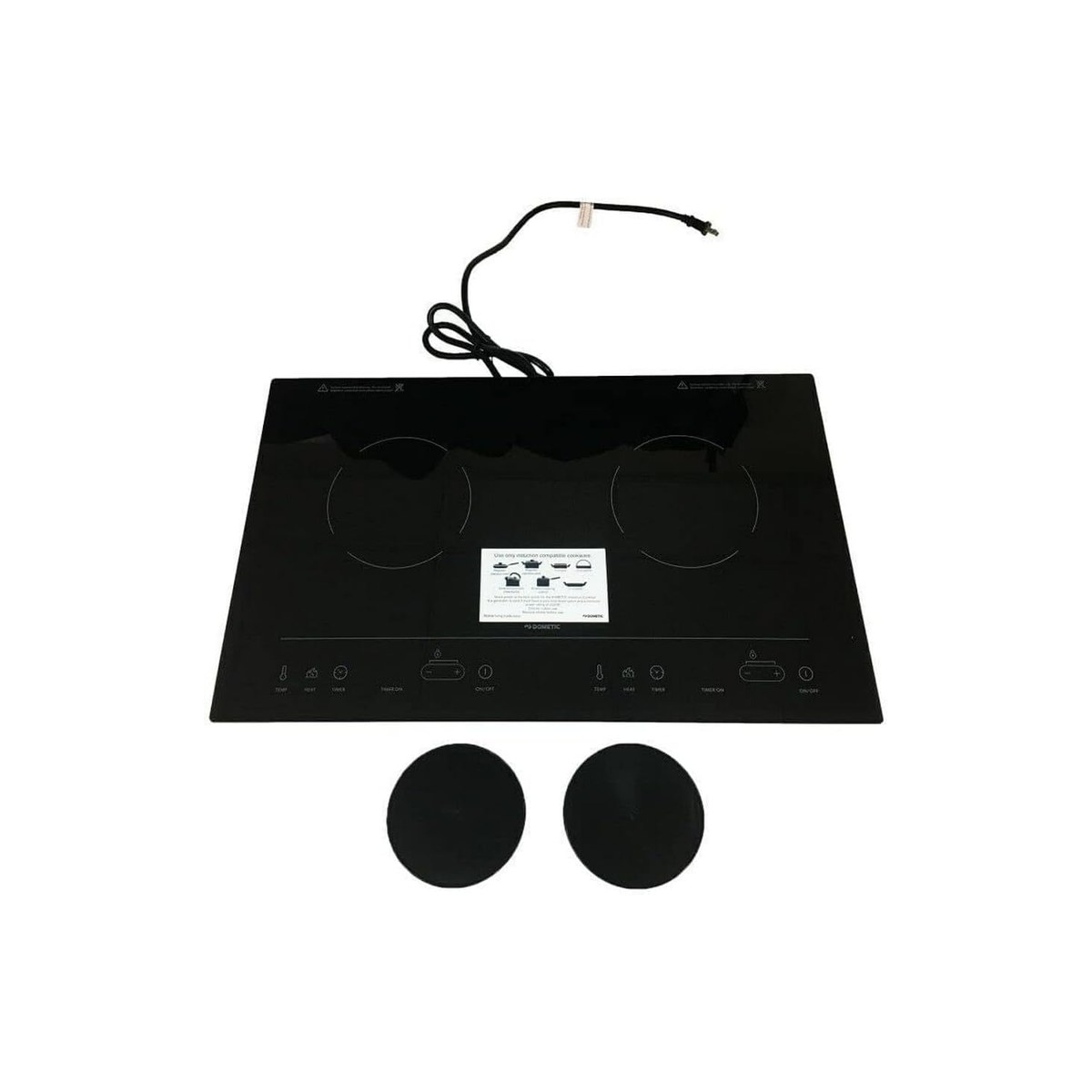
Dometic CI-21 Two-Burner Drop-In Electric Induction Cooktop for RVs, 1440W, Schott Ceran Glass (ASIN B08G5839YJ)
The drop-in induction cooktop built for a permanent RV install.
Who it's for: The RVer doing a permanent galley build who wants a flush drop-in cooktop, not a countertop unit that slides around, from a brand RV makers actually install. The Dometic CI-21 is a two-burner drop-in with Schott Ceran glass, the recognized RV OEM induction cooktop, and at 1,440 watts total it draws less than the 1,800-watt portables, so a 1,500-watt inverter can run it.
What we found: Its lower 1,440-watt ceiling is the RV feature, less peak draw, gentler on the battery, and runnable on a smaller inverter than any 1,800-watt unit here. The honest caveats are the price and the proof: at about $699 it costs several times the portable picks, and its Amazon review base is thin, just two reviews, so most of its reputation lives in RV-owner forums and factory installs rather than a deep review record. The cheaper Fogatti FOIH2B drop-in is the value alternative, though it carries zero Amazon reviews at our June 2026 check, so treat it as a forum-only recommendation.
Bottom line: Buy the Dometic CI-21 only if you are building a permanent RV galley and want a flush, brand-trusted drop-in with a battery-friendly draw, and you accept paying for the install and the OEM badge over a deep review record. For everyone else a portable unit is a fraction of the price and moves with you. Confirm the cutout dimensions before you cut anything.
Skip this guide if...
Skip a portable induction cooktop if you boondock on a small battery with little solar, because induction is a power-hungry, shore-power-and-big-battery tool, and a propane camping stove will cook anywhere for a fraction of the electrical system, our camping stoves guide covers that route. Skip it too if your cookware is all aluminum, copper, or glass, none of it works on induction without buying at least one magnetic pan. And if you only ever cook at full-hookup campgrounds, any of these works fine, the power math only matters when you are running off a battery.
Don't bother with.
- × Skip Expecting an induction cooktop that runs on 12 voltsThere is no true 12-volt DC induction cooktop on the market as of 2026, and listings that imply one are misleading. Induction needs high-frequency AC the unit generates internally from 120-volt power, so every portable induction cooktop requires a pure-sine inverter, full stop. A 1,800-watt unit pulls roughly 150 amps at 12 volts through that inverter, which is why the battery and inverter, not the cooktop, are the real purchase. Plan the power system first, the cooktop is the easy part.
- × Skip Counting on the low setting for a true gentle simmerMost portable induction cooktops, including the Duxtops here, do not hold a true low flame, they pulse: the burner fires at a higher wattage for a few seconds, then rests, averaging out to the low number on the display. For boiling, searing, and everyday cooking it does not matter, but for melting chocolate or a delicate sauce, food can still scorch during each burst. The only portable unit with genuinely continuous low power is the Breville Control Freak, and at about $1,499 it is a professional tool, not a van appliance.
- × Skip Interface disks to use your aluminum or copper pansAn interface disk, a magnetic plate you set between the cooktop and an incompatible pan, technically lets a copper or undersized pan work on induction, but it is the wrong move for a van. Controlled testing found a disk roughly doubles the energy a task uses, 0.41 versus 0.22 kilowatt-hours to boil the same water, which off a battery is the last thing you want, and it must never be paired with an aluminum pan, which cannot pull heat off the disk fast enough and overheats. Buy one induction-ready pan instead, a carbon-steel skillet covers most cooking and weighs less than cast iron.
- × Skip No-name marketplace cooktops, and built-in RV units, on review depthThe cheapest induction listings are often unbranded units with shallow review records, and even the legitimate built-in RV cooktops, the Dometic CI-21 and the cheaper Fogatti FOIH2B, carry only a handful of Amazon reviews because their buyers are factory installs and forum regulars, not Amazon shoppers. Stick to the proven portables, Duxtop and NuWave, where thousands of reviews tell you what you are getting, unless you specifically need a permanent drop-in and accept the thinner proof.
- × Skip Running two induction burners off a van batteryA double induction cooktop is great on shore power, but running both zones near full power is a 3,000-watt-inverter, 300-amp-hour-bank load that most van builds cannot sustain. Off-grid you run one zone at a time, which works, but if that is your reality a single burner is lighter, cheaper, and the same in practice. Buy two burners for a big rig with the battery to match, or for the campground pedestal, not for a 100-amp-hour van bank.
How we picked.
Sources we read and how we picked
We started from the two questions that actually trip buyers up: power and pans. We recorded each unit's max and minimum wattage, the number of power levels, weight, and footprint, then pulled the real measured 12-volt current draw from off-grid builders who put a battery monitor on the line, and the pulse-timing tests from the kitchen labs that measure what the low setting really does. Every listing was verified live on Amazon on June 13, 2026, price, rating, review count, and stock, because this category is thick with India-market brands and built-in units that confuse a US portable-cooktop search.
Our filter, in order: can a realistic van or RV power system run it, then cooking control and proof in reviews, then fit and price. That order is why the 1,300-watt NuWave Flex ranks as high as it does despite being the cheapest and least powerful, it is the one a modest battery can actually feed, and why the two full-1,800-watt Duxtops lead on control and proof for the buyers who have the power. The runner-up Duxtop 9100MC costs more than the budget NuWave on purpose: the NuWave is the low-power specialist, while the 9100MC is the value pick among full-power 1,800-watt cooktops, a different job. We rank on what you can actually run, and say so where price and capability diverge.
The power math: can your rig actually run induction
This is the number generic roundups skip. A 1,800-watt induction burner draws roughly 150 amps at 12 volts, and closer to 170 once you add inverter losses, which is why running one off-grid is a system decision, not a cooktop decision: you need a pure-sine inverter sized with headroom over that 1,800-watt draw (modified-sine can damage the electronics), where a 2,000-watt unit is the bare floor that can trip at full power and 2,400 to 3,000 watts is the safer size, plus a lithium bank of 200 to 300 amp-hours to cook freely. The good news is that induction is efficient per task: battery-monitor testing clocked boiling water for four hot drinks at about 13.7 amp-hours and a full pasta dinner for four at about 30, so a 200-amp-hour lithium bank is realistically eight to twelve meals between charges, with 400 watts of solar to refill it. The best induction cooktop for a power-limited rig is therefore the one you can run: the 1,300-watt NuWave Flex needs only a 1,500-watt inverter and as little as a 100-amp-hour battery for a meal or two at a time, where every 1,800-watt unit forces the bigger inverter.
Two more power truths. First, there is no true 12-volt induction cooktop, every unit inverts 120-volt AC internally, so an inverter is mandatory and a listing claiming otherwise is wrong. Second, the low setting is usually pulsed: a Duxtop on its lowest level fires around 467 watts for a few seconds, then rests, averaging to the 100-watt figure on the display, so the wiring must handle the higher burst current and a delicate sauce can still scorch. Only the $1,499 Breville Control Freak holds a genuinely continuous low. And on shore power, remember a single 1,800-watt cooktop already draws 15 amps at 120 volts, so two of them on one campground 15-amp circuit will trip the breaker.
Will your pans work: the cookware test
Induction heats only ferrous, magnetic cookware, the burner induces a current in the metal and the pan heats itself. The ten-second test: hold a fridge magnet to the flat bottom of the pan, if it sticks firmly, the pan works; if it slides off, it will not heat at all. Compatible cookware: bare and enameled cast iron, carbon steel, and magnetic stainless (most tri-ply and 400-series). Not compatible: plain aluminum, copper, glass, pure ceramic, and the 300-series stainless common in cheap sets, none of it magnetic. Most camping cookware is aluminum, which is exactly why so many first-time induction buyers are surprised their pots do not heat.
For a van, carbon steel is the smart answer: it is fully induction-compatible, works on a campfire or a propane stove too, and a 10-inch carbon-steel skillet weighs around 3.5 pounds against cast iron's 5.5, which matters when everything bounces down a forest road. Skip interface disks, the magnetic plates sold to make aluminum and copper pans work, because controlled testing found they roughly double the energy a task uses and they should never be paired with aluminum. One induction-ready skillet and one magnetic saucepan cover almost all van cooking. Note too that most units need a pan at least about five inches across to detect it and turn on, so a tiny espresso pot may not register.
Induction or propane, and a safety note
The real case for induction in a van is the air you breathe. A propane stove emits carbon monoxide and nitrogen dioxide; a Columbia University study measured indoor NO2 spiking to around 197 parts per billion during gas cooking, roughly ten times background, and found that switching to electric cut daily NO2 about 56 percent, an effect that is worse in a 70-square-foot van than in a house. Induction produces none of it, no flame, no combustion, no carbon monoxide, so it needs neither the roof vent open nor the cracked window a propane stove demands. The cost of that clean air is electrical: induction is power-hungry and shore-power-friendly, while propane will cook anywhere for the price of a canister. Many full-timers run both, induction on shore power or a sunny day, propane as the boondocking backup, and some experienced builders keep propane as the primary cooker because a 300-plus amp-hour induction-capable system can run several thousand dollars. Our camping stoves guide covers the flame side.
One safety note specific to induction: the electromagnetic field can interfere with an implanted cardiac pacemaker at close range, mainly older left-sided unipolar devices. Clinical testing puts the threshold around 14 inches, but the conservative consumer guidance is to keep at least about 24 inches between the device and the active burner, and to consult your cardiologist and the device maker, a real consideration in a tight galley where you stand close to the cooktop.
FAQs.
Q01 What is the best portable induction cooktop?
+
Q02 Will my pans work on an induction cooktop?
+
Q03 Can you run an induction cooktop in a van or off solar?
+
Q04 Induction or propane for van life?
+
Q05 What size inverter do I need for an induction cooktop?
+
Q06 Does cast iron work on an induction cooktop?
+
If you, then this.
- IF you want the best portable induction burner and have the powerGET Duxtop 9600LS (B01FLR0ET8; 1,800W, 20 levels, wants a 2,400W inverter + 200Ah)$116.99 →
- IF you want a proven full-power Duxtop for lessGET Duxtop 9100MC (B00GMCAM2G; 1,800W, 15 levels, most-reviewed here)$84.99 →
- IF you cook off-grid on a modest battery and inverterGET NuWave Flex (B01AV7JW2S; 1,300W runs on a 1,500W inverter + 100Ah, cheapest)$59.99 →
- IF you want two burners and have a big rig or shore powerGET Duxtop 9620LS Double (B07GB149V7; two zones, one at a time off-grid)$231.99 →
- IF you are building a permanent RV galleyGET Dometic CI-21 (B08G5839YJ; drop-in, 1,440W battery-friendly, thin reviews)$699.00 →
- IF you do not have the power for inductionGET A propane camping stove cooks anywhere for a fraction of the electrical system, see our camping stoves guidevaries →
- IF you need to size the battery and inverter firstGET Our RV lithium battery and inverter guides do the amp-hour and wattage math$0 →
RV & Van Gear: The Complete Guide
The whole-rig picture →Every system in a van, RV, or camper, organized in one place, with the safety and weight floor and the one guide we trust for each.
- In-depth Duxtop 9600LS test: measured power levels and the pulsed-low behavior; induction interface-disk energy test · CenturyLife
- Real-world 12V energy use of an induction cooktop (Victron battery-monitor measured amp-hours per cooking task) · 4WDing Australia
- Switching from gas to electric stoves cuts indoor NO2 (197 ppb peak, 56% daily reduction) · Columbia (Energy Research & Social Science, 2024)
- Induction cookware compatibility and the magnet test · KitchenAid
- Do induction cooktops interfere with cardiac pacemakers (clinical EMF distance guidance) · Europace