Best RV Lithium Batteries: 5 LiFePO4 Banks We'd Wire In (2026)
A lithium RV battery is not quite the drop-in the box promises. The cell chemistry is the easy part; what decides whether a LiFePO4 bank actually serves your rig is two things no listing leads with. It will not charge below freezing without a self-heating model, and on a stock converter and alternator it charges only part-way until you add a DC-DC charger. Size the bank to your real daily amp-hours first, then solve charging, then choose the battery. We cross-read owner threads on iRV2, r/GoRVing, and the DIY Solar boards against brand spec sheets and Will Prowse's teardown record, then verified every price and review count live on Amazon on June 9, 2026. The finding that matters: half the cheapest 'best lithium' picks are the same factory rebadged, and the real spread is cold-weather charging and honest amp-hours, not the 4000-cycle number every label shares.
- 01 LiTime 12V 100Ah (B084DB36KW) , top pick, the most-reviewed 100Ah drop-in and the safe default, ~$279
- 02 Battle Born 12V 100Ah (B06XX197GJ) , the brand-of-record, US support and a 10-year warranty, ~$800
- 03 ECO-WORTHY 12V 100Ah (B0DTP7K2FJ) , budget pick, a genuine sub-$200 lithium with Bluetooth, ~$200
- 04 Vatrer 12.8V 460Ah Self-Heating (B0DW3PJ634) , big-bank and cold-climate, self-heating 460Ah for full-timers, ~$1,100
- 05 Renogy 12V 100Ah Mini (B0DJP772YP) , compact pick that fits a tight campervan battery bay, ~$308
How they compare.
| Rank | Product | Best for | Price | Our score |
|---|---|---|---|---|
| 01 | LiTime 12V 100Ah Group 31 (B084DB36KW)
Top Pick
| best overall, the most-proven 100Ah drop-in for a typical rig | $278.99
Buy → | 9.0/10 |
| 02 | Battle Born 12V 100Ah (B06XX197GJ) | brand-of-record, US support and a 10-year warranty | $799.55
Buy → | 8.7/10 |
| 03 | ECO-WORTHY 12V 100Ah (B0DTP7K2FJ) | best budget, a genuine sub-$200 lithium with Bluetooth | $199.99
Buy → | 8.4/10 |
| 04 | Vatrer 12.8V 460Ah Self-Heating (B0DW3PJ634) | best big-bank / cold-climate, self-heating for full-timers | $1,099.99
Buy → | 8.6/10 |
| 05 | Renogy 12V 100Ah Mini (B0DJP772YP) | best compact, fits a tight campervan battery bay | $307.99
Buy → | 8.3/10 |
Prices are current Amazon prices at time of publication and can change. Scores reflect our editorial evaluation, not vendor input.
Our #1 pick: LiTime 12V 100Ah Group 31 RV LiFePO4 Battery (built-in 100A BMS, up to 15000 deep cycles, 1.28kWh, drop-in lead-acid replacement, ASIN B084DB36KW).
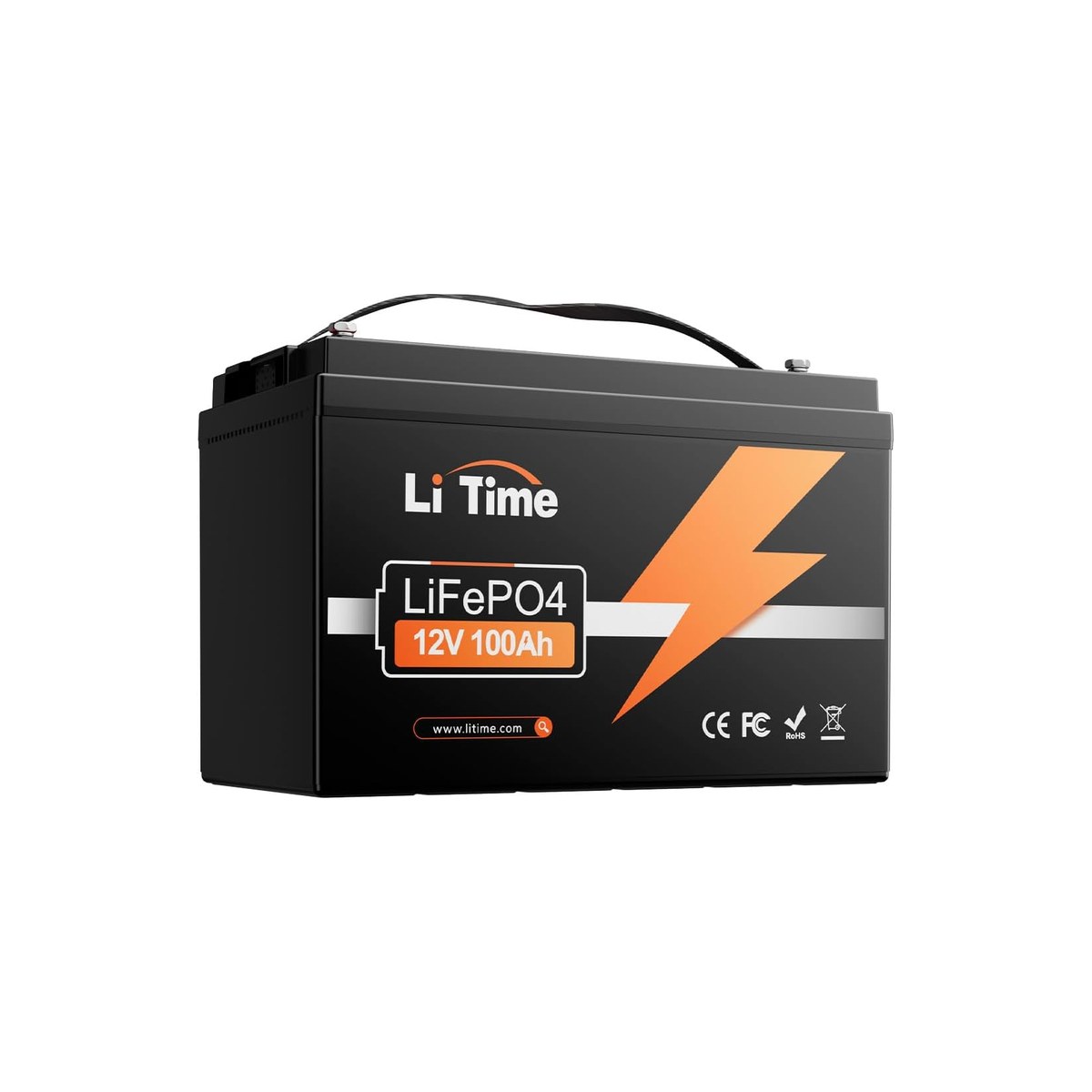
LiTime 12V 100Ah Group 31 RV LiFePO4 Battery (built-in 100A BMS, up to 15000 deep cycles, 1.28kWh, drop-in lead-acid replacement, ASIN B084DB36KW)
The most-reviewed 100Ah drop-in, and the safe default for most rigs.
Who it's for: The RVer, fifth-wheel, or travel-trailer owner swapping a tired lead-acid house battery for a proven 12V 100Ah lithium, and stacking one or two of them for a typical weekend-to-extended-trip load of lights, a 12V fridge, fans, a water pump, and device charging. This is the buyer who wants the safe, most-proven default rather than the cheapest gamble or the priciest badge, and who is not charging in hard freezes.
What we found: This is the most-reviewed RV lithium battery on Amazon by a wide margin, 1,756 ratings at 4.5 stars as of June 2026, which is the single strongest long-run reliability signal in the category. The 100A BMS covers overcharge, over-discharge, and short-circuit protection, and the Group 31 case fits most existing bays. The one spec to know before you buy: this particular model has no low-temperature charge cutoff, so charging it below freezing damages the cells with nothing in the battery to stop you. That is fine in a mild climate, but a hard-freeze boondocker needs the self-heating pick, or a model with a cutoff like the budget ECO-WORTHY.
Bottom line: For mild-climate rigs this is the right first lithium battery, proven, fairly priced at about $279, and safe by default. Two caveats matter here: on a stock converter and alternator it charges only part-way until you add a DC-DC charger, and because this model has no low-temp cutoff you must not charge it below freezing. If neither is your situation, buy it and move on; if cold or cost is, see the heated and budget picks below.
- + The most-reviewed RV lithium battery on Amazon, 1,756 ratings at 4.5 stars, the strongest long-run reliability signal in the category
- + Built-in 100A BMS for overcharge, over-discharge, high-temp, and short-circuit protection (see cons for the one kind it lacks)
- + Group 31 case drops into most existing battery bays, and at about $279 it sits well below the brand-of-record names
- + 100Ah of LiFePO4 gives near-full usable capacity, roughly double the usable amp-hours of a 100Ah lead-acid
- × This Group 31 model has no low-temp charge cutoff, so it must not be charged below freezing at all; a cold-climate buyer needs the self-heating pick or a model with a cutoff (the budget ECO-WORTHY has one)
- × Like every drop-in, it charges only part-way on a stock converter and alternator until you add a DC-DC charger
- × LiTime is no longer the cheapest 100Ah; the ECO-WORTHY budget pick undercuts it by about $80
Runner-up: Battle Born 12V 100Ah LiFePO4 Deep Cycle Battery (internal BMS, US-based support, 10-year warranty, RV / marine / solar / off-grid, ASIN B06XX197GJ).
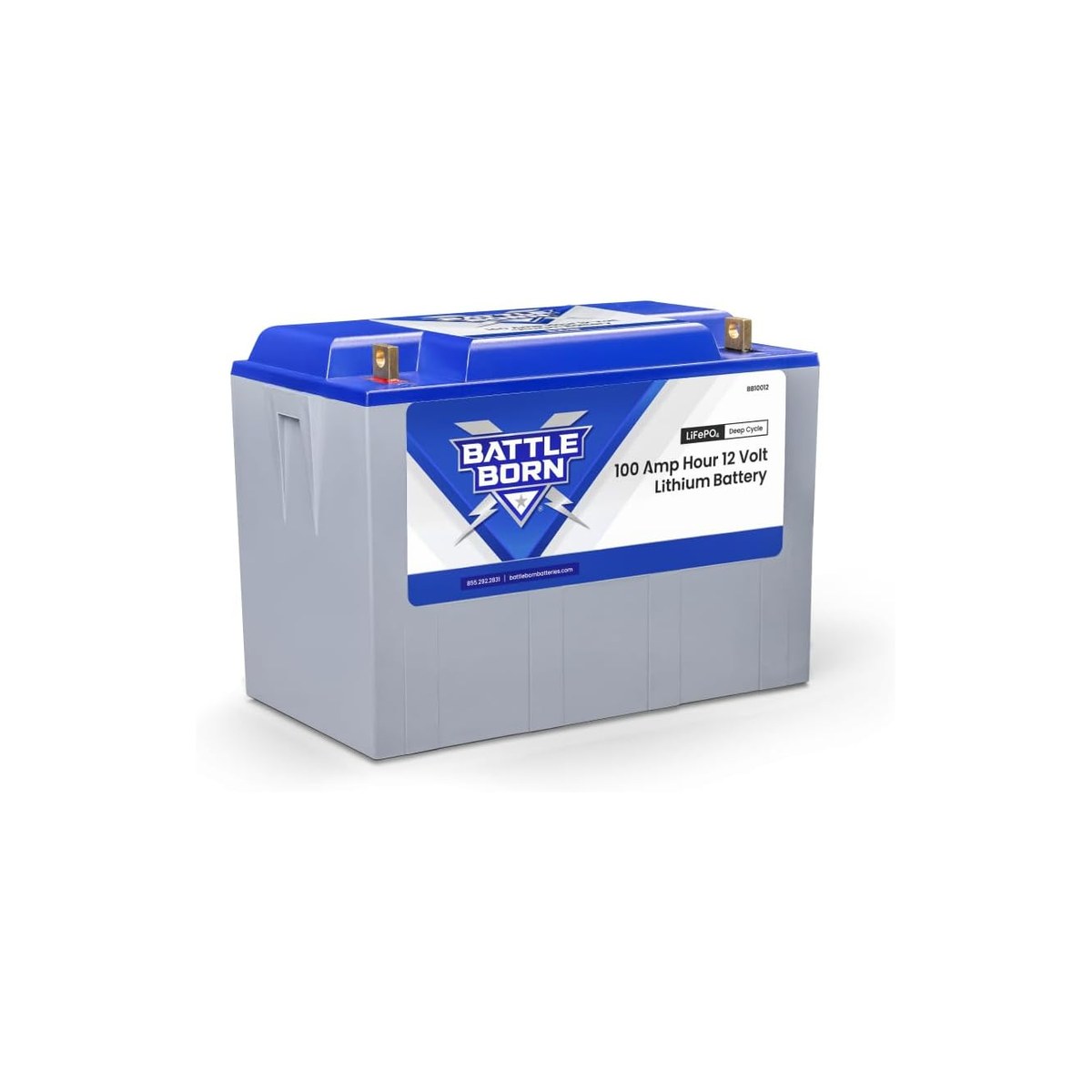
Battle Born 12V 100Ah LiFePO4 Deep Cycle Battery (internal BMS, US-based support, 10-year warranty, RV / marine / solar / off-grid, ASIN B06XX197GJ)
The brand-of-record name, if you value support over saving money.
Who it's for: The full-timer, four-season camper, or peace-of-mind buyer who wants the most-trusted name in RV lithium and is willing to pay for US-based support, a long warranty, and a deep field record. This is the owner who would rather call a human in Nevada than save a few hundred dollars, and who may want the heated variant for charging in genuine winter conditions rather than just storing through them.
What we found: Battle Born is the brand-of-record in the RV world, the one owners name first, and it is genuinely Amazon-buyable at $799.55 with 809 ratings at 4.5 stars, not the direct-only brand it is sometimes assumed to be. You are paying for US support, a 10-year warranty, and an early-mover reputation, and the honest read from the forums is that the markup is mostly brand and service rather than cells that beat a good $279 unit on a bench. The standard model pauses charging in the cold; the heated model is the one for sub-freezing use.
Bottom line: Buy Battle Born for support and longevity if you can pay for it, but go in informed: a 2025 teardown alleged a terminal-overheating flaw, the maker disputes it and issued no recall, and it is now suing the reviewer, so the question is unresolved. If you want a long-warranty US brand without that cloud, Dakota Lithium is the alternative, though owners report weaker support. For pure value, the LiTime or ECO-WORTHY does the same job for far less.
- + Brand-of-record reputation: the most-discussed lithium in the RV community, with US-based support and a 10-year warranty
- + 809 Amazon ratings at 4.5 stars, plus a heated variant for genuine cold-climate charging
- + Made by a US company with a long field record, the safest bet if you want a human to call when something goes wrong
- + Real usable 100Ah and a strong BMS, the same drop-in fit as the cheaper picks
- × At about $800 it is roughly 2.9 times the LiTime, by far the steepest price here
- × Owners and forums agree the markup is largely brand and support, not a battery that outperforms a good $279 unit on the bench
- × The standard model still only pauses charging in the cold; you need the heated variant for freezing boondocking
- × A December 2025 teardown alleged a terminal-design flaw that can overheat under load; Battle Born calls it an intentional thermal failsafe and has issued no recall, and in June 2026 it sued the reviewer for libel, so treat the dispute as unresolved
Budget pick: ECO-WORTHY 12V 100Ah LiFePO4 Battery, Upgrade 2.0 (built-in Bluetooth and SOC display, 100A BMS with low-temp protection, RV / camping / solar / trolling motor, ASIN B0DTP7K2FJ).
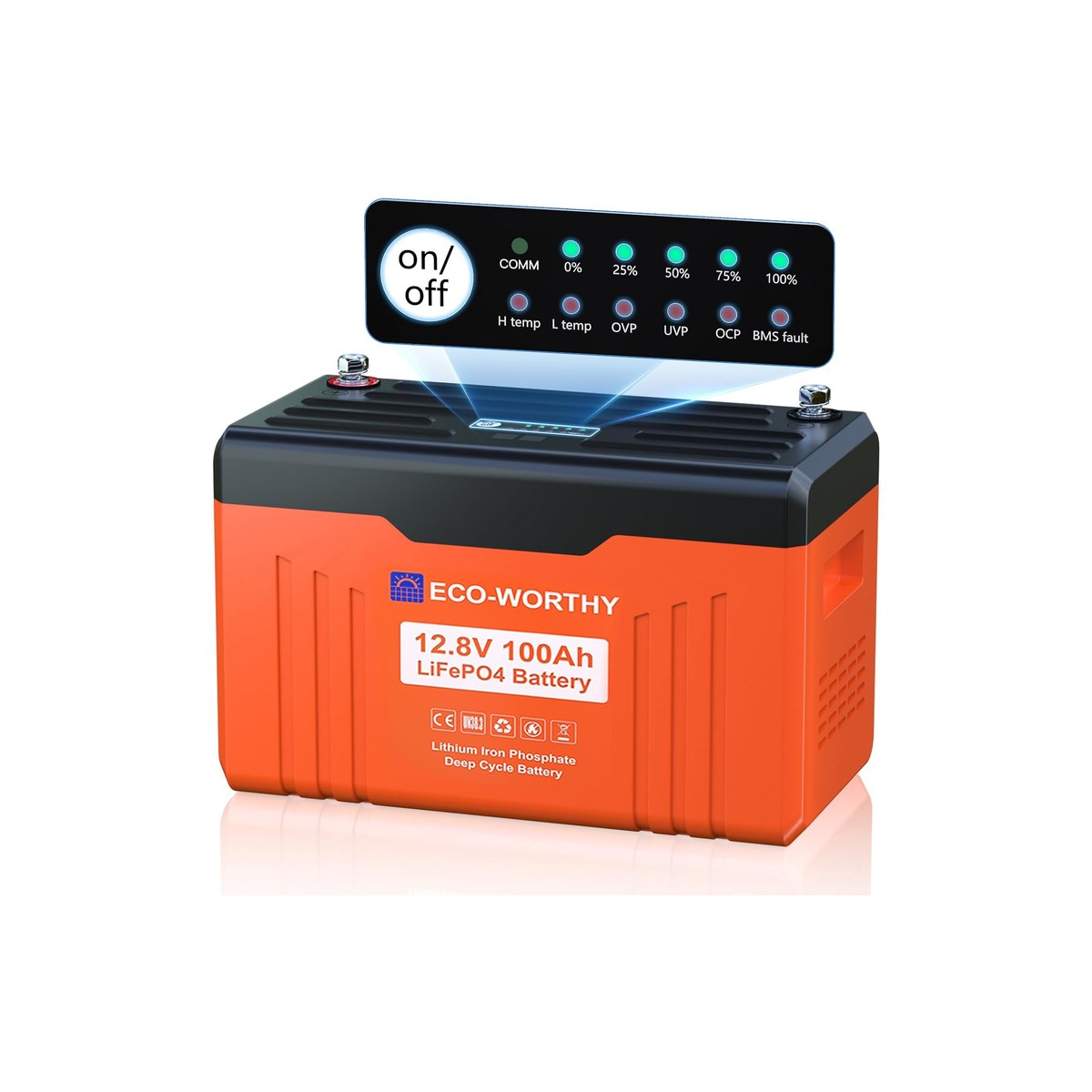
ECO-WORTHY 12V 100Ah LiFePO4 Battery, Upgrade 2.0 (built-in Bluetooth and SOC display, 100A BMS with low-temp protection, RV / camping / solar / trolling motor, ASIN B0DTP7K2FJ)
The honest sub-$200 lithium, with Bluetooth most budget cells skip.
Who it's for: The cost-conscious weekender, the second-bank buyer, or the owner dipping a toe into lithium who wants the lowest credible price without dropping to a no-name cell. This is the buyer running a modest load of lights, fans, a pump, and devices, who would rather spend about $200 to try lithium than $279 or $800, and who can accept a thinner track record and slower support as the trade for the savings.
What we found: At about $200 this is the genuine budget pick, roughly $80 under the LiTime and the cheapest credible 12V 100Ah we would actually stand behind. ECO-WORTHY is the same brand behind our Road solar-kit picks, and the Upgrade 2.0 here adds built-in Bluetooth and an SOC display you can read from your phone, which is rare this low. It carries a 100A BMS with low-temp charge protection and drops into a standard bay. The catch is record and support: only 64 ratings so far, and overseas warranty handling owners call inconsistent.
Bottom line: If price is the deciding factor and you can accept a younger track record, this is the most battery for the money in the lineup, and the Bluetooth is a real bonus at the price. We would buy it for a weekender, a backup bank, or a first lithium experiment without hesitation. For a full-time bank you will lean on hard and far from home, step up to the LiTime for the proven record or Battle Born for the support.
- + The genuine sub-$200 pick at about $200, the lowest credible price here and roughly $80 under the LiTime
- + Built-in Bluetooth and an SOC display, so you can read state of charge from your phone, unusual at this price
- + 100A BMS with low-temp protection and the same drop-in fit as pricier picks; over 400 bought per month
- × Only 64 Amazon ratings, a far thinner reliability record than the LiTime or Battle Born
- × Budget-tier support and overseas warranty handling that owners report as inconsistent
- × Low-temp protection pauses charging but does not heat, the same cold-weather limit as the other non-heated picks
Also worth considering.
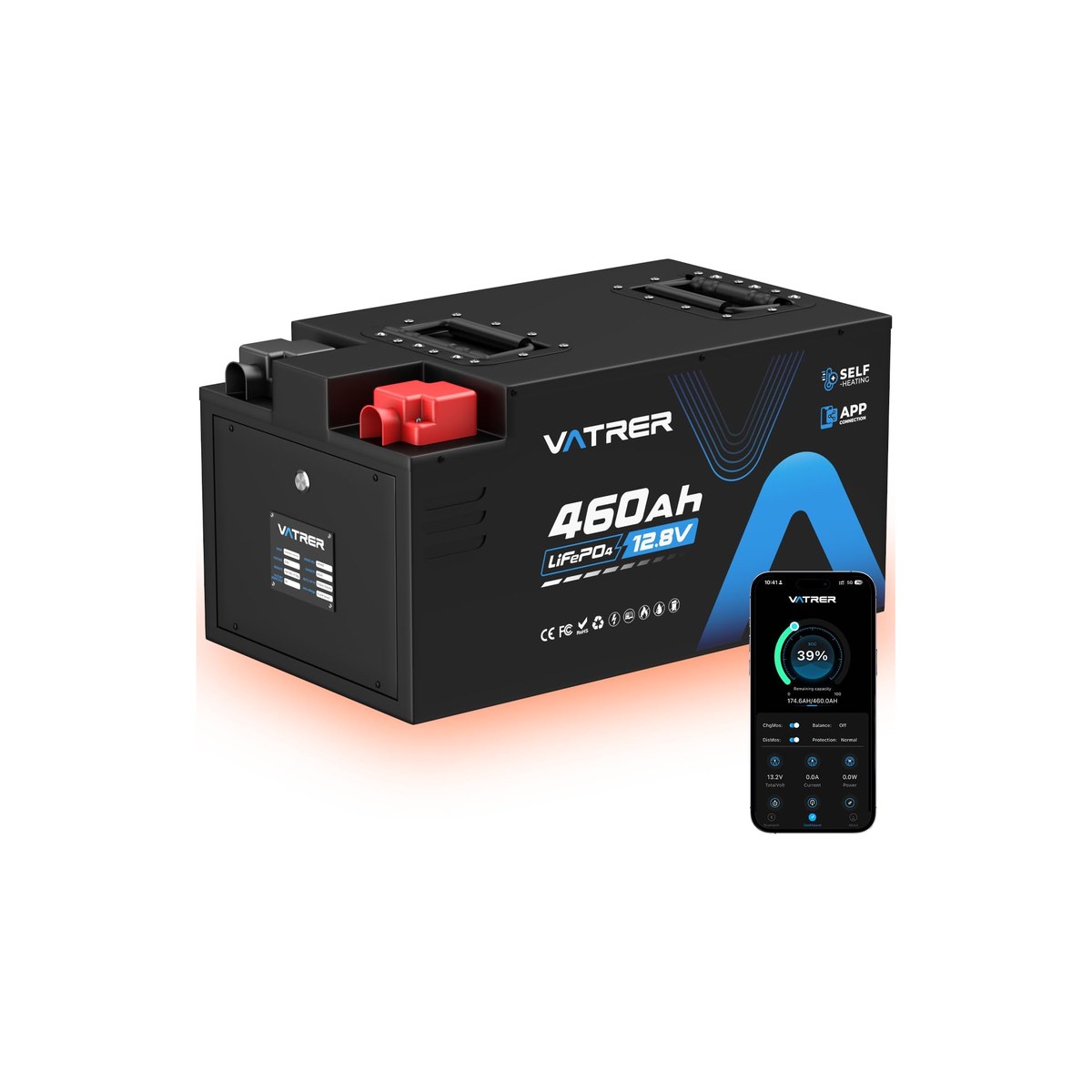
Vatrer Power 12.8V 460Ah Self-Heating LiFePO4 RV Battery (app monitoring, built-in 300A BMS, active self-heating for sub-freezing charging, ASIN B0DW3PJ634)
The big self-heating bank for full-timers who charge in the cold.
Who it's for: The full-time boondocker or four-season owner who needs a large house bank in a single box and charges in genuinely cold weather. This is the rig running a residential fridge, an inverter, and days of reserve, whose owner would rather buy one 460Ah self-heating battery than balance four 100Ah units, and who needs the cells to actually accept charge below freezing, not just survive storage.
What we found: At 460Ah this is by far the most storage here, about 5.9 kWh in one case, and it is self-heating, meaning it actively warms its cells and then accepts charge in the cold rather than just pausing like the 100Ah picks. It is the highest-rated battery in the lineup at 4.8 stars across 72 ratings, with app monitoring and a 300A BMS for big inverter loads. This is genuinely the cold-climate and big-bank answer in one, the role two separate picks would otherwise fill.
Bottom line: At about $1,100 it is the most expensive pick here, but per amp-hour it is far cheaper than stacking four heated 100Ah batteries, and it solves cold-weather charging at the same time. Buy it if you are a serious full-timer or winter camper sizing a 400Ah-plus bank; it is overkill, and overspend, for a weekender who needs 100 to 200Ah. One caveat: earlier Vatrer batches drew forum scrutiny over cell sourcing and bus-bar design, which the company says newer revisions fixed, so buy the current listing and register the warranty.
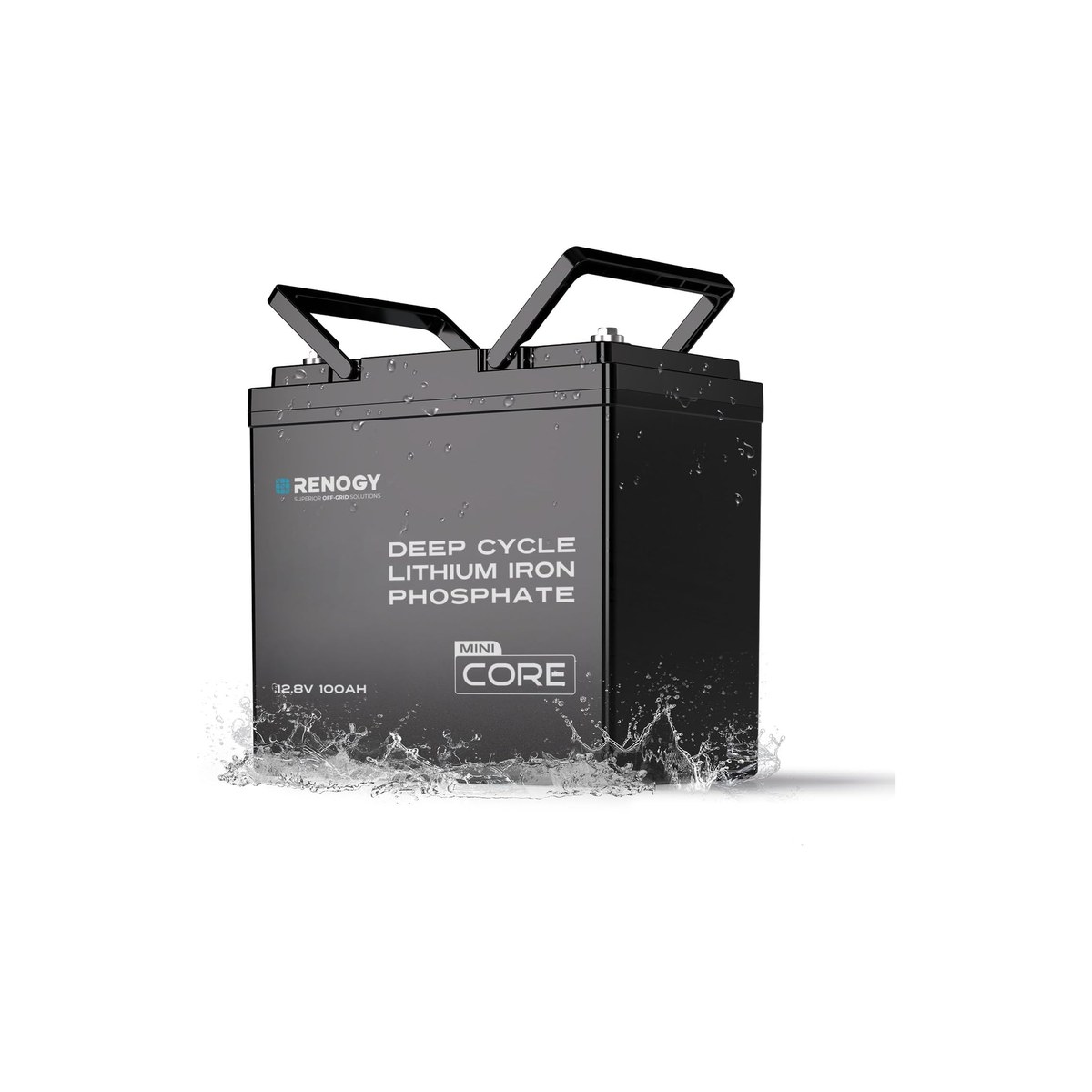
Renogy 12V 100Ah Mini LiFePO4 Battery (compact case, 100A BMS with low-temp protection, remote-monitoring compatible, RV / van / marine / off-grid, ASIN B0DJP772YP)
The compact 100Ah that fits a tight campervan battery bay.
Who it's for: The campervan, Class B, or compact-build owner fighting for every inch under a bench or seat, who needs a full 100Ah but cannot fit a standard Group 31 case. This is the buyer for whom physical size is the binding constraint, not price or brand, and who wants a mainstream name with real support rather than the smallest no-name cell on the listings.
What we found: Renogy shrank a full 12V 100Ah into a mini footprint that genuinely fits where a standard case will not, which is the whole point for a van where two batteries have to share a tight bay. It carries a 100A BMS with low-temp protection and remote-monitoring compatibility, and at 4.7 stars it is well-rated, though only across 39 ratings so far. At about $308 it sits just above the LiTime, a small upcharge you pay for the size, not for more capacity.
Bottom line: Buy the Mini when the battery bay, not the budget, is what is stopping you; it is the cleanest way to get a full 100Ah into a van build without custom fabrication. If you have room for a standard Group 31 case, the LiTime gives you the same 100Ah with a far deeper review record for less. One flag: stock ran thin at the time of writing, so confirm availability before you commit.
Skip this guide if...
Skip this guide if what you actually need is the gear around the battery rather than the battery itself. If you are charging while driving and want the bank to reach full capacity, your next buy is a DC-DC charger, not another battery, and that is a separate guide. If you want an all-in-one box with the battery, inverter, and solar input already wired together, a portable power station from our Road power guide is the no-build path. And if you are still on lead-acid and only camp at full-hookup parks, the lithium upgrade may not pay back at all; the honest answer there is to keep the lead-acid until you actually start dry-camping.
Don't bother with.
- × Skip A no-name 'self-heating' battery whose BMS can't prove it protects the cellsThe single highest-trust finding in this category: budget BMS units sometimes claim low-temp protection (and even ship with a temperature probe attached) while having no working low-temp charge cutoff. Tested examples on the DIY Solar boards charged below freezing anyway, which permanently damages the cells. If a cheap battery's listing claims cold protection or self-heating, look for the actual cutoff temperature in the spec sheet or a teardown, not just a marketing bullet. Every pick here is from a brand that documents its BMS behavior, and we flag in each pick which models include a low-temp cutoff and which do not.
- × Skip Mixing a new lithium battery in parallel with your old lead-acid or AGMDifferent chemistries charge to different voltages and rest at different points, so the lithium back-feeds the lead-acid and the lead-acid contributes almost nothing until system voltage drops, which wastes both and can stress the lithium's BMS. The consensus across RV-electrical forums is unanimous: replace the whole bank with lithium, or buy one larger lithium, but never run the two chemistries together. Budget for replacing the bank, not augmenting it.
- × Skip Assuming 'drop-in' means no other changes are neededPhysically lithium is a drop-in, electrically it is not quite. On a stock RV converter and a vehicle alternator, a lithium battery typically charges only to roughly 60 to 80 percent because those chargers taper for lead-acid voltages. To use the capacity you paid for, plan on a lithium-aware converter for shore power and a DC-DC charger for alternator charging. The battery is the easy purchase; the charging path is the part the marketing leaves out.
- × Skip Buying five 'different' budget batteries that are the same factoryLiTime, Power Queen, and Ampere Time are the same company, and Redodo and WattCycle appear to share a manufacturing source (separate companies), so a naive 'top 5 budget' list is often one battery wearing five labels. That is fine if you know it, but it is not five independent opinions. Pick one from the family on price and warranty service, and get your genuine second option from a different brand, which is exactly why our budget pick is ECO-WORTHY rather than another LiTime sibling.
- × Skip Oversizing the bank before you've sized the load and the charge sourceAmp-hours you can't refill are dead weight and dead money. A 600Ah bank behind a 200W panel and a stock alternator will sit half-empty for most of a trip. Size your daily watt-hours first, then the bank to cover a couple of days, then make sure your charge source (solar, DC-DC, or shore) can actually refill it. The battery is usually the last decision in a 12V build, not the first.
How we picked.
Sources we read and how we picked
We did not buy ten batteries and cycle them for a year, and any site claiming it did for a whole category probably didn't either. What we did was read the owners who live with these banks and the testers who open them up: owner threads on iRV2, r/GoRVing, and the DIY Solar boards, Will Prowse's long teardown record, the manufacturer spec sheets and BMS datasheets for every ASIN here, and the cold-charging guidance from Battle Born and Battery University. Then we verified every price, rating, and review count live on Amazon on June 9, 2026.
Our filter was narrow on purpose: 12V LiFePO4 drop-in house batteries that are actually buyable on Amazon with a tracked link, sorted into the roles RVers really shop, value, brand-of-record, budget, big-bank, and compact. We left out DC-DC chargers, inverters, monitors, and battery boxes, those are their own buys and their own guides. That filter is also why the lineup spans five different brands rather than five rebrands of one factory, which, as the section below explains, is a genuine hazard in this category.
How many amp-hours does your RV actually need?
Size the bank from your daily load, not from a number on a forum. A weekend camper running LED lights, vent fans, a water pump, and device charging lives comfortably on 100 to 200Ah. A van-lifer adding a 12V fridge and steady device use lands around 200 to 300Ah. A full-timer or hard boondocker with a residential fridge, an inverter, and days of reserve runs 300 to 600Ah, often paired with 400 to 600W of solar to refill it.
The reality check vendors skip: a full-size 120V residential fridge on an inverter can pull about 130Ah a day, needing roughly 200Ah of usable capacity just for itself, while a standard 12V compressor fridge (what most rigs actually run) is far lighter at about 30 to 70Ah a day, a small chest unit closer to 24 and a big upright up to 90. Running a rooftop air conditioner off batteries starts at 300Ah and realistically wants 600Ah-plus plus a large inverter. The honest rule is to size for your continuous loads first, double it for reserve and cloudy days, then make sure your charge source can actually refill it before you buy more battery than you can keep full.
The cold-charging truth: low-temp cutoff vs self-heating
This is the single thing owners learn the hard way. A LiFePO4 battery must not be charged below about 32 degrees Fahrenheit; doing so plates lithium on the cells and permanently damages them. Most quality batteries include a low-temp cutoff that protects against this, though not all do (our overall LiTime Group 31 pick does not), and where cold protection exists it comes in two very different forms that vendors blur on purpose.
Low-temp cutoff is passive: the BMS simply stops accepting charge when the cells are below freezing, protecting them but leaving you unable to recharge until things warm up. Self-heating is active: the battery draws a little power to warm its own cells to roughly 35 to 41 degrees, depending on brand, then accepts charge. If you only store the rig through winter, cutoff is fine. If you actually camp and recharge below freezing, you need self-heating, which is why the Vatrer is the cold-climate pick and the standard 100Ah units are not, no matter what their listings imply.
Do you really need a DC-DC charger with lithium batteries?
Lithium is sold as a drop-in replacement for lead-acid, and physically it is, same case, same terminals. Electrically it is not quite. On a stock RV converter and a tow vehicle's alternator, a lithium battery typically charges only to roughly 60 to 80 percent, because those chargers were tuned for lead-acid voltages and taper off too early for lithium.
To get the full capacity you paid for, you generally want a lithium-aware converter for shore power and, for charging off the engine, a DC-DC charger. The DC-DC unit sets the correct 14.4 to 14.6V, limits current so you don't cook the alternator, and keeps the house bank from back-feeding the starting battery. Budget for one if you charge while driving; it is the accessory the drop-in marketing quietly leaves out, and we cover it in a separate guide.
Are LiTime, Redodo, and Power Queen the same battery?
Largely, yes, and this is the trap in every 'top 5 budget lithium' list that doesn't say so. LiTime (formerly Ampere Time) and Power Queen are the same company per their trademark filings, and Redodo and WattCycle appear to share a manufacturing source, though they are separate companies. Their 100Ah cells, cases, and BMS units are often near-identical, which is why their specs, and even their listing photos, look like siblings.
That is not a reason to avoid them, it is a reason to buy one and not three. Our budget pick is ECO-WORTHY precisely because it is genuinely a different brand from our top pick, so the lineup isn't one factory wearing five labels. If you do shop the LiTime family, treat Redodo and Power Queen as the slightly cheaper siblings of the LiTime, not as independent second opinions, and pick on price and warranty service, since the battery inside is much the same.
Group sizes, fit, and never mixing lithium with old AGM
Measure before you buy. A Group 31 case is longer but shorter than a pair of 6V golf-cart batteries, so a battery that fits the bay on paper may not route cables the way the old one did, and Group 27 sometimes fits an old dual-6V tray better than Group 31 does. The compact pick in this guide exists because vans often can't take a standard case at all.
And do not parallel a new lithium with your existing lead-acid or AGM batteries. The two chemistries charge to different voltages and rest at different points, so the lithium back-feeds the lead-acid and the lead-acid does almost nothing until system voltage drops, which wastes both. If you're upgrading, replace the whole bank with lithium or buy one larger lithium; do not mix the two.
FAQs.
Q01 Can you charge a lithium RV battery in freezing weather?
+
Q02 Is a lithium RV battery really 'drop-in'? Do I need a DC-DC charger?
+
Q03 How many amp-hours do I need for my RV?
+
Q04 AGM vs lithium for an RV, is it worth it?
+
Q05 Are LiTime, Redodo, and Power Queen the same battery?
+
Q06 How much does an RV lithium battery cost?
+
Q07 How long do RV lithium batteries last?
+
Q08 Can a lithium battery run my RV air conditioner?
+
If you, then this.
- IF you want the safe, most-reviewed default, a proven 12V 100Ah drop-in at a fair price for a typical rigGET LiTime 12V 100Ah Group 31 (B084DB36KW; 1,756 ratings, no low-temp cutoff, the safe mild-climate default)$278.99 →
- IF you want the brand-of-record with US support and a long warranty, and you value service over saving moneyGET Battle Born 12V 100Ah (B06XX197GJ; US support, 10-year warranty, heated variant; note the unresolved 2026 terminal-design dispute) or Dakota Lithium (B08N57HR2K; 11-year warranty, cleaner reputation, weaker support)$799.55 →
- IF you want the lowest credible price and can accept a thinner track record, ideally with Bluetooth monitoringGET ECO-WORTHY 12V 100Ah Upgrade 2.0 (B0DTP7K2FJ; genuine sub-$200, Bluetooth + SOC display)$199.99 →
- IF you are a full-timer or winter camper sizing a big single bank and need real cold-weather chargingGET Vatrer 12.8V 460Ah Self-Heating (B0DW3PJ634; 5.9 kWh, active self-heating, 300A BMS)$1,099.99 →
- IF your battery bay is too tight for a standard case and you need a full 100Ah in a compact footprintGET Renogy 12V 100Ah Mini (B0DJP772YP; compact case, confirm stock before buying)$307.99 →
- IF you need to charge the bank while driving, or off a stock converter, to its full capacityGET a DC-DC charger and a lithium-aware converter (see our DC-DC chargers guide), not another batteryvaries →
RV & Van Gear: The Complete Guide
The whole-rig picture →Every system in a van, RV, or camper, organized in one place, with the safety and weight floor and the one guide we trust for each.
- Charging lithium batteries at high and low temperatures (cold-charging damage) · Battery University
- Understanding the temperature limits of LiFePO4 batteries (cold-charging and heating) · Battle Born Batteries
- Careful: charging a lithium battery from an alternator (why you need a DC-DC charger) · Victron Energy
- Battle Born terminal-design dispute and the 2026 Dragonfly Energy v. Will Prowse lawsuit (context) · RV Miles