Best RV Water Filters: 5 Picks, and What's Actually Certified (2026)
An RV water filter screws between the campground spigot and your hose and strips sediment, chlorine, and taste before water reaches the rig. The buying trap is the paperwork: nearly every filter in the category invokes NSF, but NSF/ANSI 42 covers taste, 53 covers health claims like lead, and P231, the purifier standard a bacteria or virus claim actually needs, is held by no RV filter we could find. We read the manufacturers' own certification wording, queried NSF's public database on June 12, 2026, and verified every listing live on Amazon the same day. The honest headlines: zero of the major RV filter brands show a listing in NSF's database under their own names, the famous 'bacteria' line on the default filter describes storage, not your drinking water, and the manufacturer's own storage advice for a used filter is the refrigerator.
- 01 Camco TastePURE 40043 (B0006IX87S) , top pick, the $20 inline default, 53,000-plus ratings, hose protector included
- 02 Frizzlife MV99 (B08PCJNPHR) , the certification upgrade, verified IAPMO listings plus auditable gallons, ~$76
- 03 Clear2O CRV2006 (B07VNTLKD9) , the carbon-block bridge, finer media still inline, ~$35
- 04 Beech Lane Dual-Stage (B07GBZ83HH) , the open-cartridge canister system, 1,900-gallon claim, ~$70
- 05 Clearsource Ultra (B07SX5RPG6) , the flagship three-stage build, with one claim we read out loud, ~$600
How they compare.
| Rank | Product | Best for | Price | Our score |
|---|---|---|---|---|
| 01 | Camco TastePURE 40043 (B0006IX87S)
Top Pick
| best overall, the proven city-water polisher, deepest review base in the category | $19.97
Buy → | 9.0/10 |
| 02 | Frizzlife MV99 (B08PCJNPHR) | the certification upgrade, verified IAPMO 42 and 53 listings, gallon-rated capacity | $75.99
Buy → | 8.7/10 |
| 03 | Clear2O CRV2006 (B07VNTLKD9) | the carbon-block bridge, 1 micron block in the familiar inline format | $34.99
Buy → | 8.6/10 |
| 04 | Beech Lane Dual-Stage (B07GBZ83HH) | the mounted canister value, standard 10 inch cartridges, choose your media | $69.99
Buy → | 8.4/10 |
| 05 | Clearsource Ultra (B07SX5RPG6) | the top-shelf build, three stages and real flow, virus claim read as a claim | $599.99
Buy → | 8.3/10 |
Prices are current Amazon prices at time of publication and can change. Scores reflect our editorial evaluation, not vendor input.
Our #1 pick: Camco TastePURE RV Water Filter 40043, Inline GAC and KDF Filtration, 20 Micron, Flexible Hose Protector Included, Made in USA (ASIN B0006IX87S).
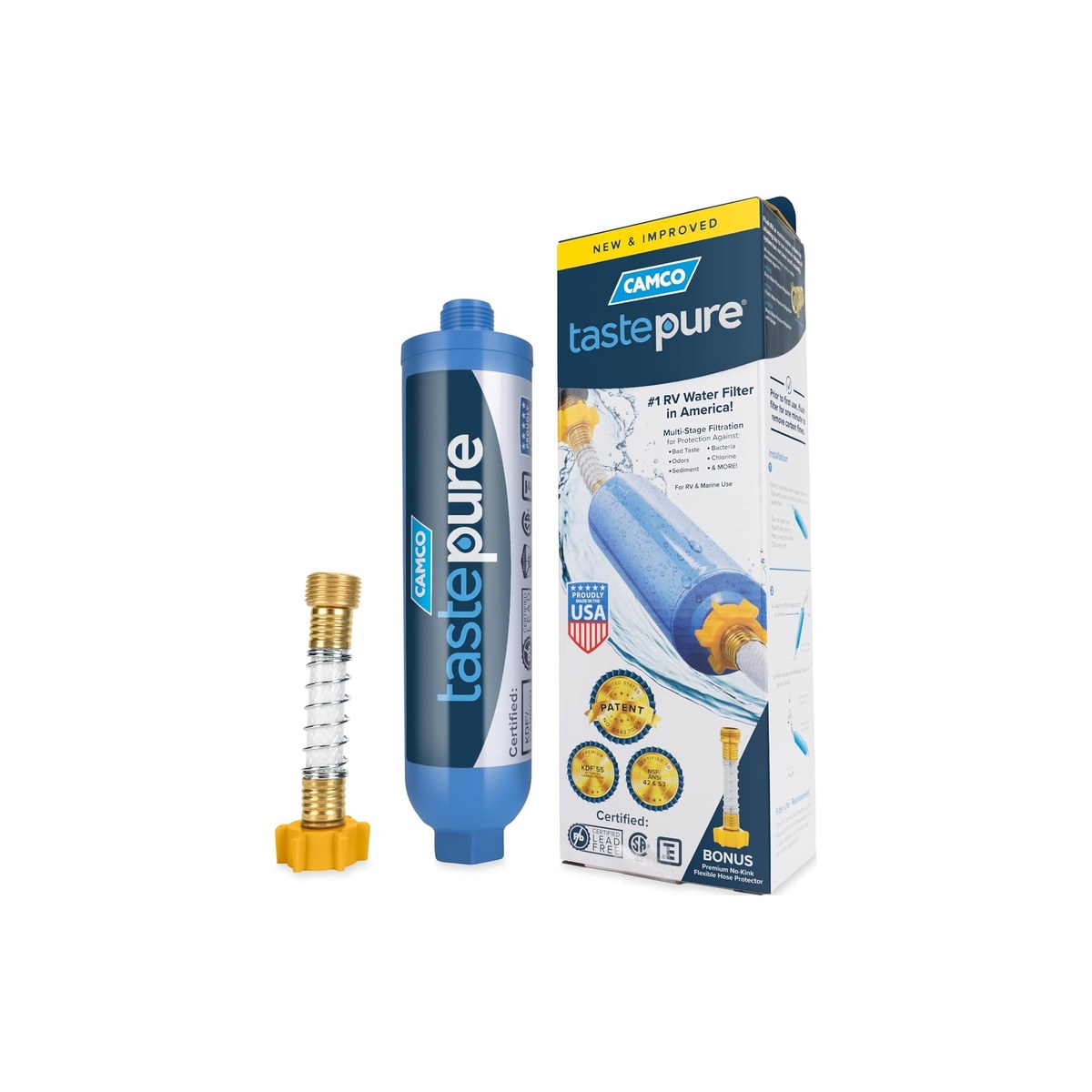
Camco TastePURE RV Water Filter 40043, Inline GAC and KDF Filtration, 20 Micron, Flexible Hose Protector Included, Made in USA (ASIN B0006IX87S)
The $20 default, read as the polisher it is.
Who it's for: The hookup camper who wants water that tastes right and a rig protected from campground grit, at the price of a pizza. The TastePURE 40043 is the category's default for a reason: a 53,000-rating track record, made in USA, the hose protector in the box, and honest utility as a chlorine, taste, and sediment polisher on city water.
What we found: The media is granular activated carbon plus KDF behind a 20 micron screen, and the wording matters everywhere: Camco's paperwork reads tested and certified by TEI Analytical Laboratories against NSF/ANSI 42 for chlorine, taste, and odor, and NSF/ANSI 53 for lead, which is a lab report, not an NSF listing, and NSF's public database shows no Camco filters under the brand name as of June 12, 2026. The KDF line about preventing bacteria growth applies when the filter is not in use, it keeps the cartridge itself from souring in storage. At $19.97 with 4.7 stars across 53,260 ratings, it is the best-proven version of exactly what it is.
Bottom line: Buy the 40043 as the default it is, flush the new cartridge at the spigot until the water runs clear before connecting it to the rig, and replace it on flow drop rather than the calendar. Between trips, do what Camco says: drain it, bag it, refrigerate it, or just budget a fresh one per season. Step up the ladder when your water needs more than taste and grit handled.
- + 4.7 stars across more than 53,000 ratings, the deepest review base in the category, under the Camco brand and in stock
- + GAC plus KDF media for chlorine, taste, and odor with a 20 micron sediment screen, and the flexible hose protector included, strain relief most clones and the 2-pack skip
- + Made in USA, and the paperwork names its names: TEI Analytical Laboratories, NSF/ANSI 42 and 53, a lab and standards you can look up, where the clones offer a bare 'NSF Certified'
- × Lab-tested is not NSF-listed: Amazon's own spec field calls it External Testing Certification, and no Camco filter appears in NSF's public database
- × 20 micron is grit-only filtration, bacteria run 0.2 to 2 microns and pass straight through, this is not a safety filter
- × Capacity is sold as about three months with no gallon rating to audit, and sediment load, not the calendar, is what actually kills it
Runner-up: Frizzlife MV99 RV Inline Water Filter, 0.5 Micron Carbon Block, IAPMO R&T Listed to NSF/ANSI 42 and 53, Replaceable FZ-2 Cartridge (ASIN B08PCJNPHR).
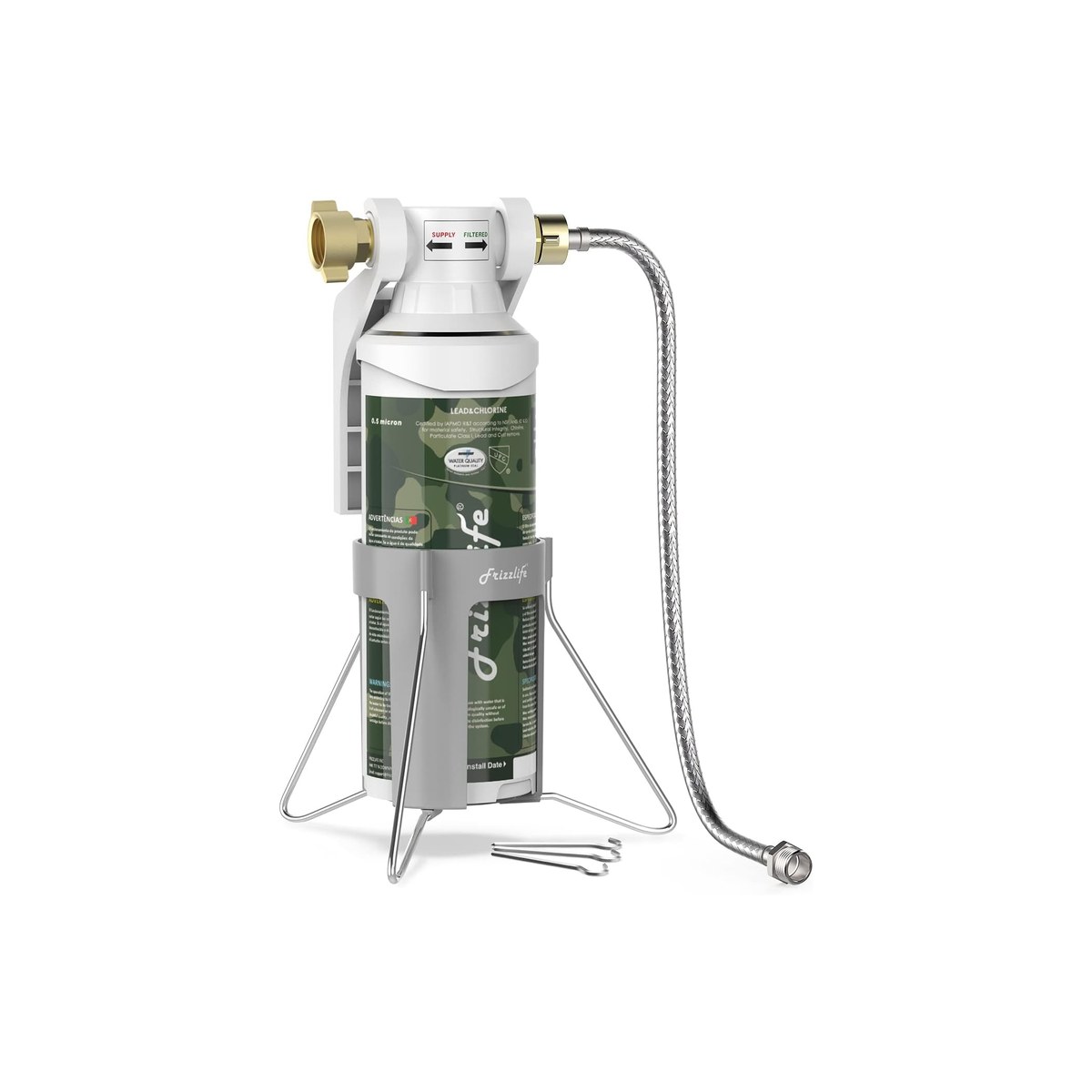
Frizzlife MV99 RV Inline Water Filter, 0.5 Micron Carbon Block, IAPMO R&T Listed to NSF/ANSI 42 and 53, Replaceable FZ-2 Cartridge (ASIN B08PCJNPHR)
The inline whose paperwork we audited, files and all.
Who it's for: The buyer who looked at the cert ladder and wants the top rung available in an inline body. The Frizzlife MV99 is the only pick here with verified third-party listings from a certification body, IAPMO R&T, covering both the taste standard and the lead-class health standard, and it backs the paper with gallon numbers you can hold it to. It suits the rig that drinks from the tap.
What we found: The paperwork is the most specific in our lineup, and we checked it ourselves: the IAPMO R&T directory shows Frizzlife Technology Inc holding active file W-11830 for NSF/ANSI 42 and W-11831 for NSF/ANSI 53, listed at the company-file level with the MV99 model tie on Frizzlife's page, as audited as this aisle gets. Capacity is gallon-rated, 5,000 for chlorine and 1,000 for lead, on a 0.5 micron carbon block with lead-free brass. The trade is flow: 1.4 GPM at 60 PSI per the manufacturer, a real step down from the Camco's open 2.5 GPM class, at $75.99 with 4.6 stars across 724 ratings.
Bottom line: Buy the MV99 when lead is on your mind, you want capacity you can audit, and your shower head tolerates 1.4 GPM, a number rated at 60 PSI, so expect a bit less behind our chain's 45 PSI regulator, with common RV shower heads at roughly 1.5 to 2 GPM on city water. Replace the FZ-2 cartridge on gallons, not vibes. If the flow tax stings, the Beech Lane's two-stage canister spreads the work across more media area instead.
- + The only verified third-party listing in our lineup: IAPMO R&T files W-11830 and W-11831 for NSF/ANSI 42 and 53, active when we checked the directory ourselves
- + Auditable capacity, 5,000 gallons for chlorine and 1,000 for lead per Frizzlife, where the default filter sells months
- + 0.5 micron carbon block with lead-free brass fittings and a replaceable FZ-2 cartridge, 4.6 stars across 724 ratings
- × Flow pays for the fine media: Frizzlife's own spec is 1.4 GPM at 60 PSI, the listing table says 2, we print the manufacturer's number
- × At $75.99 it is nearly four Camcos, the price of paperwork and a finer block
- × 0.5 micron carries no nominal-or-absolute qualifier, so we read it as nominal, the honest reading for any unqualified micron number
Budget pick: Clear2O CRV2006 RV and Marine Inline Water Filter, 1 Micron Solid Carbon Block, Spigot-End Mounting (ASIN B07VNTLKD9).
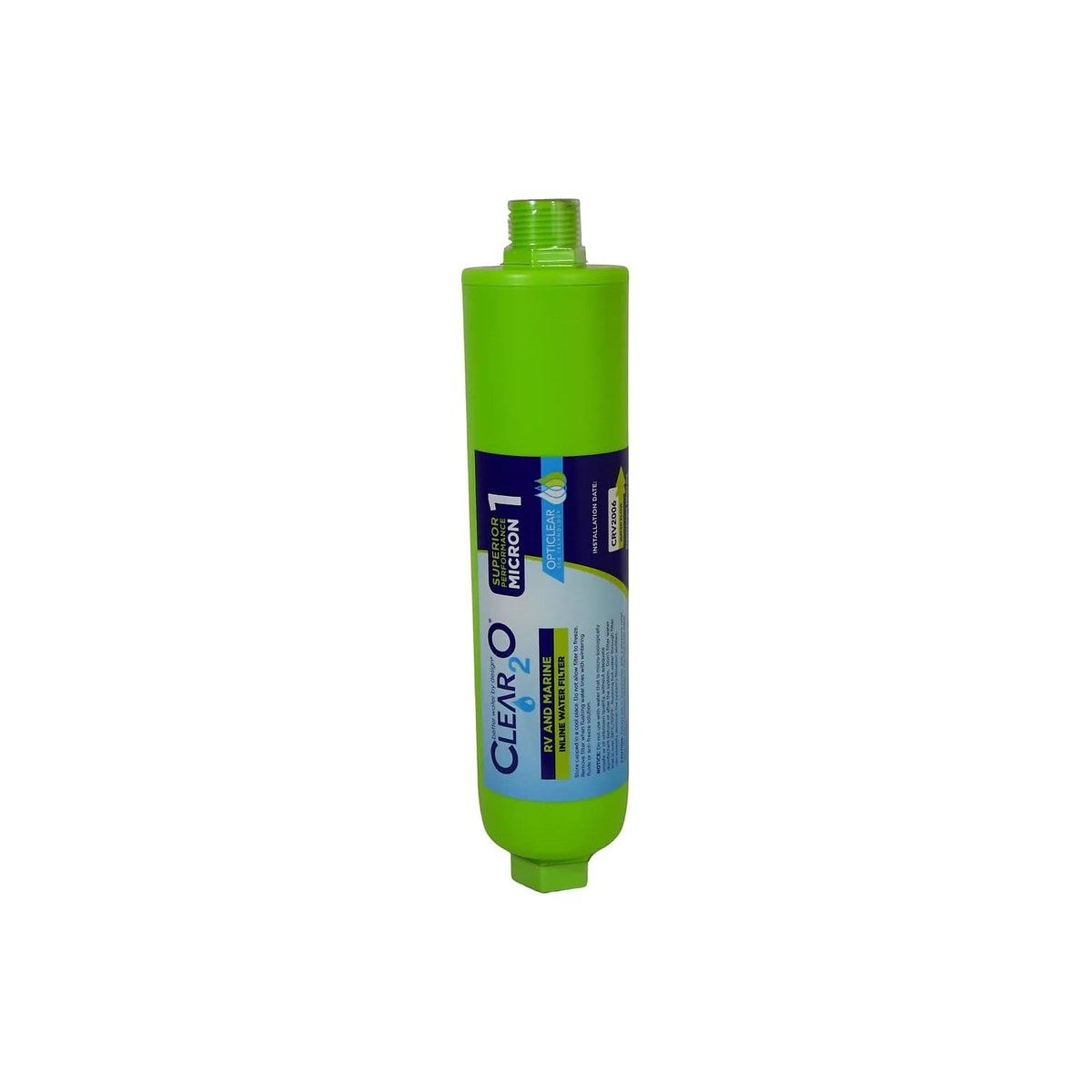
Clear2O CRV2006 RV and Marine Inline Water Filter, 1 Micron Solid Carbon Block, Spigot-End Mounting (ASIN B07VNTLKD9)
Carbon-block filtration, without signing up for a canister install.
Who it's for: The buyer between rungs: more filtration than loose carbon granules, no appetite yet for brackets and housings. The Clear2O CRV2006 packs a full-length solid carbon block, the media format that buys contact time and a finer micron number, into the familiar screw-between-spigot-and-hose form, and at $34.99 it is the cheapest way in our lineup to find out whether better media changes your water.
What we found: The block is rated 1 micron with no nominal-or-absolute qualifier, so we read it as nominal, and the claims are tier-two paperwork: independently tested to meet NSF/ANSI 42 and 53 per the retail copy, with no listing in NSF's database, the same lab-report class as the Camco. Two practical notes from Clear2O itself: mount it at the spigot end, not the rig inlet, and pair it with the washable DirtGUARD sediment pre-filter in dirty-water parks, because a fine block behind no pre-filter is the first thing a gritty campground kills. No gallon rating or flow spec is published, only a months-class claim, which we count against it.
Bottom line: Buy the CRV2006 as the taste-and-clarity step-up for city-water hookups, give it the DirtGUARD or at least clean source water, and flush the carbon fines at the spigot before first hookup like every block. If your water problem is paperwork-grade, lead worries, audited capacity, spend the extra $41 on the Frizzlife. If it is volume and cartridge choice, the Beech Lane canister is the better $70.
- + A full-length solid carbon block at 1 micron, finer media than the granular default, in the same screw-on inline format
- + $34.99 with 4.6 stars across 425 ratings under the Clear2o brand, the cheapest carbon-block path in our lineup
- + Clear2O sells the washable DirtGUARD pre-filter alongside it, the right pairing for sediment-heavy parks
- × The 1 micron number carries no nominal-or-absolute qualifier, so read it as nominal, cyst-grade filtration conventionally requires 1 micron absolute
- × Fine media in a small body clogs first: without a sediment pre-filter, gritty parks will blind the block early
- × No gallon rating or flow spec published, only a months-class lifespan claim, the spec silence we mark down everywhere else, marked down here too
Also worth considering.
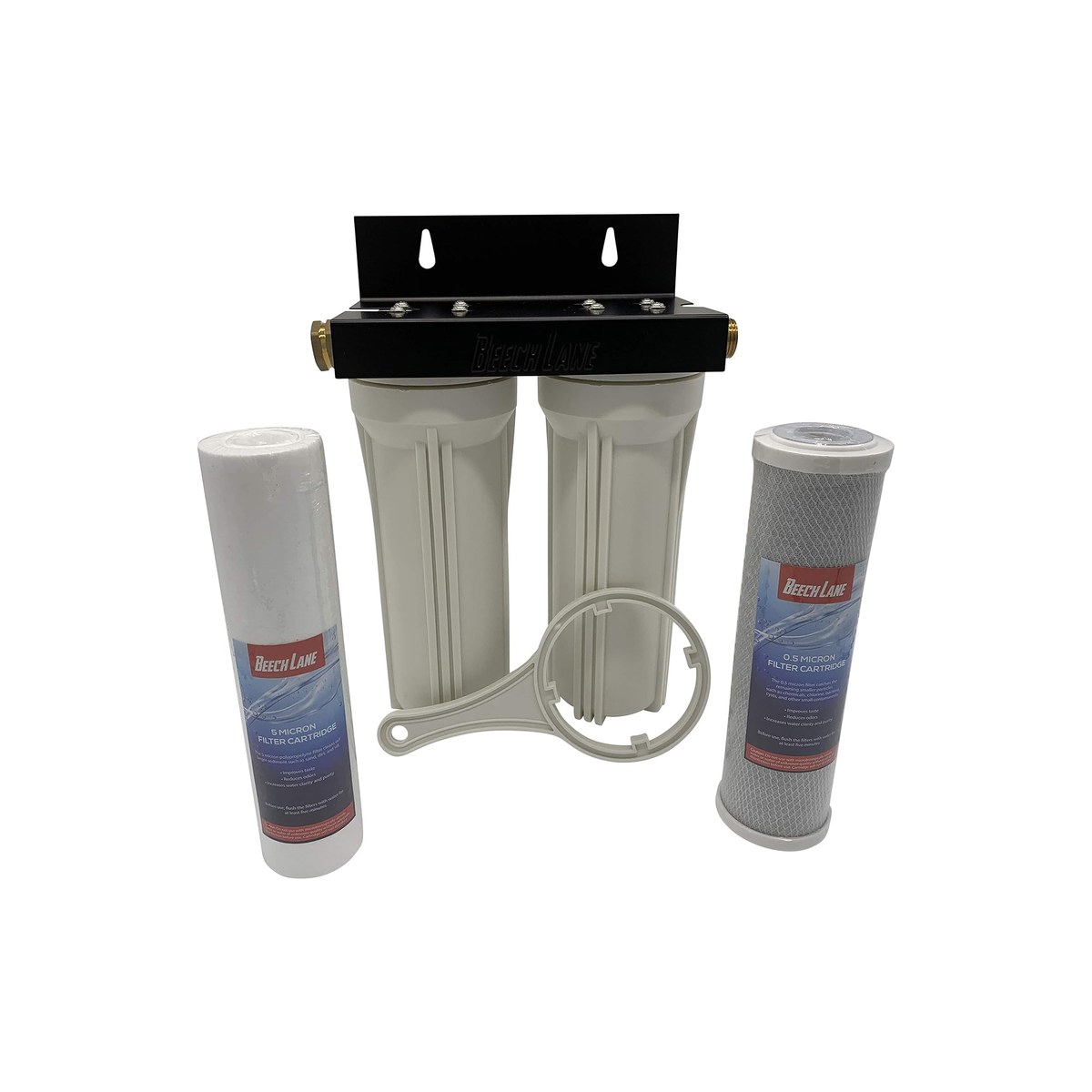
Beech Lane External RV Dual Water Filter System, Two Standard 10 Inch Housings, 5 Micron Sediment and 0.5 Micron Carbon Block Cartridges, Brass Fittings (ASIN B07GBZ83HH)
Two standard housings, and the cartridge world opens up.
Who it's for: The rig that camps enough to mount its filtration. The Beech Lane pairs two standard 2.5 by 10 inch housings on a bracket with lead-free brass fittings, running a 5 micron sediment stage into a 0.5 micron carbon block, and because the housings take industry-standard cartridges, you choose the media grade every replacement cycle instead of marrying one brand's cartridge. If your rig shipped with a built-in 10 inch housing, you already own half of this pick, check the cartridge size before buying.
What we found: The included cartridge set claims 1,900 gallons per Beech Lane, and the two-stage order does the engineering favor: cheap sediment media catches the grit so the carbon block does only chemistry. Certification claims: none at all, the honest bottom of our ladder, silence beats borrowed halos, on paperwork at least; flow is unpublished too, the same spec silence we mark down on the Clear2O, counted against it here as well, the 1,900 gallons is the spec Beech Lane does put on the record. It is $69.99 at 4.6 stars across 1,886 ratings, and the strategic value is the standard housings: 1 micron absolute, lead-rated, or iron-specific cartridges all drop in later as your water demands.
Bottom line: Buy the Beech Lane when you camp enough that cartridge cost per gallon matters and you want a system that grows with your water problems instead of getting replaced by them. Mount it, winterize it by pulling the cartridges and draining the housings by hand, blown-out lines do not empty canisters, and dry the threads, trapped water cracks housings in a freeze.
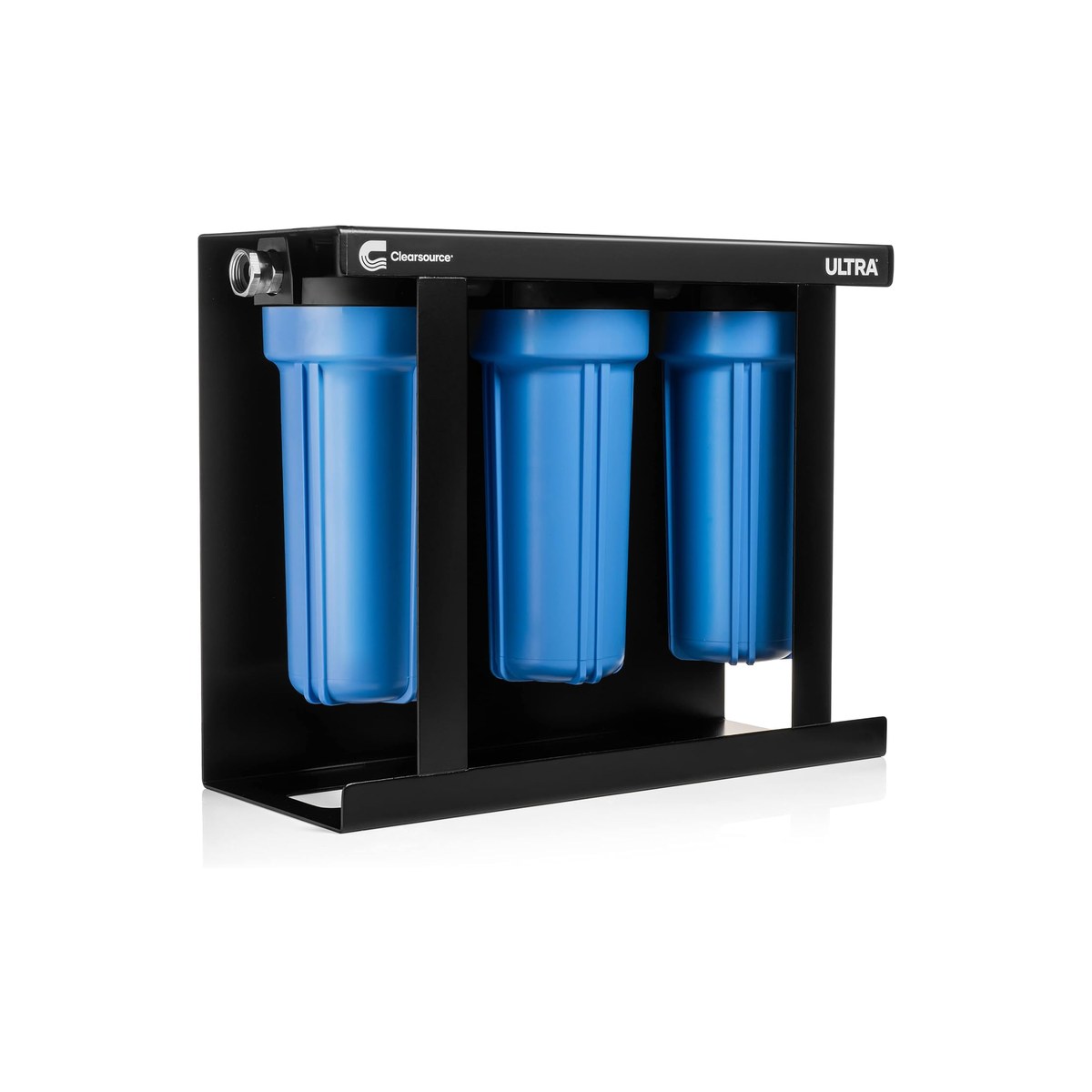
Clearsource Ultra RV Water Filter System, Three-Stage Metal Chassis with VirusGuard, 4.5 GPM Class Flow (ASIN B07SX5RPG6)
The serious hardware, with one claim we read out loud.
Who it's for: The full-timer done with disposable inlines. The Clearsource Ultra is a powder-coated metal chassis running three stages, 5 micron sediment, 0.5 micron coconut carbon block, then the VirusGuard cartridge, at a flow class the inline filters cannot touch. It is the category's heavyweight build, and it suits the buyer who wants hardware-grade filtration and can read one claim with us first.
What we found: The hardware case is real: stainless fittings, replaceable cartridges, 4.5 GPM claimed flow, and Clearsource's own Premier page gives the category's best definition of an absolute micron rating, every pore the rated size or better. The claim to read carefully: VirusGuard advertises certified capability against bacteria, cysts, and viruses, and names no certifying body, no standard, and no listing number anywhere we could find, while the purifier standard such a claim wants, P231, appears nowhere in Clearsource's materials. At $599.99 with 4.6 stars across 724 ratings, buy it as superb filtration hardware, not as a purifier. That unanchored claim is why the best-built hardware here sits fifth: our ladder prices wording before steel.
Bottom line: Buy the Ultra when flow, build, and cartridge volume are worth six hundred dollars to your daily water life, full-timers on long hookups are the natural home, and treat the virus line as unproven until Clearsource names a standard. On a boil advisory you boil, with this or any filter here. If $600 is rich but the chassis idea is right, the Beech Lane is the same architecture in value trim.
Skip this guide if...
Skip this guide if you camp a weekend or two a year on treated city water: flush the campground hose for a minute before connecting, and your rig's grit screen plus decent municipal water covers most of what a $20 filter does. Skip the upgrade ladder if your real complaint is white scale on fixtures, that is hardness, a water softener's job, not a filter's, and our RV water softener guide covers that side. And no purchase here answers a boil advisory: filters polish safe water, they do not make unsafe water safe, so when the campground posts one, you boil or drink bottled, with any filter in this guide.
Don't bother with.
- × Skip Believing 'NSF Certified' in a listing titleWe queried NSF's public certification database on June 12, 2026, and found zero listings under the brand names we checked, Camco, Clearsource, Clear2O, Hydro Life, AQUA CREST, while clone titles lead with 'NSF Certified' anyway. The wording game runs in steps: a lab test report becomes 'tested and certified,' which retail titles inflate to 'NSF certified' or 'NSF listed.' Lab-tested paperwork is legitimate, our own top pick carries it and we say so, but it is not a listing, and Camco's own sentence plays that first step, tested and certified by TEI Analytical Laboratories, surviving our ladder only because the names attached, a real lab and real standards, are exactly what the inflated titles delete. The one pick with a true listing body, the Frizzlife, we verified in IAPMO's directory ourselves, files W-11830 and W-11831. And the instructive clone is AQUA CREST: its verifiable NSF listing covers the aesthetic taste standard only, while its sales copy advertises lead reduction, and the materials certification it cites did not appear in the database at all when we looked. Demand the body, the standard, and the listing number.
- × Skip Treating any hookup filter as a purifierBacteria run 0.2 to 2 microns; the default inline screens at 20. Carbon's microbial contribution is actually negative: it strips the chlorine that was disinfecting the water, and a damp carbon bed is a fine place for microbes to live, which is exactly why the purifier standard, NSF P231, exists for gear that claims to make water microbiologically safe. No RV hookup filter we could find holds it. City water arrives already treated, so this rarely matters, until a boil advisory posts, and then the answer is boiling or bottled water, not anything that screws onto a hose.
- × Skip The 'bacteria control' wordplayThe KDF media inside the default inline filters is bacteriostatic in storage: the manufacturer's own sentence says it prevents bacteria growth when the filter is not in use, meaning the cartridge resists souring between trips. Clone listings amputate that sentence into title phrases like 'Bacteria Control' and 'Bacteria Protection,' which buyers read as 'removes bacteria from my drinking water.' It does not, and no inline in this class does. When a $20 filter title promises bacteria anything, you are reading marketing surgery, not a spec.
- × Skip Letting a wet filter cook in the bay between tripsA used filter is wet, full of trapped organics, and stored in a compartment that hits triple-digit temperatures, which is a microbial incubator, not storage. Camco's own guidance for the gap between trips is to drain the filter, bag it, and keep it in the refrigerator, advice that quietly concedes what a used cartridge is. The practical rule: refrigerate for gaps of days to a few weeks, and for a months-long gap, throw it away and start the season fresh, a $12 to $20 cartridge is not worth a gut bet.
- × Skip Unqualified micron numbersA micron rating without a qualifier is a nominal rating: it catches many particles of that size, not all of them. An absolute rating means every pore is the rated size or better, a definition we quote from Clearsource's own Premier page because it is the clearest in the category. The convention for cyst-safe filtration is 1 micron absolute, so a bare '1 micron' on a $20 inline, or '0.2 micron' on a budget three-stage, is a nominal claim wearing absolute clothes. We read every unqualified number in this guide as nominal, including on our own picks, and you should do the same everywhere.
How we picked.
Sources we read and how we picked
We started from the manufacturers' own certification wording, the exact sentences on Frizzlife, Clear2O, Clearsource, and Beech Lane product pages, and for Camco, whose site does not expose its product pages, the wording printed on its retail listings. We then checked the claims against the public certification directories on June 12, 2026, NSF's database and IAPMO R&T's, and verified every listing live on Amazon the same day: price, rating, stock, brand byline, and what ships in the box. The discipline: a listing claim we verified in a directory gets printed with its file numbers, and any claim we could not verify stays printed as a claim, on every pick, evenly.
Our filter, in order: claim precision first, exact wording, named bodies, auditable numbers, then review scale on a genuine brand listing, then build and value. The ladder ranks across lanes by how many buyers each pick serves: the $20 Camco outranks the better-papered Frizzlife because the default job, taste and grit on treated city water, is most buyers' whole job, and 53,000 ratings is proof at that job nothing else here approaches. The Frizzlife, Clear2O, Beech Lane, and Clearsource then each buy something specific, paper, media, ecosystem, build, for the buyer whose water asks for it, and the ladder runs on wording: a pick claiming nothing sits above a pick claiming certified with no certifier.
The certification decoder: 42, 53, 372, and P231
Four standards do the work in this category, and they are not interchangeable. NSF/ANSI 42 is aesthetic: chlorine, taste, odor. A filter certified only to 42 makes water taste better, it does not make water safer. NSF/ANSI 53 is the health-claims standard, lead and cysts among them, and a 53 claim should name its contaminant. NSF/ANSI 372 covers lead-free materials of the device itself and says nothing about what it filters. And NSF P231 is the microbiological purifier standard, the one a bacteria or virus removal claim actually needs, held, as far as we could find, by no filter in the RV aisle.
Then there is the wording ladder. A true listing means a body like NSF, IAPMO R&T, or WQA lists the product publicly and audits it. Below that sits lab-tested paperwork, a one-time test report from an independent laboratory, which is what the category's default filter honestly carries. Below that, vague invocations, NSF-rated elements, meets NSF standards, certified capability with no certifier named. And at the bottom, bare adjectives. The honest brands live at every rung; what separates them is whether the wording matches the rung they are actually on. That is the column we built this guide around, the same ladder discipline our water pressure regulator guide runs on its certification paperwork.
Microns, media, and the flow tax
The micron ladder runs 20, 5, 1, 0.5, 0.2: at 20 you are catching grit, at 5 fine sediment, at 1 micron absolute you reach cyst-class filtration, and 0.2 is bacteria territory, if and only if the rating is absolute, every pore the rated size or better. Media matters as much: granular carbon is cheap and open-flowing but water can channel around it; a solid carbon block forces contact time and finer filtration; KDF adds storage-life and some metals handling. Every step finer costs flow, which is the tax the spec sheets whisper: the open-flow Camco runs a 2.5 GPM class, the fine-blocked Frizzlife is 1.4 GPM at 60 PSI by its own spec.
The flow tax stacks with the rest of the hookup chain, and that is where our sibling guides connect. Campground spigot to 45 PSI pressure regulator, our regulator guide's number, to filter to hose, the whole chain hanging on garden hose threads: a fine block fed by a restrictive regulator can starve the whole rig, and on tankless water heaters, our heater guide documents minimum flow gates around 0.6 to 0.9 GPM, a blinded filter is exactly how a working heater stops lighting. The diagnosis when the flow rate drops is a bypass test: pull the filter, compare flow, and if it jumps, you found it, replace the cartridge rather than running unfiltered for long. Otherwise work the chain: kinked hose, regulator, and only if you are running off the tank rather than city water, the pump inlet screen, then ask the campground.
Lifespan, storage, and the refrigerator trick
Capacity claims come in two currencies, and only one is auditable. Gallon ratings, the Frizzlife's 5,000 for chlorine and 1,000 for lead, the Beech Lane set's 1,900, can be checked against your usage; months-based claims, the default filter's three-month average, are vibes wearing a unit of time. The real lifespan driver is sediment load: a gritty well-water park can blind a fine carbon block in days, the same block that runs a season on clean city water, which is what washable sediment pre-filters are for. Replace on flow drop or gallons, whichever arrives first, and flush every new carbon element at the spigot until it runs clear, the black water is harmless carbon fines, and the spigot flush keeps them out of your rig's plumbing.
Storage is the part nobody reads until year two. A used filter is wet and organic-loaded, and a hot storage bay incubates it, so Camco's own between-trips guidance is drain it, bag it, refrigerate it. Take the manufacturer's hint: fridge it for short gaps, replace it after long ones. Freezing is the other seasonal killer, and it works differently on canisters: blowing out the water lines does not empty a filter housing, you unscrew it, dump it by hand, pull the cartridge, and dry the threads, because water trapped in the threads cracks housings as surely as a full bowl does. Inline filters just come off and winter indoors.
Source-water honesty: city, well, and boil advisories
What a hookup filter can do depends on what arrives at the spigot. Treated city water is the design case: the work is taste, chlorine, and grit, and every pick here does it. Rural parks on well water shift the job toward sediment and smells, lead with a sediment pre-filter and expect cartridges to die young. Lakes, streams, and questionable tanks are purifier territory, pump-fed systems and UV gear, a different aisle, and worth saying plainly: Acuva, the UV brand years of RV guides recommended, went through bankruptcy and its line now belongs to Watersprint, which sells and supports it, so older links and advice point at a company that changed hands. Check where any UV or purifier recommendation actually leads before you rely on it.
Two closing honesty notes. First, whole-rig filtration at the spigot also strips the chlorine that was protecting water sitting in your fresh tank, so if you fill the tank through a carbon filter, sanitize the tank on schedule, stored dechlorinated water is happier biology than you want; an under sink point-of-use filter inside the rig is the drinking-water complement that leaves tank chlorine alone. Second, the boil advisory rule has no asterisk: when one posts, every filter in this guide is out of its depth, carbon and sediment media are not microbiological treatment, and the gear that legitimately is, P231-certified purifiers, proper reverse osmosis, UV, does not live in the hose-thread aisle. Boil or drink bottled until the advisory lifts.
FAQs.
Q01 What is the best RV water filter?
+
Q02 Do RV water filters remove bacteria?
+
Q03 How long does an RV water filter last?
+
Q04 How should I store my RV water filter between trips?
+
Q05 Why is the water black when I first use a new filter?
+
Q06 What order do the regulator, filter, and hose go in at the spigot?
+
Q07 Do I need a water filter or a water softener for my RV?
+
If you, then this.
- IF you want the proven default for taste and grit on city waterGET Camco TastePURE 40043 (B0006IX87S; flush at the spigot before hookup, hose protector included)$19.97 →
- IF lead is on your mind and you want capacity you can auditGET Frizzlife MV99 (B08PCJNPHR; IAPMO files W-11830 and W-11831 verified, 1.4 GPM flow trade)$75.99 →
- IF you want finer media without mounting anythingGET Clear2O CRV2006 (B07VNTLKD9; 1 micron carbon block, mount at the spigot end)$34.99 →
- IF you camp enough to mount a system and choose your own cartridgesGET Beech Lane Dual-Stage (B07GBZ83HH; standard 10 inch housings, 1,900-gallon claim)$69.99 →
- IF you are full-timing and want the serious hardwareGET Clearsource Ultra (B07SX5RPG6; three stages, real flow, virus claim read as a claim)$599.99 →
- IF your campgrounds run gritty or on well waterGET Clear2O DirtGUARD CPF1000 pre-filter (B0899G45XC; washable sediment stage that saves the fine media behind it)$44.74 →
- IF you are stocking up for the season on the defaultGET Camco TastePURE 2-pack (B0024E6V30; note: no hose protector in this pack)$30.58 →
- IF the campground posted a boil advisoryGET Nothing here: boil or drink bottled, no hose-thread filter treats microbiologically unsafe water$0 →
RV & Van Gear: The Complete Guide
The whole-rig picture →Every system in a van, RV, or camper, organized in one place, with the safety and weight floor and the one guide we trust for each.
- NSF certified products database, drinking water treatment units (brand queries, June 12, 2026) · NSF
- Frizzlife MV99 product page (IAPMO R&T certification claim, gallon ratings, flow spec) · Frizzlife
- Clearsource RV filtration systems (VirusGuard wording, absolute micron definition) · Clearsource
- Clear2O RV filtration (CRV2006 carbon block, DirtGUARD pre-filter guidance) · Clear2O
- Beech Lane dual filter system page (cartridge set, 1,900-gallon claim, brass fittings) · Beech Lane