Best RV Water Pressure Regulators: 5 Picks, Set Right at 45 PSI (2026)
A campground spigot can deliver whatever the local water system pushes, and your rig's plumbing was built for far less: the working rule across manufacturers is 45 to 50 PSI, never above 60. A water pressure regulator is the $13 to $80 part that enforces that rule, and the decision is simpler than the twelve-product search results suggest: fixed or adjustable, gauge or not, and whose lead-free claim actually names a standard. We read the manufacturer guidance, the owner forums where burst lines and trickle showers get diagnosed, and the certification fine print, then verified every price and claim live on Amazon on June 12, 2026. The honest headlines: only one regulator in the category claims the NSF/ANSI 61 drinking-water standard, the gauge usually dies before the valve, and a cheap regulator that drifts is the hazard it was bought to prevent.
- 01 RVGUARD Adjustable with Gauge (B083HSQMHX) , top pick, the only NSF/ANSI 61 claim we found, ~$30
- 02 Camco 40055 (B003BZD08U) , the fixed default, $13, 23,000+ ratings, preset 40-50 PSI
- 03 Camco 40064 (B000EDQQD8) , fixed with a gauge, early warning for ~$25
- 04 Renator M11-0660R (B01N7JZTYX) , the most-reviewed adjustable, cert claim read honestly, ~$29
- 05 Valterra A01-1117VP (B003YJLAIK) , the high-flow step-up for weak showers, ~$80
How they compare.
| Rank | Product | Best for | Price | Our score |
|---|---|---|---|---|
| 01 | RVGUARD Adjustable with Gauge (B083HSQMHX)
Top Pick
| best overall, the only NSF/ANSI 61 claim we found, best-rated adjustable at scale | $29.99
Buy → | 9.0/10 |
| 02 | Camco 40055 Brass Barrel (B003BZD08U) | the fixed default, nothing to set or break, the category's most-reviewed unit | $12.62
Buy → | 8.8/10 |
| 03 | Camco 40064 with Gauge (B000EDQQD8) | fixed simplicity plus a gauge that flags creep and gauge death | $25.14
Buy → | 8.5/10 |
| 04 | Renator M11-0660R (B01N7JZTYX) | the most-reviewed adjustable, with its paperwork read honestly | $28.88
Buy → | 8.6/10 |
| 05 | Valterra A01-1117VP (B003YJLAIK) | the high-flow adjustable when budget regulators choke the shower | $80.17
Buy → | 8.2/10 |
Prices are current Amazon prices at time of publication and can change. Scores reflect our editorial evaluation, not vendor input.
Our #1 pick: RVGUARD RV Water Pressure Regulator Valve with Gauge and Inlet Screen Filter, Lead-Free Brass, Factory-Set 45 PSI, CSA Approved per Listing (ASIN B083HSQMHX).
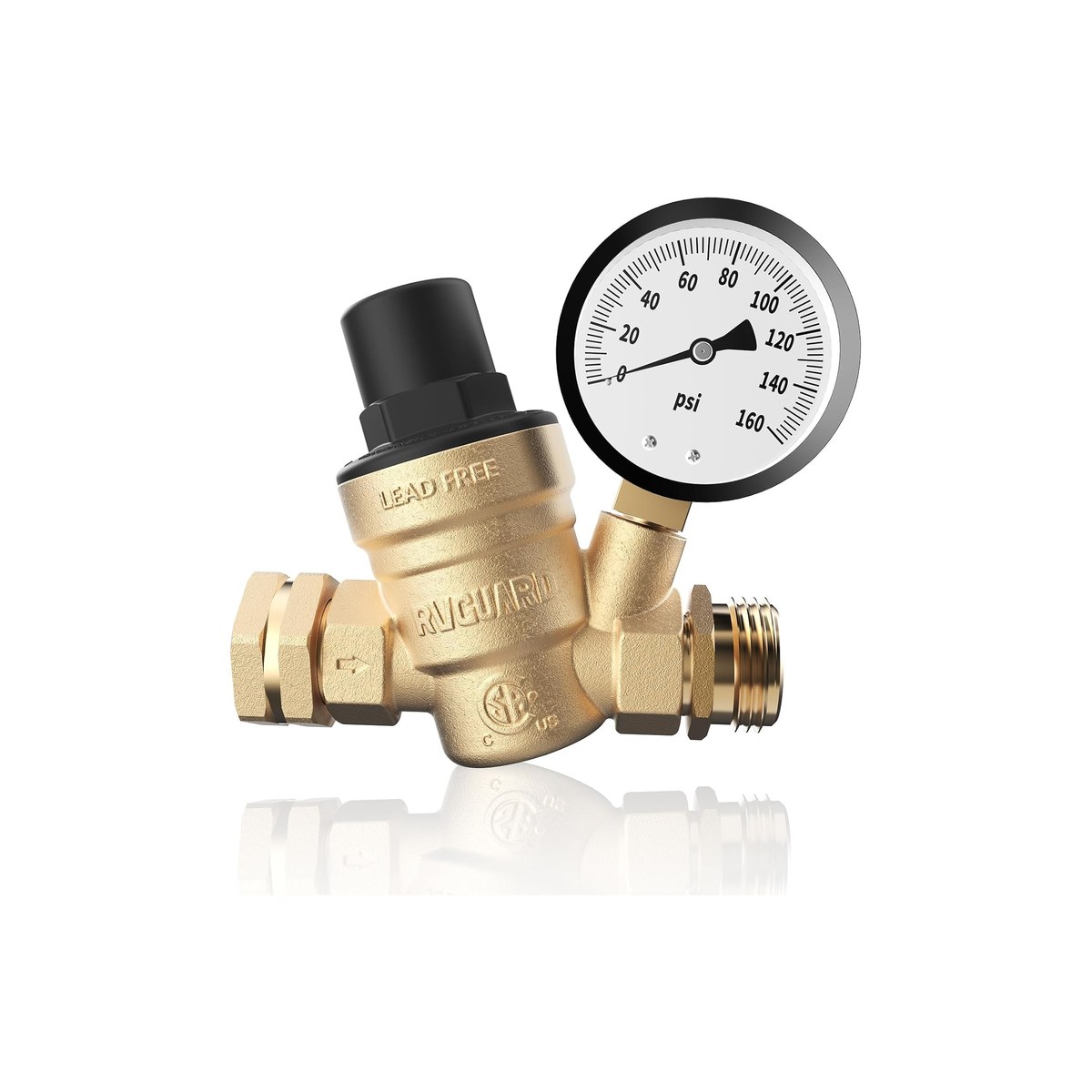
RVGUARD RV Water Pressure Regulator Valve with Gauge and Inlet Screen Filter, Lead-Free Brass, Factory-Set 45 PSI, CSA Approved per Listing (ASIN B083HSQMHX)
The only listing we found claiming NSF/ANSI 61.
Who it's for: The RVer who wants the adjustable-with-gauge setup the category has converged on, set it at the spigot, read the dial, forget it, with the boldest paperwork in the field. RVGUARD's listing is the only one we found claiming both NSF/ANSI 61 and NSF/ANSI 372 for its lead-free brass, and at 4.6 stars across more than 13,000 ratings it is also the best-rated adjustable at scale.
What we found: The RVGUARD ships factory-set at 45 PSI, the industry default, with a gauge, an inlet screen filter, and a screwdriver adjustment, and its certification line reads, quoted exactly: 'Meets NSF/ANSI 61 and NSF/ANSI 372.' That is the brand's own statement, not a certification we confirmed in a public database, but it is the boldest paperwork in a category of bare claims. The honest context: it comes from the same white-label factory ecosystem as the Renator and Kohree, the boilerplate is nearly identical across brands, so you are paying for bolder paperwork and a slightly higher rating, not a different casting. A tool-free knob version exists for about $27 if you would rather not carry a screwdriver.
Bottom line: Buy the RVGUARD, set it between 45 and 50 PSI at the campground spigot, and treat the gauge as a consumable: across every brand in this class, the gauge fogs, sticks, or freezes long before the valve fails. Never chase the dial past 60, whatever the scale reads. If adjusting anything sounds like a chore, the fixed Camco below does the job for $13 with no moving decisions at all.
- + The only listing we found claiming both NSF/ANSI 61 and NSF/ANSI 372 for its lead-free brass, the boldest paperwork claims in the field
- + Factory-set at 45 PSI, the industry default, with a gauge and an inlet screen filter, at 4.6 stars across more than 13,000 ratings
- + A tool-free knob version exists for about $27 if you would rather adjust without a screwdriver
- × Adjustment needs a screwdriver on this version, and the gauge, like every gauge in this class, is the part that fails first
- × It shares a white-label factory ecosystem with the Renator and Kohree, so you are paying for bolder paperwork, not unique hardware
- × Treat any sub-$35 adjustable as a seasons-long purchase, not a decade one
Runner-up: Camco 40055 Brass RV Water Pressure Regulator, Preset 40-50 PSI, CSA Lead-Free Content Certified to NSF/ANSI 372 per Listing (ASIN B003BZD08U).
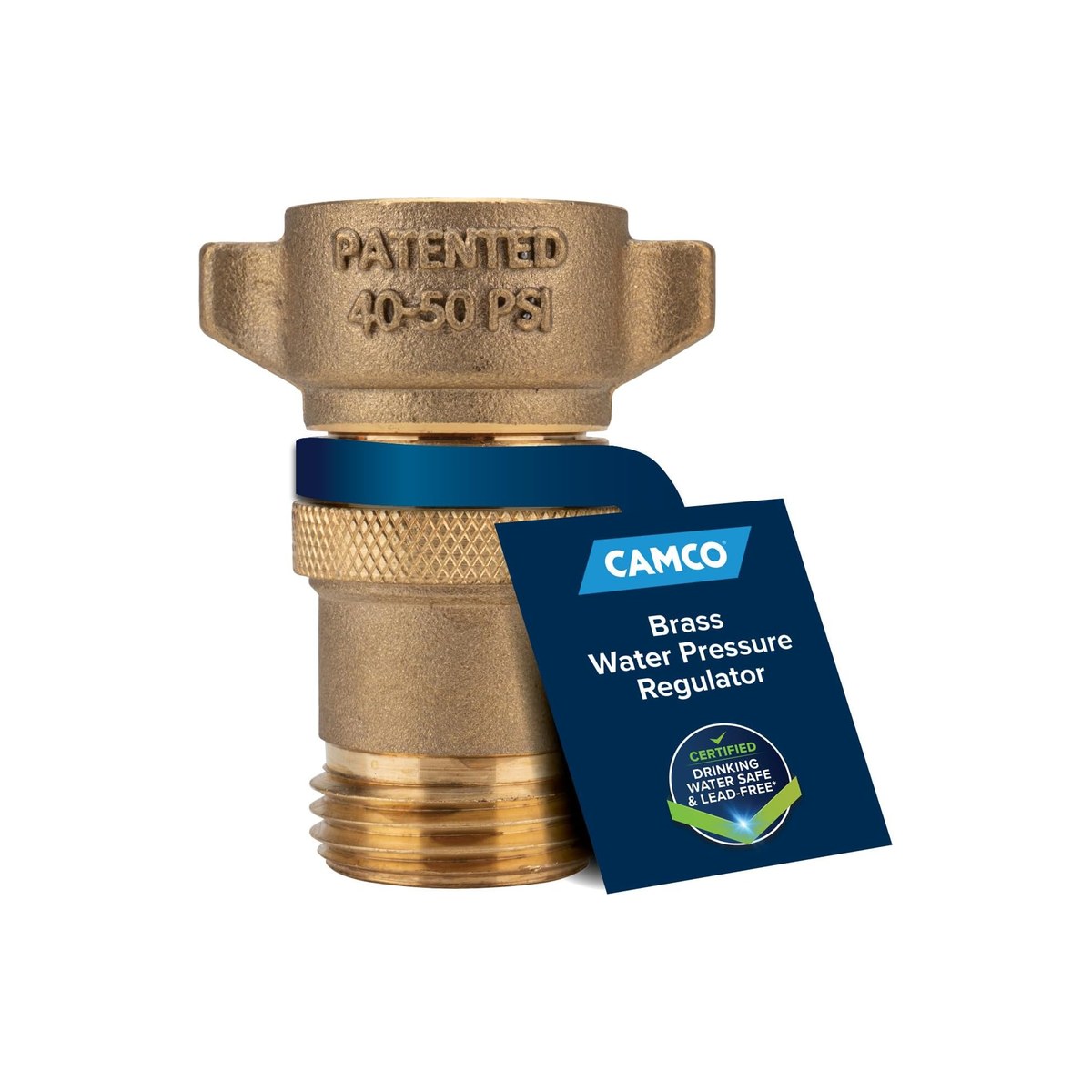
Camco 40055 Brass RV Water Pressure Regulator, Preset 40-50 PSI, CSA Lead-Free Content Certified to NSF/ANSI 372 per Listing (ASIN B003BZD08U)
The $13 fixed default with 23,000 ratings behind it.
Who it's for: The RVer who wants the problem solved for $13 with nothing to set, read, or break. The Camco 40055 is a brass barrel preset to 40-50 PSI: screw it onto the spigot, attach the hose, done. It is the most-reviewed product in the entire category, 4.7 stars across more than 23,000 ratings, and the unit most rigs quietly run for years.
What we found: The 40055 is the category king on every measure that matters for a fixed unit: 4.7 stars at the largest scale in the field, a 125 PSI maximum inlet rating, and the strongest certification language among the fixed picks, quoted exactly: 'CSA lead-free content certified to NSF/ANSI 372.' The trade-offs are inherent to fixed barrels: you cannot see the pressure, you cannot adjust it, and small fixed regulators restrict flow more than adjustables, owner testing on the forums puts barrel-style units around 2 gallons per minute, which is where weak-shower complaints come from on big rigs. For one hookup at a time, it simply works.
Bottom line: Buy the 40055 if you want the cheap, proven, zero-thought answer, and keep one in the wet bay even if you run something fancier, because a $13 spare regulator has saved more weekends than most upgrades. Step up to the 40064 to add a gauge, or to the RVGUARD if you want to set the pressure yourself. Skip nothing else about it: at this price it is the easiest yes in the guide.
- + 4.7 stars across more than 23,000 ratings, the most-reviewed regulator in the category by a wide margin, at $13
- + Preset to 40-50 PSI with a 125 PSI maximum inlet rating, so there is nothing to set and nothing to set wrong
- + The strongest fixed-pick certification language: 'CSA lead-free content certified to NSF/ANSI 372' per the listing
- × No gauge and no adjustment: you cannot see incoming pressure or tune the output
- × Small fixed barrels restrict flow more than adjustables, the source of weak-shower complaints on bigger rigs
- × Like any spigot-end regulator, easy to forget at the campsite and easy for someone to walk off with
Budget pick: Camco 40064 Brass RV Water Pressure Regulator with Color-Coded Gauge, Preset 40-50 PSI, CSA Lead-Free Content Certified to NSF/ANSI 372 per Listing (ASIN B000EDQQD8).
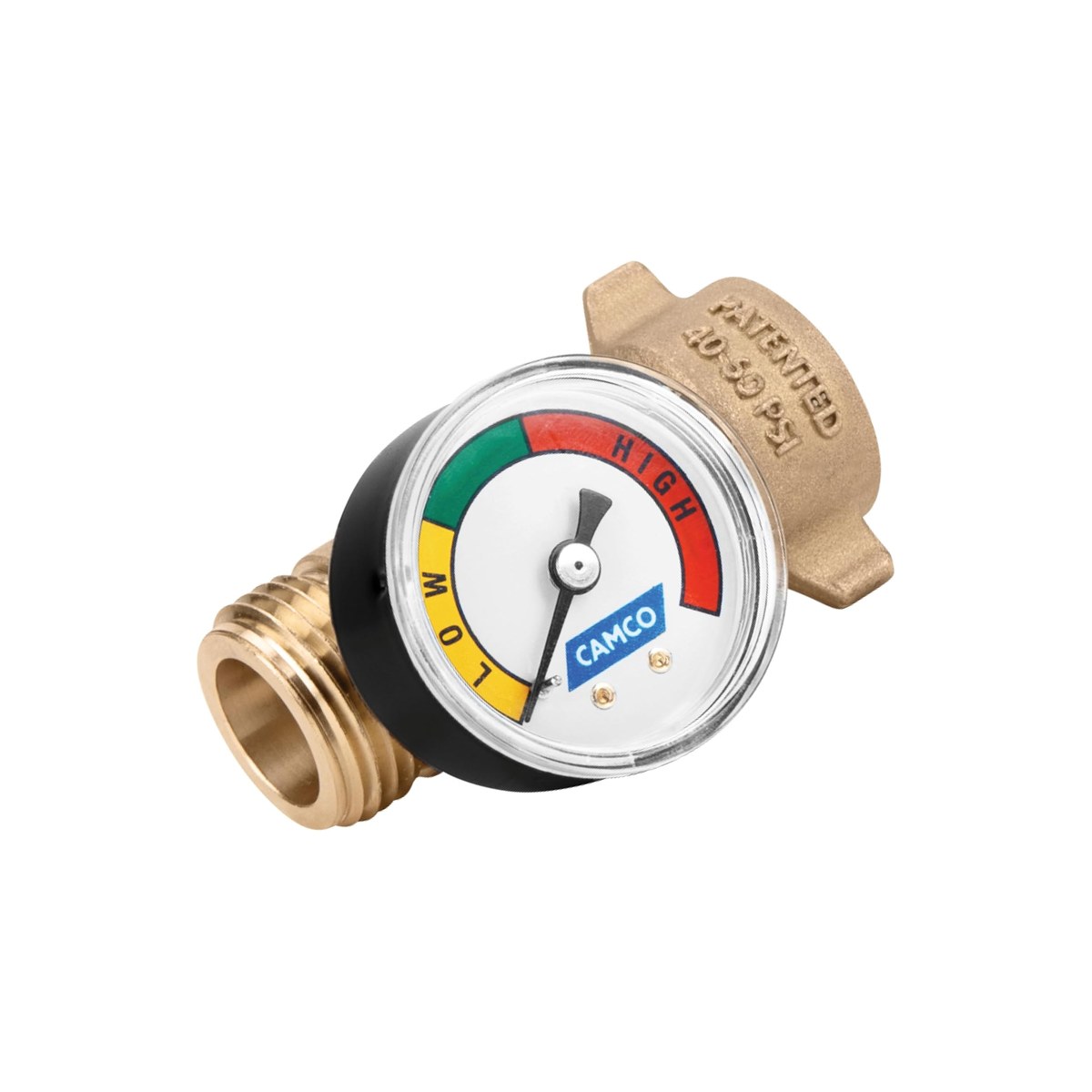
Camco 40064 Brass RV Water Pressure Regulator with Color-Coded Gauge, Preset 40-50 PSI, CSA Lead-Free Content Certified to NSF/ANSI 372 per Listing (ASIN B000EDQQD8)
Fixed simplicity, plus a gauge that keeps pressure visible.
Who it's for: The fixed-regulator buyer who still wants to see what the water system is doing. The 40064 is the same preset 40-50 PSI Camco brass, with an easy-read, color-coded gauge on top, so you can glance at the reading at every hookup without taking on an adjustment screw. It suits the RVer who has heard the horror stories and wants visibility, not controls, for about $25.
What we found: The 40064 carries the identical certification line as the 40055, 'CSA lead-free content certified to NSF/ANSI 372,' the same 40-50 preset and 125 PSI maximum inlet, and adds the color-coded gauge, at 4.6 stars across more than 4,000 ratings for about $25. The gauge earns its $12 premium by making change visible: a reading that wanders from what you normally see is your cue to investigate, and a dead-zero reading on a fully open, flowing hookup tells you the gauge itself died first, the most common ending for gauges across every brand here.
Bottom line: Choose the 40064 when you want fixed-regulator simplicity with eyes on the system, the $12 over the bare barrel buys early warning, not control. It is the right middle step for owners who do not want to set anything but have read enough failure stories to want a dial. If you find yourself wishing you could act on what the gauge shows, that is the sign you wanted the RVGUARD all along.
- + The same preset 40-50 PSI Camco brass and the same 'CSA lead-free content certified to NSF/ANSI 372' listing language, plus a color-coded gauge
- + The gauge makes trouble visible: a reading that wanders from what you normally see means something changed, and a dead-zero reading on a fully open, flowing hookup means the gauge died
- + 4.6 stars across more than 4,000 ratings at about $25
- × Still fixed: when the gauge shows something you do not like, you cannot adjust your way out of it
- × The gauge itself is the most failure-prone part in this whole category, across every brand
- × Costs double the bare 40055 for visibility alone
Also worth considering.
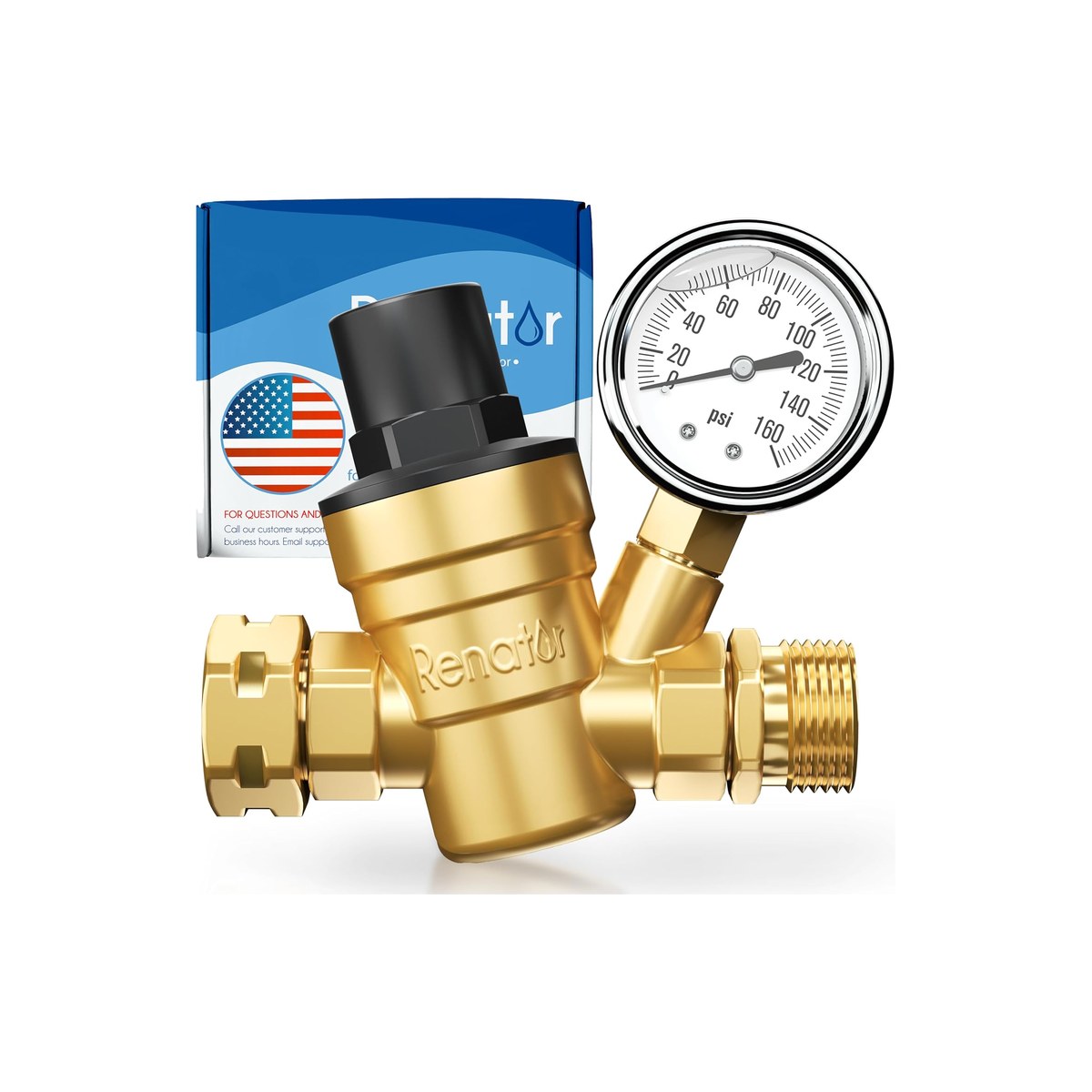
Renator M11-0660R RV Water Pressure Regulator, Brass, Adjustable with Oil-Filled Gauge and Inlet Screen, Factory-Set 45 PSI (ASIN B01N7JZTYX)
The most-reviewed adjustable, with its cert claim read honestly.
Who it's for: The buyer who weighs review depth above all else. The Renator M11-0660R is the most-reviewed adjustable in the category, 4.5 stars across nearly 17,000 ratings, with the oil-filled gauge, inlet screen, and 45 PSI factory preset that define the class. It suits the RVer who wants the crowd-validated pick and is comfortable reading a certification claim for what it is.
What we found: The Renator earns its volume: years as the category leader, a liquid-filled gauge that damps needle flutter, and a $29 price. Two honest readings, though. Its lead-free line, 'tested to contain less than .13% lead,' is a content claim with no certifying body named, more modest paperwork than the RVGUARD's, and the 'adjustable up to 160 PSI' on the listing is the gauge scale talking, not an invitation: every manufacturer that states a limit puts the ceiling at 60. Owners also document the gauge's oil bubbles, Renator publishes a venting procedure for it, and heavy users report replacing these units rather than repairing them.
Bottom line: The Renator is a fine buy at $29 and the safest-feeling choice by sheer review count, just buy it knowing what the paperwork says and does not say. We rank the RVGUARD ahead on the certification language alone, since the hardware appears to share an upstream factory. Either way, treat any sub-$35 adjustable as a seasons-long purchase, not a decade one, and let the gauge tell you when.
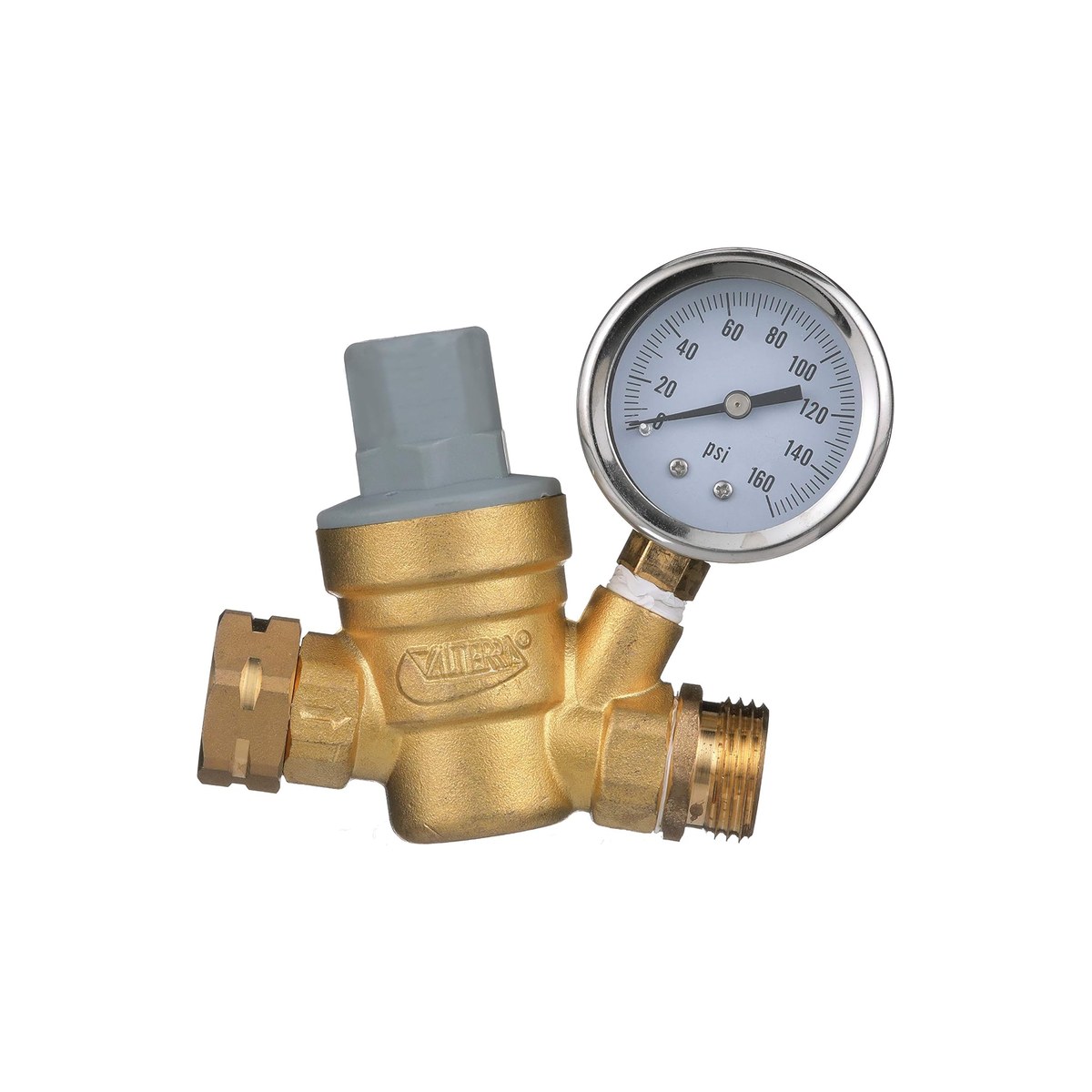
Valterra A01-1117VP Lead-Free Brass Adjustable Water Regulator with Pressure Gauge, High-Flow, Maximum Operating Pressure 60 PSI (ASIN B003YJLAIK)
The high-flow step-up when budget regulators choke the shower.
Who it's for: The bigger rig where a barrel regulator turns the shower into a trickle. Small fixed regulators cut flow as part of cutting pressure, and the documented owner fix is a high-flow adjustable like the Valterra A01-1117VP, the unit forums name when the complaint is water volume, not water pressure. It suits full-hookup travelers willing to pay roughly $80 to make the problem go away.
What we found: The Valterra is the established high-flow adjustable: a gauge, a 15 to 65 PSI adjustment band per retailer specs, a 'maximum operating pressure 60 psi' line in its own table, and long-term owners who describe rebuilding rather than replacing it. The honest catches scale with the price. At $80.17 verified it costs six Camco barrels, its listing names no certification standard at all, just 'lead-free brass design' conforming with federal and state laws, and stock was thin when we checked, ten units left. The flow improvement is the entire purchase case: if your showers are fine, this is $50 of solution you do not need.
Bottom line: Buy the Valterra when flow is the problem you are solving, a big rig, long hose runs, a family showering on full hookups, and you want a regulator built to be serviced. Skip it if a $13 barrel keeps everyone happy, and know the true endgame for flow obsessives is a whole-house unit like the Watts LF263A from a plumbing supplier, which has no credible Amazon listing and sits past the point of diminishing returns for most rigs.
Skip this guide if...
Skip this guide if you never connect to city water: a rig that fills its fresh tank and runs entirely on the 12-volt pump regulates its own pressure, and a regulator only matters on the hose between a spigot and your inlet. Skip it too if your rig has a quality regulator built into the city-water inlet and the manual says so, though a $13 external barrel still protects the hose and filter the built-in cannot reach. Everyone else hooking up to campground water is the audience: this is the cheapest protection in RVing, and the question is only which kind.
Don't bother with.
- × Skip Running without a regulator, or removing it for better shower pressureThe trickle-shower complaint is real, small fixed barrels do restrict flow, but the fix is a high-flow regulator, not naked plumbing. Campground pressure varies spigot to spigot with no one monitoring it, owner threads document hookups measured at 110 and 120 PSI with immediate leaks, and some parks post signs requiring regulators at check-in. Your plumbing's weak points are the plastic fittings and appliance connections, and one over-pressurized afternoon can cost more than every regulator in this guide combined. Clean the regulator's own inlet screen first, free and often enough, then solve flow with the Valterra, never with removal.
- × Skip Trusting 'adjustable up to 160 PSI' marketingThe 160 number on adjustable listings is the gauge's dial scale, not a sane setting. The manufacturers that put a limit in writing agree: Camco's listing says 'settings above 60-psi are not recommended,' and Valterra's spec table lists a maximum operating pressure of 60 PSI with the same warning in its description. The factory preset across the category is 45 for a reason. If you find yourself winding a regulator past 60 to fix weak water, the problem is flow restriction, which is a different purchase, not more pressure.
- × Skip Assuming the big-brand adjustable comes with a gaugeWe verified the Camco 40058, the brand's adjustable regulator, and its listing mentions no gauge anywhere: you set it with a screwdriver and trust the spring. Plenty of buyers assume adjustable means adjustable-with-gauge because the category's bestsellers bundle them. Check what is actually in the box: if you want Camco and a gauge, the fixed 40064 has one; if you want adjustable and a gauge, the RVGUARD, Renator, and Valterra all include theirs. An adjustable you cannot read is a guess with threads.
- × Skip The clone listings riding the bestsellers' coattailsThis category is a white-label ecosystem: the leading adjustables share near-identical hardware and boilerplate, and at least one clone brand copied a competitor's product title verbatim, down to the punctuation, and now ranks on the first page. With the castings this similar, the differences you can actually buy are the certification language and the seller behind it, which is why our top pick is the unit whose listing claims NSF/ANSI 61 and 372 by name. When two regulators look identical, read the paperwork line, not the star rating.
- × Skip Leaving the regulator on the spigot through a freeze, or all seasonGauges are the first casualty in this category, and a freezing night is the classic killer: owners report cracked gauges after a single cold snap, because the gauge and valve body hold water. Spigot-end regulators also walk away at campgrounds, they are the easiest thing on your site to pocket. Bring the regulator inside when temperatures drop, drain it for storage, and keep a $13 fixed barrel as the spare so a dead gauge never decides whether you hook up.
How we picked.
Sources we read and how we picked
We read the manufacturer guidance, Camco's and Valterra's own pressure warnings, Winnebago's published recommendation, Renator's FAQ, the owner forums where burst fittings and trickle showers get diagnosed, and the certification fine print on every listing, then verified each price, rating, and claim live on Amazon on June 12, 2026. Certification language in this guide is quoted exactly as the listings state it, because in this category the difference between 'certified to' and 'tested to contain' is the whole story.
Our filter, in order: the lead-free paperwork as written, then rating at scale, then the pressure and flow honesty. One transparency note: the leading adjustables, RVGUARD, Renator, Kohree, and several clones, share a white-label factory ecosystem with nearly identical hardware and boilerplate, so we ranked on the things that genuinely differ, the certification claims as written and the review depth, rather than pretending the castings differ. The fixed picks are both Camco because the 40055 is the most-reviewed unit in the category and nothing else in the fixed lane comes close.
What pressure to set, per the manufacturers
The numbers that matter come from the people who make the equipment. Camco presets its adjustable at 45 PSI and prints 'settings above 60-psi are not recommended' on the listing; Valterra presets at 45, lists a maximum operating pressure of 60 PSI, and adds 'check your RV manual'; Winnebago's published guidance recommends regulators that control pressure to 50 PSI maximum. That convergence is the rule of this guide: set 45 to 50, never above 60, and stay at the low end on an older rig or any plumbing history you do not know.
Why it matters is the supply side: nobody regulates the spigot. Municipal systems can run far higher than any rig tolerates, owner threads document campground hookups measured at 110 and 120 PSI with plumbing leaking the same afternoon, and pressure varies spigot to spigot. There is no systematic survey of campground pressure, which is exactly the point: you cannot know what a given pedestal delivers, so the regulator is not optional equipment, it is the assumption your plumbing was built on. The PEX tubing itself is rated well beyond these numbers; the plastic fittings, clamps, and appliance connections it feeds are not.
Fixed barrel versus adjustable with gauge
The fixed barrel is the category's honest workhorse: preset to 40-50 PSI, brass, around $13, nothing to set and nothing to misread. Its known cost is flow. Cutting pressure in a small barrel also throttles volume, and owner testing on the forums puts barrel-style units around 2 gallons per minute, drifting lower over time, which is why the weak-shower complaint follows fixed regulators around big rigs. For a small trailer or a single-bathroom rig, that trade is usually invisible. For a family on full hookups, it is the reason the adjustable tier exists.
Adjustables add a spring you can set and, on every good one, a gauge to verify it, factory-set at 45 across the category. The gauge is also the honest weak point: across every brand, oil-filled gauges fog, bubble, stick at zero, and crack in freezes long before the valve wears out, and pressure creep, a cheap regulator drifting upward over time, is the documented failure mode where the safety device becomes the hazard. That is why a gauge matters even on a fixed unit, why we treat sub-$35 adjustables as seasons-long purchases, and why the high-flow Valterra, built to be serviced, is the step-up rather than just a bigger spring.
Reading the lead-free fine print: 372 versus 61
Every regulator in this category says lead-free; almost none of them mean the same thing by it. NSF/ANSI 372 is a lead-content standard, it caps the weighted average lead in wetted surfaces at 0.25 percent, while NSF/ANSI 61 is the broader drinking-water standard covering what a component may leach into the water it touches. The category's actual claims, quoted from the listings: the RVGUARD says 'Meets NSF/ANSI 61 and NSF/ANSI 372,' the only 61 claim we found, with 'CSA Approved' in its title; Camco's units are 'CSA lead-free content certified to NSF/ANSI 372,' the only third-party-certified claim in this guide; the Renator states a lead-test result, 'tested to contain less than .13% lead,' with no certifying body named, and Kohree's near-identical boilerplate makes the same tested-content claim; the Valterra says only 'lead-free brass' with no standard at all.
Read those as four tiers: a third-party certification with a named body, which in this guide only Camco carries; a self-declared claim that names standards, the RVGUARD's 'Meets' sentence is the brand's own statement, and we could not independently confirm it against NSF's or CSA's public certification databases; a content claim you are trusting the factory on; and a bare marketing adjective. None of this means the cheaper units are dangerous, brass plumbing components sold in the US must comply with federal lead-free law regardless, but when the hardware is this similar across brands, the paperwork is the difference you can actually read and compare. It is the reason the RVGUARD edges out an otherwise near-identical Renator here, and the comparison worth making in any white-label category: when the castings match, buy the better-documented one.
Where it goes, the filter question, and how long it lasts
Put the regulator on the spigot, first in line, so it protects everything downstream: the hose, the inline filter, and the rig. That order, regulator at the pedestal, then the filter, then the hose to your inlet, is the one Renator's own FAQ and Camping World's hookup guides both teach, and it means a pressure spike meets brass before it meets anything plastic. The counterpoint some owners argue, mounting at the rig's inlet to deter theft, trades hose protection for security; if walk-off worries you, a locking cable costs less than the hose the regulator is no longer protecting.
On lifespan, the pattern across thousands of reviews is consistent: the gauge dies first, fogged, stuck at zero, or frozen and cracked, while the valve body soldiers on. Owners report budget adjustables lasting seasons rather than decades, one documented owner went through three in a year, and the failure that actually threatens your plumbing is silent creep, which only a gauge reveals. The practical regimen: glance at the gauge each hookup, bring the regulator inside for freezes, drain it for storage, replace it when the reading wanders, and keep a $13 fixed barrel in the wet bay so a dead gauge never strands you unprotected.
FAQs.
Q01 What is the best RV water pressure regulator?
+
Q02 What PSI should an RV water pressure regulator be set at?
+
Q03 Do you really need a water pressure regulator for an RV?
+
Q04 Does the regulator go before or after the water filter?
+
Q05 Why is my shower weak with a pressure regulator on?
+
Q06 What does lead-free actually mean on these regulators?
+
Q07 How long does an RV water pressure regulator last?
+
If you, then this.
- IF you want the adjustable-with-gauge default with the strongest paperworkGET RVGUARD Adjustable with Gauge (B083HSQMHX; the only NSF/ANSI 61 claim we found, factory-set 45 PSI)$29.99 →
- IF you want it solved for $13 with nothing to set or breakGET Camco 40055 (B003BZD08U; preset 40-50 PSI, 23,000+ ratings, the category king)$12.62 →
- IF you want fixed simplicity but eyes on the pressureGET Camco 40064 (B000EDQQD8; same preset brass plus a color-coded gauge)$25.14 →
- IF you want the adjustable with the deepest review historyGET Renator M11-0660R (B01N7JZTYX; nearly 17,000 ratings, oil-filled gauge, content-claim paperwork)$28.88 →
- IF your shower is a trickle on full hookups and you want flow backGET Valterra A01-1117VP (B003YJLAIK; the high-flow adjustable, 60 PSI max operating), after cleaning your inlet screen first, free and often enough$80.17 →
- IF you are storing the rig or expecting a freezeGET bring the regulator inside and drain it, gauges crack in one cold night; keep a $13 Camco 40055 as the wet-bay spare$12.62 →
RV & Van Gear: The Complete Guide
The whole-rig picture →Every system in a van, RV, or camper, organized in one place, with the safety and weight floor and the one guide we trust for each.
- Does your RV really need a water pressure regulator? · TheRVgeeks
- Water pressure regulator round-up (50 PSI guidance) · Winnebago
- RV water pressure regulator: commonly asked questions · Renator
- How to hook up an RV water filter and pressure regulator · Camping World