Best RV Water Heaters: 5 Tank and Tankless Picks That Fit Your Cutout (2026)
An RV water heater is either a tank, six gallons heated and reheated by a 12,000 BTU burner, or a tankless unit that heats water as it flows and never runs out. The fork is real: a tank buys recovery and simplicity, a tankless buys endless showers with a minimum-flow catch, and the temp-rise physics, BTU divided by flow times 500, decides whether either one actually feels hot in January. We read the manufacturer datasheets and manuals, the Suburban spec sheet and service manual, Girard's owner's manual, then verified every listing live on Amazon on June 12, 2026. The honest headlines: max-GPM claims are summer numbers, altitude ratings differ by 5,300 feet between brands, and a dripping relief valve, the classic water-heater panic, is usually normal thermal expansion doing its job.
- 01 Suburban SW6DE Advantage (B01MY7FHKM) , top pick, the gas and electric tank default, anode-protected steel, ~$500
- 02 Fogatti InstaShower 8 Plus (B091F7HGPK) , the tankless retrofit, door included, three size choices, ~$513
- 03 Girard GSWH-2 (B019BWN8E2) , the OEM-grade tankless, most-reviewed installed tankless we verified, ~$782
- 04 Ranein Gen II 65,000 BTU (B0D7GKVWT9) , budget tankless, the biggest burner here, eyes open, $399
- 05 Dometic WH-6GEA (B08LW5JXKP) , the Atwood-cutout tank, aluminum, no anode ever, ~$500 at our re-check
How they compare.
| Rank | Product | Best for | Price | Our score |
|---|---|---|---|---|
| 01 | Suburban SW6DE Advantage (B01MY7FHKM)
Top Pick
| best overall, the datasheet-anchored tank default with real parts support | $499.99
Buy → | 9.0/10 |
| 02 | Fogatti InstaShower 8 Plus (B091F7HGPK) | the tankless retrofit, exterior door included in three sizes | $512.99
Buy → | 8.7/10 |
| 03 | Girard GSWH-2 (B019BWN8E2) | the OEM-grade tankless, deepest manual and review base in the lane | $781.99
Buy → | 8.6/10 |
| 04 | Ranein Gen II 65,000 BTU (B0D7GKVWT9) | budget tankless, the biggest burner on the page, bought eyes open | $399.00
Buy → | 8.4/10 |
| 05 | Dometic WH-6GEA (B08LW5JXKP) | the Atwood-cutout tank, aluminum liner, no anode rod ever, price swings on this listing | $500.00
Buy → | 8.3/10 |
Prices are current Amazon prices at time of publication and can change. Scores reflect our editorial evaluation, not vendor input.
Our #1 pick: Suburban SW6DE Advantage 6 Gallon RV Water Heater, Gas and Electric, Direct Spark Ignition, Porcelain-Lined Steel Tank with Anode Rod, 12,000 BTU (5239A) (ASIN B01MY7FHKM).
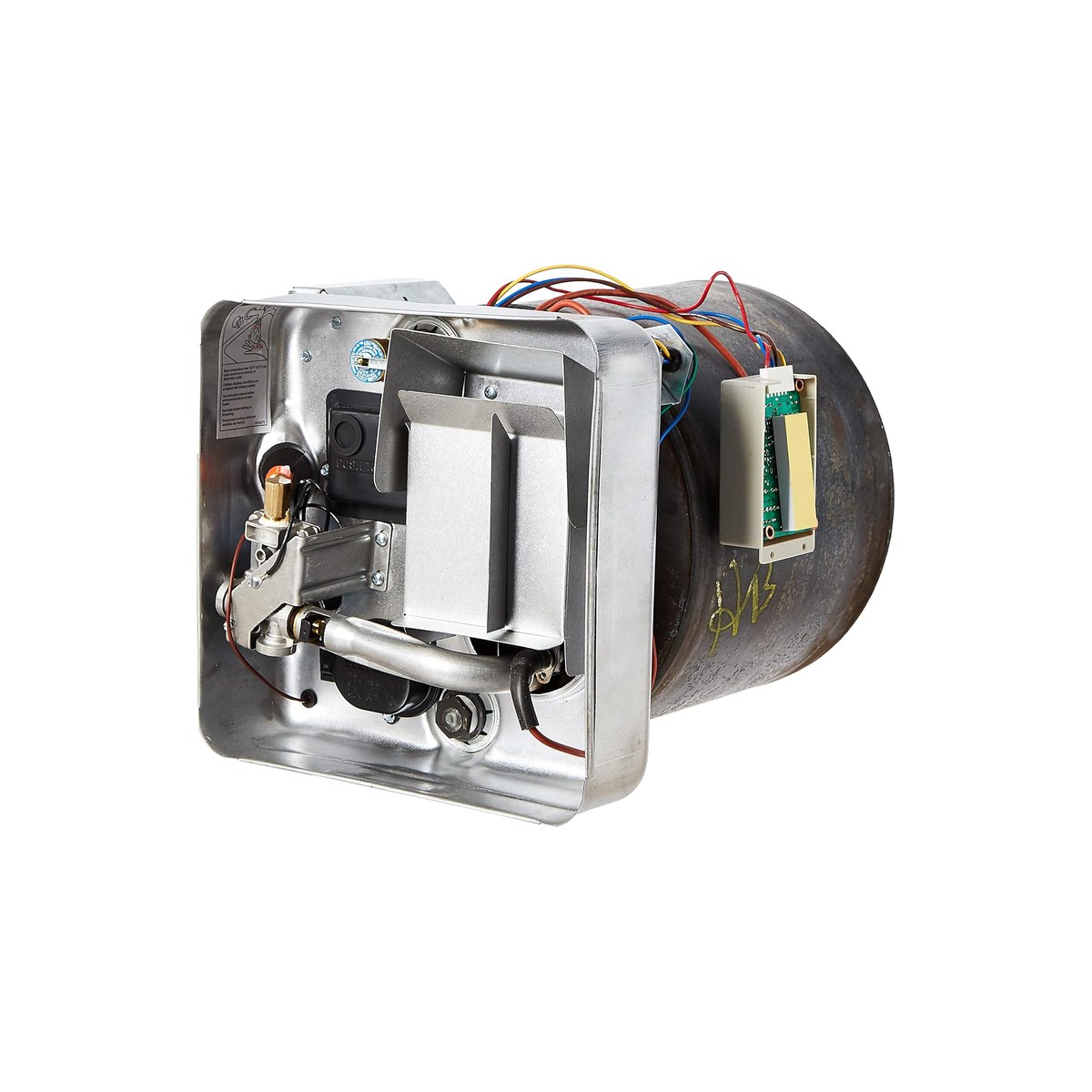
Suburban SW6DE Advantage 6 Gallon RV Water Heater, Gas and Electric, Direct Spark Ignition, Porcelain-Lined Steel Tank with Anode Rod, 12,000 BTU (5239A) (ASIN B01MY7FHKM)
The spec-anchor tank, datasheet numbers and a yearly anode.
Who it's for: The owner replacing a tired tank heater with the default the spec sheets orbit. The Suburban SW6DE is a 6 gallon gas and electric tank, DSI ignition with no pilot to babysit, a porcelain-lined steel tank with a replaceable anode rod, and the deepest manual and parts trail in this guide, which is what you want bolted to a rig you plan to keep.
What we found: Suburban's datasheet does the talking: 12,000 BTU recovering 10.1 gallons per hour on gas, a 1,440 watt element adding 6.1 GPH on shore power, and both can run at once, the 16.2 figure listings quote is arithmetic, not a Suburban spec. The cutout is 12.75 by 12.75 by 19.19 inches. Two flags from the live listing: the price is $499.99 with 4.6 stars across 3,336 ratings, and no exterior door ships in the box, Suburban sells doors as accessories, so a new install needs one while a straight replacement reuses the old door.
Bottom line: Buy the SW6DE as the default it is, and treat the anode rod as the deal you signed: pull it with a 1-1/16 inch socket once a year, replace it past 75 percent consumed, and the steel tank stays protected. Run the element on hookups, the burner when you need speed, and never energize that element with the tank empty, dry-firing it is the classic spring casualty and the warranty does not cover it.
- + Gas and electric together: 12,000 BTU at 10.1 gallons per hour recovery, plus a 1,440 watt element adding 6.1 GPH, both rates straight from Suburban's datasheet
- + Porcelain-lined steel tank protected by a replaceable anode rod that doubles as the drain plug, a 1-1/16 inch socket is the whole service kit
- + 4.6 stars across more than 3,300 ratings, sold under the Suburban brand by an RV parts dealer, with a published manual and parts ecosystem
- × No exterior door in the box, doors are accessories per Suburban's own spec sheet, fine for replacements that reuse the old door, a separate purchase for new installs
- × Six gallons is a buffer, not endless: about two quick showers, then the recovery wait
- × The steel tank's anode is a real yearly chore, and skipping it voids Suburban's warranty per the manual
Runner-up: Fogatti InstaShower 8 Plus RV Tankless Water Heater, Gen 3, 55,000 BTU, 12V DC, Three Door Size Options 15x15, 15x18, and 18x18 Inches (ASIN B091F7HGPK).
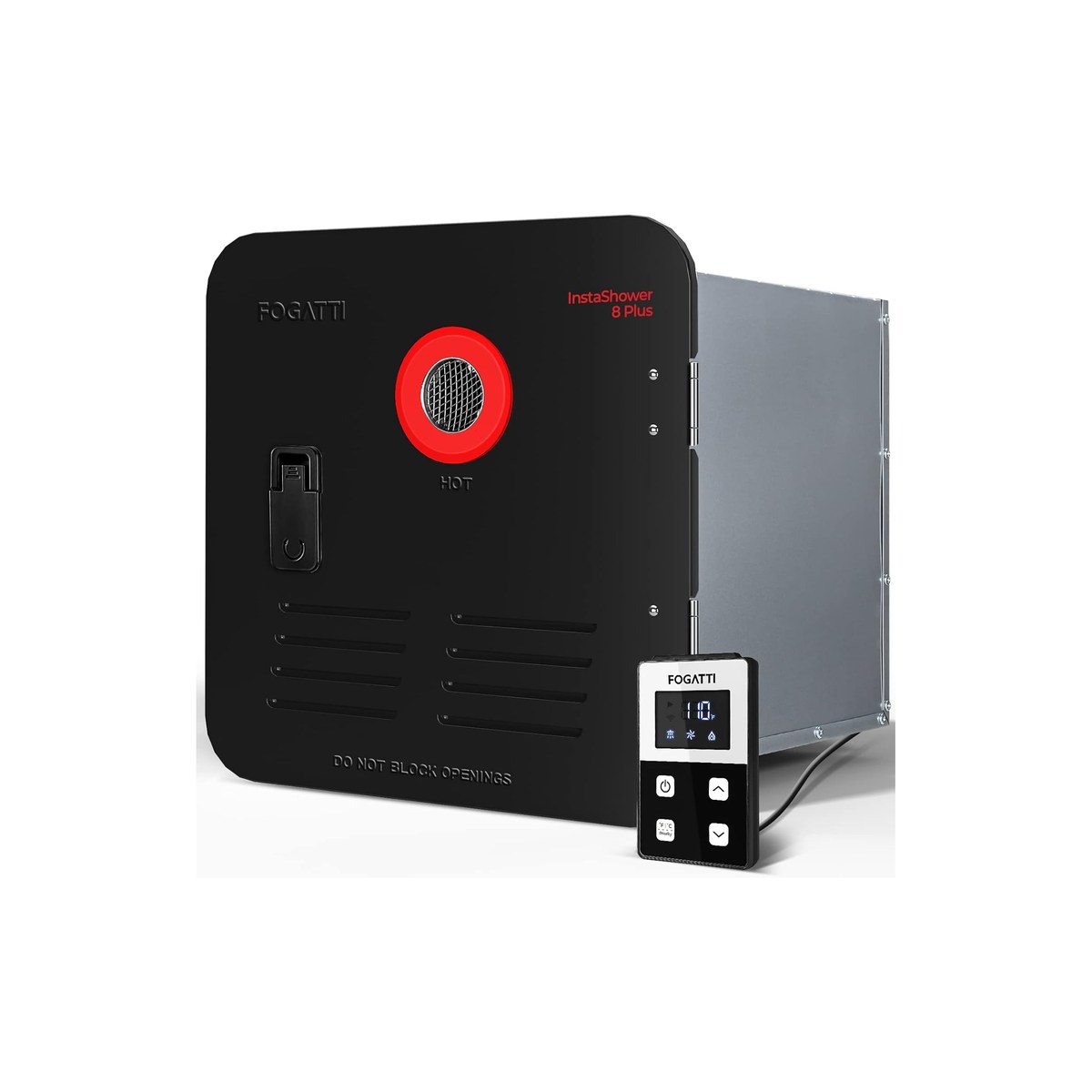
Fogatti InstaShower 8 Plus RV Tankless Water Heater, Gen 3, 55,000 BTU, 12V DC, Three Door Size Options 15x15, 15x18, and 18x18 Inches (ASIN B091F7HGPK)
Endless hot water, with the retrofit door already in the box.
Who it's for: The owner converting a tank cutout to endless hot water without a fabrication project. The InstaShower 8 Plus is the retrofit-first tankless: the exterior door comes in the box in your choice of three sizes covering most Suburban, Atwood, and Dometic tank openings, so the swap is plumbing and gas work, not bodywork. It suits the family rig where the recovery wait is the daily complaint.
What we found: 55,000 BTU on demand with temperature control from 95 to 123 degrees, 12 volt ignition, and a listed high-altitude mode to 9,800 feet, Fogatti's marketing claim, not a tested standard. The physics worth knowing before you buy any tankless: temperature rise is BTU divided by flow times 500, so 55,000 BTU lifts 1.5 GPM about 73 degrees but 2.9 GPM only about 38, before efficiency losses, which is why max-flow numbers feel hot in July and lukewarm in October. At $512.99 with 4.3 stars across 970 ratings, it is the value path to endless hot water, sold by a third party under the Fogatti brand byline.
Bottom line: Buy the 8 Plus when the recovery wait, not the propane bill, is the problem you are solving, and set expectations with the physics, not the marketing: showers are endless at moderate flow, and winter inlet water trims the max. Confirm the door size matches your cutout before ordering, and check the box on arrival. For navy-shower boondockers who shut water off between rinses, read the sandwich note first.
- + The door is in the box in your choice of three sizes: 15x15 for 4 and 6 gallon cutouts, 15x18 for 6 gallon, and 18x18 for the 10-to-16 gallon class, per Fogatti
- + 55,000 BTU with temperature control from 95 to 123 degrees, a listed high-altitude mode to 9,800 feet, Fogatti's claim, and 12 volt ignition
- + 4.3 stars across 970 ratings under the Fogatti brand, the proven mid-priced path to endless hot water
- × Tankless physics still applies: at 55,000 BTU, high flow plus cold inlet water means warm, not hot, the max-GPM number is a summer number
- × Like every flow-triggered tankless, shutting water off mid-shower restarts the cold-water sandwich
- × Like our tank picks it ships from a third-party seller; the listing merges door-size variants, so confirm the box matches the door size you ordered
Budget pick: Girard GSWH-2 Tankless RV Water Heater, 42,000 BTU, 12V, Onboard Microprocessor, Digital Control Panel, Freeze Protection, Lippert 2022107534 (ASIN B019BWN8E2).
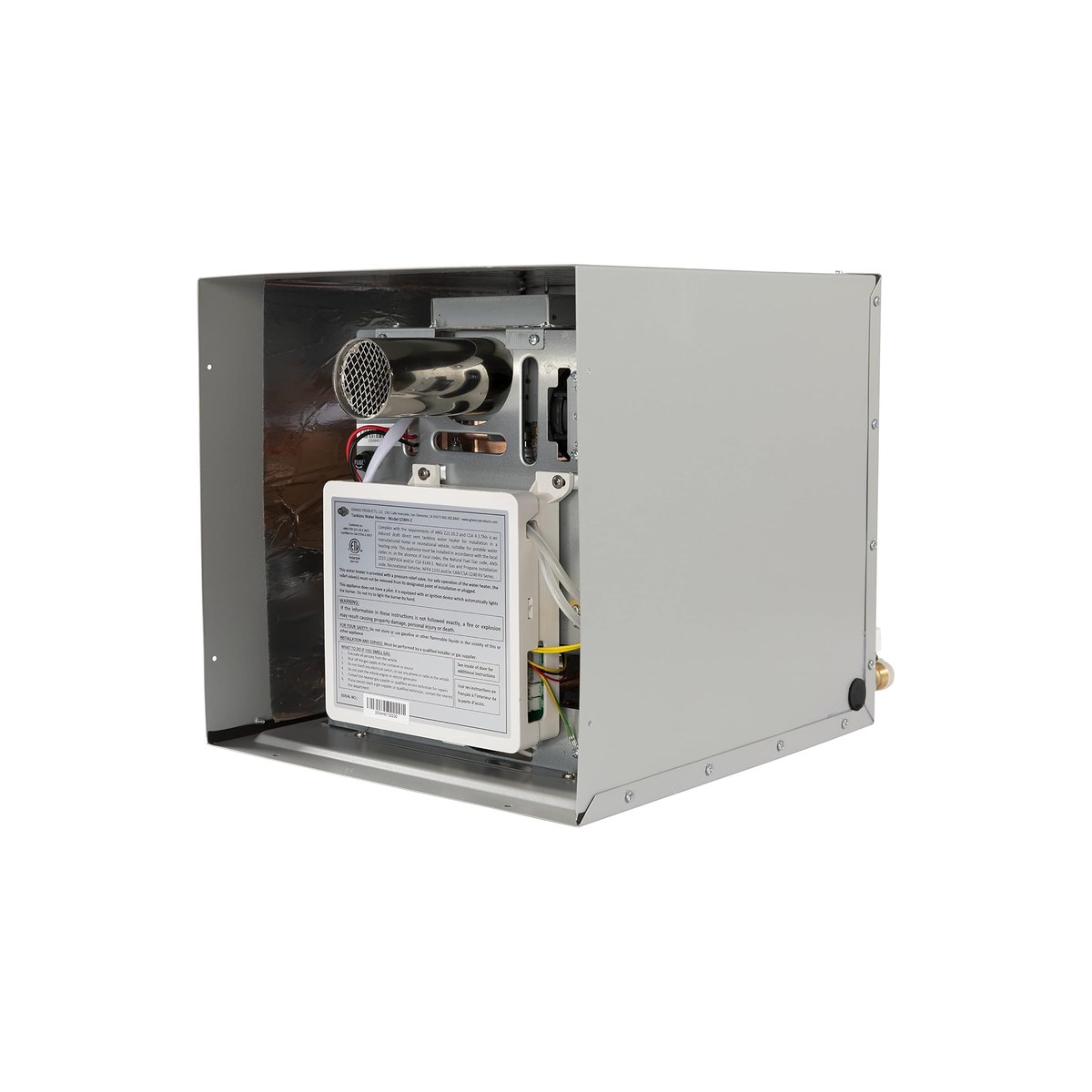
Girard GSWH-2 Tankless RV Water Heater, 42,000 BTU, 12V, Onboard Microprocessor, Digital Control Panel, Freeze Protection, Lippert 2022107534 (ASIN B019BWN8E2)
The documented tankless, with the manual the others don't write.
Who it's for: The buyer who wants endless hot water with OEM-grade paper behind it. The Girard GSWH-2 is the OEM-lineage unit here: Lippert-owned, microprocessor-controlled, with a digital control panel, and the only manual among our tankless picks that states its own minimum flow instead of leaving you to discover it. It suits the owner who reads documentation before drilling holes in a rig.
What we found: The documentation is the story: minimum flow actually stated in writing, 0.80 GPM plus or minus 10 percent at the control board per the technical manual, 0.60 in the newest owner's revision, plan around the higher number, temperature adjustable 95 to 124 degrees with 115 the factory recommendation, and a freeze-protection thermostat that fires the burner below 38 degrees and shuts off at 58, drawing propane and 12 volts to do it. The burner is an honest 42,000 BTU, about a 56 degree raw rise at 1.5 GPM, sized for one shower. On the live listing it is $781.99 at 4.3 stars across 1,583 ratings, the most-reviewed installed tankless we verified.
Bottom line: Choose the Girard when you want tankless with the strongest paper trail on the page and a freeze function you can trust to the letter of its manual, propane and 12 volts permitting. Respect the minimum flow: pair it with a shower head that keeps the trigger threshold flowing, run it at the scald-safer 115 degree factory setting, and descale it annually like every tankless. Step down to the Ranein if $782 buys too much documentation.
- + The most-reviewed installed tankless we verified, 4.3 stars across more than 1,500 ratings, under the Girard brand
- + The strongest documentation among our tankless picks: minimum flow stated in writing, 0.80 GPM plus or minus 10 percent at the control board, 0.60 in the newest owner's revision
- + Built-in freeze protection fires the burner below 38 degrees and shuts off at 58, per the manual, it needs propane and 12 volt power to do it
- × 42,000 BTU is the honest small burner of the lane: about a 56 degree raw rise at 1.5 GPM, one warm shower at a time, not two fixtures
- × At $781.99 it costs nearly two Raneins, you are paying for documentation, support, and the OEM pedigree
- × The minimum-flow discipline is real: trickle flows below the sensing threshold will not keep the burner lit
Also worth considering.
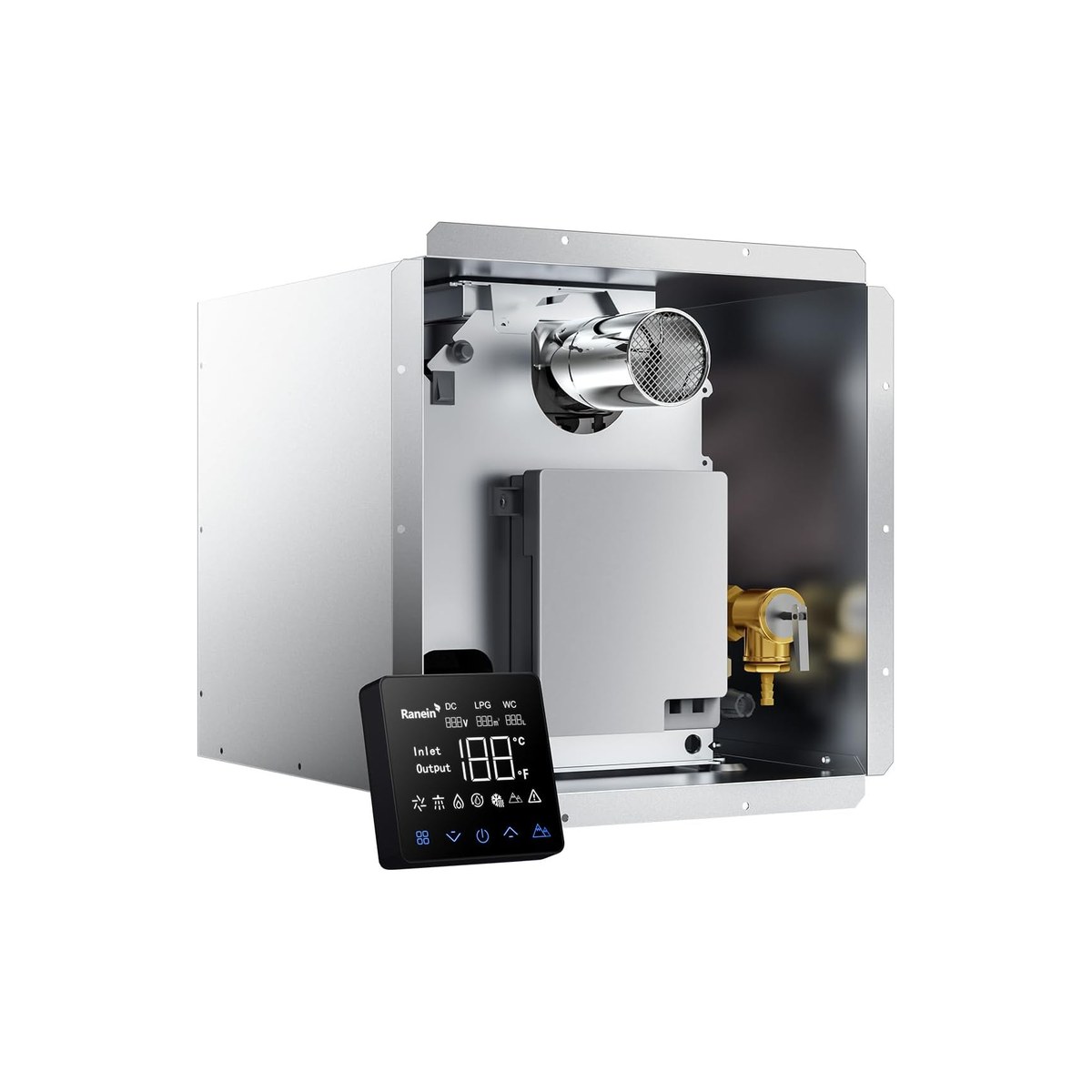
Ranein Gen II RV Tankless Water Heater, 65,000 BTU, 12V On-Demand, Multi-Function Controller, CSA-Approval and High-Altitude Claims per Listing (ASIN B0D7GKVWT9)
Sixty-five thousand BTU for $399, bought with eyes open.
Who it's for: The budget buyer who wants the biggest burner per dollar and accepts a young brand to get it. The Ranein Gen II puts 65,000 BTU, the largest in our lineup, behind a $399 price and a 4.3 star average across 600 ratings, with listing claims of CSA approval and high-altitude readiness. It suits the rig that showers at full flow and the owner who reads the eyes-open part.
What we found: The big burner is the real advantage: 65,000 BTU supports about a 43 degree raw rise at 3 GPM where the 42,000 BTU class manages 28, so it holds temperature at flows where smaller burners go lukewarm. The eyes-open part: the listing's 3.9 GPM headline works out to a 33 degree raw rise, a summer number, the brand is young with no manual library behind it, the CSA and altitude lines are listing claims we could not verify against a published standard, and no exterior door appears in the box on the listing we checked, confirm before ordering.
Bottom line: Buy the Ranein when the budget is firm, the rig stays at modest elevations, and full-flow showers matter more than brand history, the 600-rating base at 4.3 stars is genuine early proof. Treat it like the consumable end of the lane: descale it, screen the intake against wasps, and if the no-door box stalls your install, the Fogatti's door-included bundle is the $114 answer. Suburban's own ST-60 tankless sits between them if the badge matters.
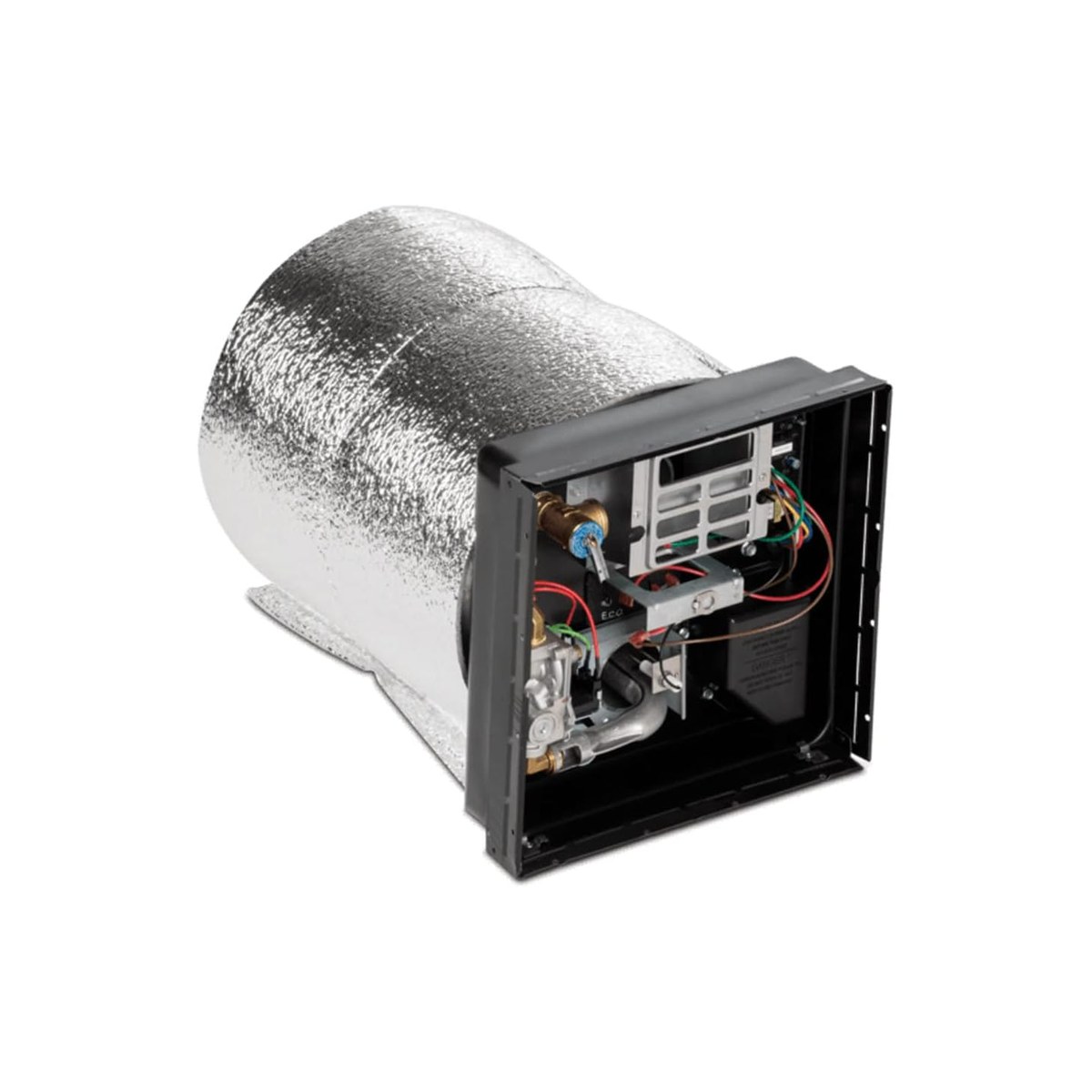
Dometic WH-6GEA RV Water Heater, 6 Gallon, Gas and Electric, Aluminum-Clad Tank with No Anode Rod, Atwood Lineage (ASIN B08LW5JXKP)
The no-anode tank, for rigs cut to Atwood's pattern.
Who it's for: The owner whose rig came with an Atwood and wants the like-for-like swap. Dometic absorbed Atwood, and the WH-6GEA carries that design forward: a 6 gallon gas and electric tank whose aluminum-clad interior is the corrosion protection, so there is no anode rod to pull, ever. It suits the Atwood-cutout rig where a Suburban swap would mean reworking the opening.
What we found: The listing states the differentiator plainly: an aluminum tank that requires no anode rod, the opposite maintenance regime from the Suburban's steel-and-anode design, maintenance is periodic flushing instead of a yearly rod swap. It runs gas and electric like the SW6DE, with a 1,400 watt element per the listing. The flags: this listing moves fast, $701.99 with a dozen units left at our first check, $500.00 and in stock at a same-day re-check, so treat the price as weather, and the listing's dimension fields contradict each other, measure your cutout against Dometic's spec sheet rather than the page, sold by an RV parts dealer under the Dometic brand.
Bottom line: Buy the WH-6GEA to keep an Atwood-pattern rig original: same hole, same no-anode routine, same parts channel. The trade you are accepting is that the aluminum liner is the sacrificial layer, when it pinholes the tank is the consumable, the mirror image of the Suburban's replaceable-rod bargain. The 4.2 across 302 ratings is a thinner base than the Suburban's; price and stock both swing on this listing, check the live page, and the fallbacks if it vanishes are the gas-only WH-6GA at 3.4 stars, or reworking the cutout for a Suburban.
Skip this guide if...
Skip this guide if your current heater works and the complaint is lukewarm water or a drip: a bypass valve left in the winter position, an open mixing valve, a dead 1,440 watt element that should read about 10 ohms when healthy, or a relief valve weeping normal thermal expansion are all fixes measured in minutes, and the troubleshooting decoder below covers each one. Skip the upgrade too if you camp on full hookups twice a year, the factory tank does fine. A new heater earns its place when the tank itself leaks, the rig needs more hot water than recovery allows, or you are converting to tankless deliberately.
Don't bother with.
- × Skip Anode-port add-on electric elementsA 400 watt screw-in element that replaces the anode rod sounds like a cheap path to electric heat, and on a Suburban it is a warranty bonfire: Suburban's owner manual states that add-on electric heating elements 'are not approved to be installed in Suburban products. They could create an unsafe condition and will also void all warranties.' It also displaces the anode on the one tank design that requires one, leaving the steel unprotected, and 400 watts heats at less than a third the rate of the factory 1,440 watt element. If you want electric heat, buy the DE model with the element built in.
- × Skip Running a portable camp shower as the installed heaterPortable propane shower units are real products for campsite showers and dog washes, and they rank for RV water heater searches. They are outdoor-only appliances: no sealed combustion chamber, no exterior vent, and the manufacturers require open-air use. Inside an RV, a bathroom, or a shower tent, the combustion has nowhere to go and carbon monoxide accumulates. An installed RV water heater is a sealed, exterior-vented appliance by design. If the budget says portable, use it outside, full stop, and treat it as campsite gear, not a heater install.
- × Skip The no-name tankless waveAmazon's tankless results are crowded with young brands at $220 to $440 whose listings share the same class of claims: 65,000-class BTU, headline GPM, CSA certified, high altitude ready. Run the physics before believing the combination: 65,000 BTU at 3.9 GPM is a 33 degree raw temperature rise, a number that only feels hot with summer inlet water. Several showed only-a-few-left stock and review counts mostly under 200 when we checked. We scored the Ranein, the one with 600 ratings, and named its claims as claims; treat the rest as unproven until the review base exists.
- × Skip Plugging or capping a weeping relief valveThe temperature and pressure relief valve opens at 210 degrees Fahrenheit or 150 PSI, and a drip during heating cycles is usually normal thermal expansion in a closed RV system, the service manuals document it and prescribe restoring the tank's internal air pocket, a six-step procedure. Plugging the valve converts an annoyance into a pressure-vessel hazard, and Suburban's manual is explicit: never place a valve between the relief valve and the tank, and never plug the relief valve under any circumstances. Fix the air gap, suspect the valve only if it weeps cold or flows steadily, never silence it.
- × Skip Trusting the retail spec layerOn the tank side, listings quote a 16.2 gallons-per-hour combined recovery that Suburban's own datasheet never prints, the real numbers are 10.1 gas and 6.1 electric, listed separately. On the tankless side, one budget-class manual permits use only below 4,500 feet while a rival's marketing claims 9,800, and the Girard's minimum flow reads 0.60 GPM in its newest owner's manual, 0.80 per faucet in the older revision, and 0.80 plus or minus 10 percent in the technical manual, even a manufacturer's own documents drift across revisions, which is why we name the document we quote. The dimension fields on one of our own picks contradict each other. Datasheets and manuals are the only spec layer that holds; we quote them, and where only listing numbers exist, we say so.
How we picked.
Sources we read and how we picked
We anchored this guide to manufacturer documents: Suburban's water heater datasheet and its operation and service manuals, the Atwood service manual that explains the aluminum tank, and Girard's owner's manual, because the retail spec layer in this category invents numbers, a combined recovery figure the manufacturer never publishes, three different minimum flows for one unit, dimension fields that disagree with themselves. We then verified every pick live on Amazon on June 12, 2026: price, rating, stock, brand byline, and what actually ships in the box.
Our filter, in order: datasheet honesty, then maintenance-regime fit, then review scale on a genuine brand listing. That order is why the 42,000 BTU Girard outranks the 65,000 BTU Ranein, documentation and proof beat burner size in a category this noisy. The filter ranks within a lane; across lanes we weigh how many buyers a pick serves, which is why the Fogatti's door-in-box retrofit case at $513 sits above the Girard's paper trail at $782. And the premium tier gets named instead of scored: the Truma AquaGo, a hybrid that starts near 0.4 gallons per minute per Truma and kills the cold-water sandwich with an internal mixing vessel, sells through dealers at a four-figure installed price rather than through the Amazon listings we verify, the off-platform pick if you are near a dealer.
Tank vs tankless, and the numbers that matter
A tank heater stores six gallons and reheats it: the Suburban's 12,000 BTU burner recovers 10.1 gallons per hour, its 1,440 watt element adds 6.1 GPH on shore power, and the practical meaning is about two quick showers, then a wait. The recovery rate is the spec that separates tanks, not capacity alone: the 10 gallon Suburban shares the same 12,000 BTU burner per the datasheet, so the bigger tank is pure buffer, not faster heat. A tankless heater fires on demand when flow trips its sensor and never runs out, but it trades the buffer for a flow gate: below the minimum, around 0.8 GPM on the Girard per its technical manual, the burner will not light, and stopping mid-shower restarts a cold-water sandwich when you resume. A restrictive campground pressure regulator can starve a tankless below its trigger flow, the flow restriction our water pressure regulator guide documents on its cheap fixed units. Propane use follows the design split too: a tank cycles all day to hold six gallons at temperature, a tankless burns only while water flows, which is part of how Girard's manual justifies its 115 degree factory setting, propane savings.
One formula reads every tankless listing for you: temperature rise equals BTU divided by flow in GPM times 500, before efficiency losses. A 55,000 BTU unit lifts 1.5 GPM about 73 degrees, plenty, but its advertised 2.9 GPM only about 38, which on a 45 degree winter inlet is a lukewarm 83 degree shower. Max-GPM headlines are summer numbers, and no burner on this page beats the arithmetic. Size a tankless by the flow you actually shower at, and size a tank by how many people shower back to back. And set whatever you buy with skin in mind: tank heaters store water at 130 to 140 degrees, hot enough to scald at the tap, so temper at the faucet or fit a thermostatic mixing valve if kids are aboard.
Cutouts, doors, and the retrofit map
Fitment is the question that decides half of these purchases. Suburban's 6 gallon cutout is 12.75 by 12.75 by 19.19 inches per its datasheet, and Atwood-pattern openings run shallower front-to-back, which is why like-for-like replacement is the path of least resistance: Suburban into a Suburban hole, the Dometic WH-6GEA into an Atwood-pattern hole. Cross-brand tank swaps mean reworking the opening, measure your cutout and check it against the manufacturer's spec sheet, not the listing's dimension fields, before ordering anything.
Tankless conversions bridge the cutout problem with door kits: the Fogatti ships its exterior door in your choice of 15x15 for 4 and 6 gallon openings, 15x18 for 6 gallon, or 18x18 for the 10-to-16 gallon class, per Fogatti's fitment map, and the door size you order is the fitment decision. On the install itself, the water side is DIY-friendly; the gas connection needs a proper leak test before first light, and if that sentence does not sound routine to you, the gas hookup is a pro job. Two traps to dodge: the Suburban tanks ship with no exterior door at all, doors are accessories on the spec sheet, fine for replacements that reuse the old door, a separate line item for new installs; and merged listings sell door-included and door-less variants of the same tankless unit side by side, so confirm what is in the box before you schedule the install weekend.
Altitude and winter, the specs nobody prints
Altitude is a real spec that almost no roundup mentions: one budget-class tankless manual we pulled prohibits use above 4,500 feet outright, while Fogatti markets high altitude operation to 9,800 feet, a 5,300 foot disagreement that covers most of the Mountain West. Thin air means less oxygen for the same propane orifice, and a unit run far above its rating risks incomplete combustion, not just weak showers. If you camp high, demand a documented altitude rating before buying, and treat marketing-page numbers without a cited test standard as claims, which is how we have labeled them on our own picks.
Winter splits the category in two. A tank winterizes the classic way: bypass valve kit, drain it through the anode port with a 1-1/16 inch socket, and keep antifreeze away from the anode, Suburban warns it corrodes the rod and sediments the tank, so pull the rod and store it dry. Tankless is a different regime: drain and purge per the manual, at least one tankless manual advises against bypass kits entirely, and the built-in freeze protection that fires the burner below 38 degrees, on the Girard, only works while it has propane and 12 volt power, which quietly drains a boondocking battery all winter. Whichever you own, de-winterize in the right order: fill the tank, purge the air, and only then energize the element, a dry-fired element is the classic spring casualty and no warranty covers it.
The troubleshooting decoder: igniting, lukewarm, smells, drips
A gas burner that is not igniting on a DSI heater tries three times, locks out, and lights the red indicator on the wall switch, the reset is the switch itself: off, wait five seconds, on. Work the checklist before parts: 12 volt supply in the 10.5-to-13.5 range, propane on with an empty-line purge after storage, gas pressure at 11 to 14 inches water column per the service manual, and the ECO high-limit not tripped. Lukewarm water has its own short chain, in order of likelihood: the winterizing bypass valve still in bypass, a mixing valve left open, a dead element on electric, it should read about 10 ohms, a failed thermostat, Suburban regulates near 130 degrees, or a broken cold-water diffuser tube short-circuiting cold to the outlet.
The reset button question has a brand-split answer: on a Suburban, the ECO high-limit reset sits on the thermostat assembly on the tank face behind the exterior door, press it by hand only; on Atwood-lineage heaters the equivalent is a one-shot thermal cutoff that is replaced, not pressed. Rotten egg smell is the water chemistry classic: Suburban's manual prescribes about six ounces of household bleach per 10 gallons of tank water, run it to every faucet, let it sit, then flush, and in sulfur-heavy water an aluminum anode in place of magnesium calms the reaction, while Atwood aluminum tanks just get the chlorination. Sediment is the quiet performance killer in both designs: a $11 cleaning wand flushes a tank in minutes at de-winterizing, and an annual descale flush does the same for tankless heat exchangers, and if you camp hard-water country, a portable softener upstream is the prevention that makes that flush rare, our RV water softeners guide covers it.
FAQs.
Q01 What is the best RV water heater?
+
Q02 Should I get a tank or a tankless water heater for my RV?
+
Q03 Why is my RV water heater not working on gas or electric?
+
Q04 Where is the reset button on my RV water heater?
+
Q05 Why does my RV hot water smell like rotten eggs?
+
Q06 Is my RV water heater's pressure relief valve supposed to drip?
+
Q07 How do I winterize an RV water heater?
+
If you, then this.
- IF you want the default tank with datasheet numbers and parts for yearsGET Suburban SW6DE Advantage (B01MY7FHKM; no door in the box, replacements reuse the old one)$499.99 →
- IF you are converting a tank cutout to endless hot waterGET Fogatti InstaShower 8 Plus (B091F7HGPK; door included, pick the size that matches your cutout)$512.99 →
- IF you want tankless with the deepest manual and review baseGET Girard GSWH-2 (B019BWN8E2; plan on 0.9 GPM of flow to keep it lit)$781.99 →
- IF the budget is firm and you shower at full flowGET Ranein Gen II 65,000 BTU (B0D7GKVWT9; claims are listing claims, no door in the box)$399.00 →
- IF your rig is cut for an Atwood and you want the like-for-like swapGET Dometic WH-6GEA (B08LW5JXKP; no anode ever, price and stock swing on this listing)$500.00 →
- IF your Suburban-style steel tank is due its yearly anodeGET Magnesium anode rod 2-pack (B07RCB3M1P; 1-1/16 inch socket, aluminum-clad tanks take none)$16.97 →
- IF your hot water works but the tank has never been flushedGET Camco 11691 water heater tank rinser (B002XL2IBS; the $11 sediment wand)$10.78 →
- IF you live on shore power and want simple electric hot waterGET Bosch ES4 Tronic 3000T mini-tank (B0148O65IE; 120 volt, 12 amps, mounts inside at a sink, not in the exterior heater cutout, a shore-power appliance)$259.00 →
RV & Van Gear: The Complete Guide
The whole-rig picture →Every system in a van, RV, or camper, organized in one place, with the safety and weight floor and the one guide we trust for each.
- Suburban water heater lineup page, links the tank spec sheet (12,000 BTU, recovery rates, cutouts) · Suburban (Airxcel)
- Girard tankless RV water heaters (GSWH-2 documentation and manuals) · Girard Products / Lippert
- RV tankless vs traditional water heaters, long-term real-world testing · TheRVgeeks
- RV water heater pressure relief valve, why weeping is usually normal · TheRVgeeks