Best RV Solar Panel Kits: 5 Complete Systems We'd Wire In (2026)
A kit is not a panel. What decides whether your rig stays charged off-grid is the charge controller, the wiring gauge, and the battery you pair it with, not the wattage printed on the glass. The right RV solar panel kit is the one whose controller matches your array and whose real-world output you have sized honestly, because a 400W kit harvests closer to 300W on a good day once heat and a flat roof take their cut. We cross-read the spec sheets from Renogy and ECO-WORTHY against sources that actually measure output, including a bench test that clocked a 400W ECO-WORTHY array at 347 real watts versus a Renogy at 381, plus EcoFlow's air-conditioning math and owner failure-mode threads. The load-bearing finding: cheap kits cut the corners you cannot see, undersized wire and PWM controllers dressed up as MPPT, and that is where a kit either lasts or dies.
- 01 Renogy 400W MPPT Kit (B0FG2VF2V2) , top pick, a true 40A MPPT 400W kit with the longest-proven panel life, ~$638
- 02 ECO-WORTHY 400W Kit (B0BPY72B9R) , best value, the same 400W MPPT spec for $190 less, ~$450
- 03 Renogy 200W Kit (B015DEY2TM) , budget starter for a small travel trailer, 30A PWM, ~$286
- 04 ECO-WORTHY 200W Complete (B0FWRK8JN6) , best all-in-one, kit with battery and inverter already sized, ~$600
- 05 ECO-WORTHY 800W Complete (B0FH4TMXSY) , best big-rig, 7.168 kWh bank and a 3,000W inverter, ~$2,200
How they compare.
| Rank | Product | Best for | Price | Our score |
|---|---|---|---|---|
| 01 | Renogy 400W Kit (40A MPPT, B0FG2VF2V2)
Top Pick
| best overall 400W kit for a typical motorhome or trailer | $637.99
Buy → | 9.0/10 |
| 02 | ECO-WORTHY 400W Kit (40A MPPT, B0BPY72B9R) | best value, same 400W MPPT spec for less | $449.99
Buy → | 8.7/10 |
| 03 | Renogy 200W Kit (30A PWM, B015DEY2TM) | budget starter for a small travel trailer / weekender | $285.99
Buy → | 8.2/10 |
| 04 | ECO-WORTHY 200W Complete w/ battery + inverter (B0FWRK8JN6) | best all-in-one, no sizing the battery or inverter yourself | $599.99
Buy → | 8.6/10 |
| 05 | ECO-WORTHY 800W Complete, 7.168 kWh (B0FH4TMXSY) | best big-rig / full-time off-grid, the only one near A/C | $2,199.99
Buy → | 8.5/10 |
Prices are current Amazon prices at time of publication and can change. Scores reflect our editorial evaluation, not vendor input.
Our #1 pick: Renogy 400W Premium RV Solar Panel Kit (4x 100W monocrystalline, true 40A Rover MPPT charge controller, Bluetooth module, mounting brackets, inline fuses, MC4 cabling, ASIN B0FG2VF2V2).
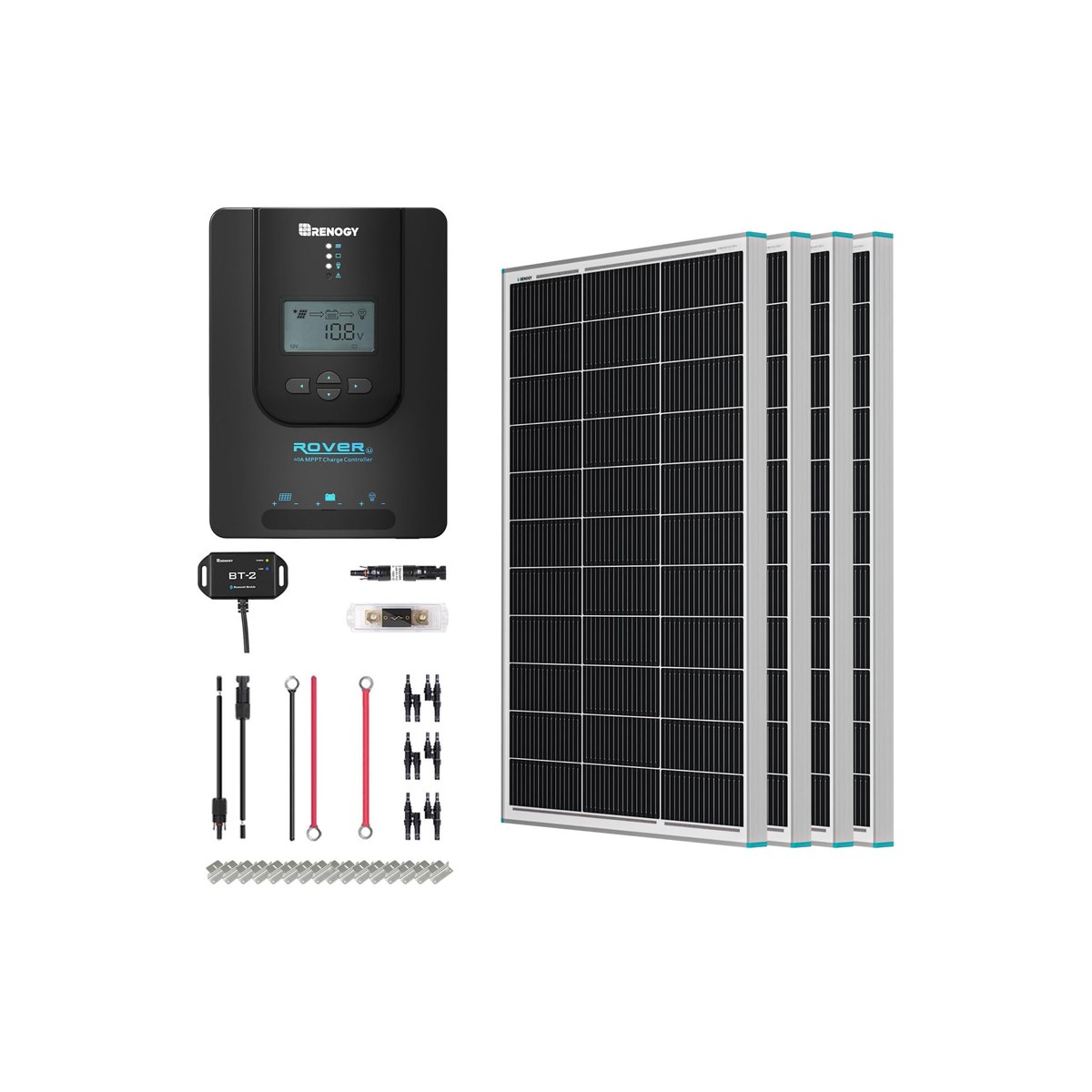
Renogy 400W Premium RV Solar Panel Kit (4x 100W monocrystalline, true 40A Rover MPPT charge controller, Bluetooth module, mounting brackets, inline fuses, MC4 cabling, ASIN B0FG2VF2V2)
The buy-once 400W kit: a real MPPT controller and 25-year panels.
Who it's for: The motorhome, fifth-wheel, or travel-trailer owner sizing a 400W rooftop array for full-time or frequent off-grid use. This is the rig that runs a 12V fridge, vent fans, lights, a water pump, laptops, and a TV, and wants those loads covered with margin rather than rationed. It is also the buyer who plans to keep the rig for years and would rather pay once than replace a cheaper kit later, so a 400 watt rv solar panel kit built to last is the right starting point.
What we found: This is a true 40A MPPT Rover controller, not a PWM unit wearing an MPPT label, and MPPT harvests roughly 15 to 30 percent more energy than PWM, with the gap widening in cold weather. The honesty point is the output number: an independent bench test measured this Renogy array at 381 real watts in full sun against an ECO-WORTHY's 347, so size for 70 to 80 percent of the 400W rating once heat and a flat roof take their cut. Renogy also earns its price on the parts you cannot see day one: panels rated 25-plus years at under 0.5 percent annual loss, IP67 junction boxes, and US-based support.
Bottom line: Buy the Renogy RV solar panel kit if you are living in the rig or keeping it for the long haul, because over the life of the rig it is the cheaper one, just not at the register. Like every Amazon kit, the in-box wire suits short runs, so use 10AWG beyond ten feet. At about $638 it is the most expensive standard kit here, so if you will keep the rig only a few years, the ECO-WORTHY 400W below is the value call.
- + True 40A MPPT Rover controller, not a PWM unit wearing an MPPT label, so it harvests roughly 15 to 30 percent more than PWM, and the gap widens in cold weather
- + Measured ~381 real watts in an independent bench test, the highest of the kits here and closest to its rating
- + 25-plus-year panels at under 0.5 percent annual degradation, IP67 junction boxes, and US-based support, the buy-once choice
- + Everything in the box: Bluetooth monitoring, mounting brackets, inline fuses, and MC4 cabling
- × The most expensive standard kit here by a wide margin (~$638)
- × In-box wiring is sized for short runs, so go to 10AWG if the controller sits more than about ten feet from the panels
- × A buyer keeping the rig only a few years may never recoup the premium over the ECO-WORTHY 400W
Runner-up: ECO-WORTHY 400W Premium RV Solar Panel Kit (4x 100W monocrystalline, 40A MPPT charge controller, Bluetooth module, brackets and cabling, ASIN B0BPY72B9R).
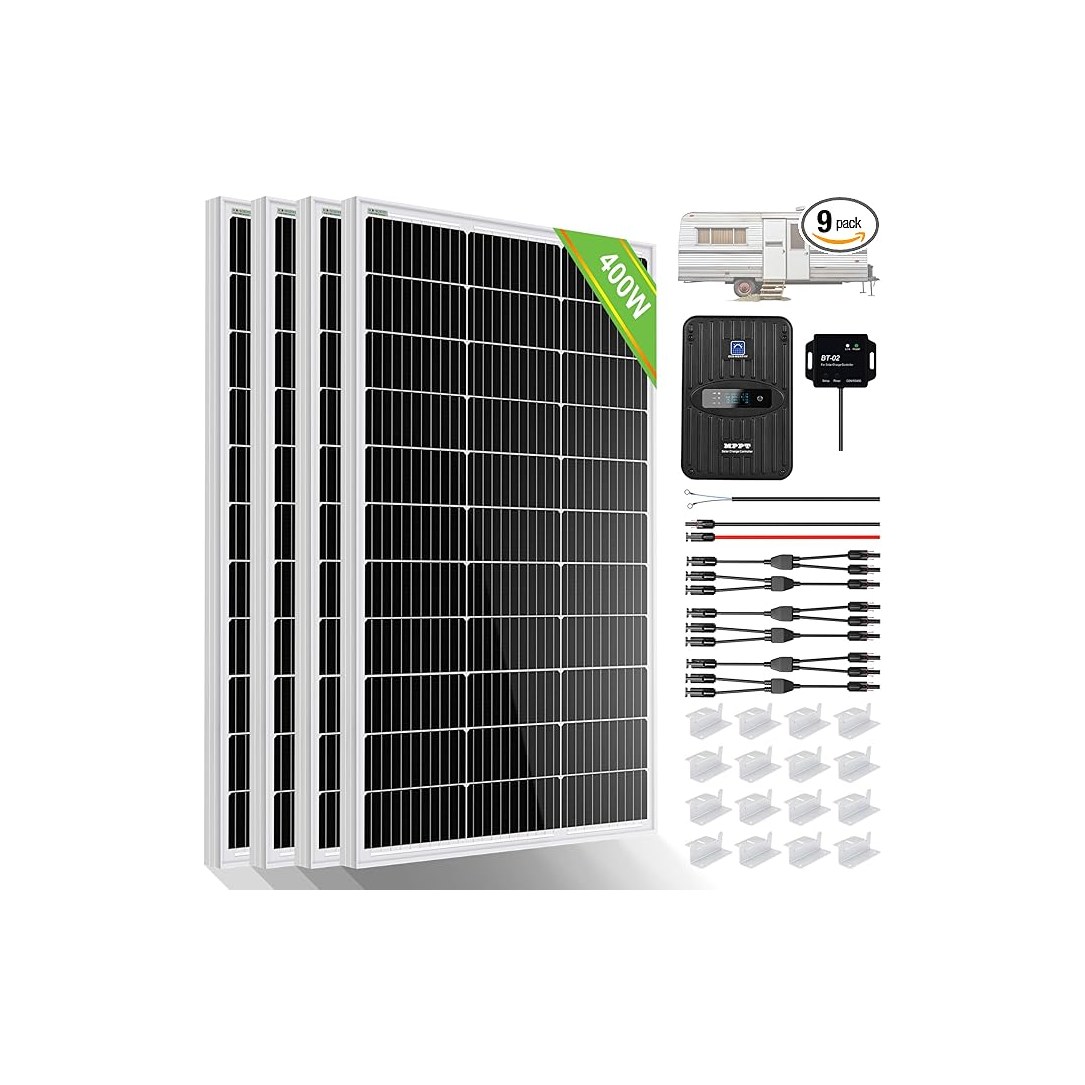
ECO-WORTHY 400W Premium RV Solar Panel Kit (4x 100W monocrystalline, 40A MPPT charge controller, Bluetooth module, brackets and cabling, ASIN B0BPY72B9R)
The same 400W MPPT spec for $190 less, if you accept the trade.
Who it's for: The RVer who wants a genuine 400W MPPT kit at the lowest credible price and is clear-eyed about the trade. This is the buyer sizing the same full-timer loads as the Renogy owner, a fridge, fans, laptops, and a TV, but who plans to keep the rig a handful of years rather than a lifetime, and would rather put the $190 difference toward the rest of the build than toward brand longevity. If that is you, the same MPPT spec for less is the honest call.
What we found: It delivers the spec that matters, a true 40A MPPT controller on a 400W array, for roughly $190 less than the Renogy. That same bench test clocked it at 347 watts against the Renogy's 381, so plan around 340 effective watts. The junction boxes are IP65 rather than IP67, the brackets are thinner, and the in-box cable is undersized for 400W over any real distance, so swap to 10AWG beyond about ten feet. ECO-WORTHY lists the same 25-year output warranty as Renogy, but owners report its overseas support as inconsistent, so a panel that underperforms in year three is harder to get honored.
Bottom line: One trap before you buy: ECO-WORTHY sells 400W kits in both MPPT and PWM versions on near-identical listings, so confirm the title reads 40A MPPT (our pick, B0BPY72B9R, does); if it does not, assume PWM and skip it. With that settled, this is the best-value RV solar kit on Amazon for a buyer who has accepted the longevity and support gap. If you are living in the rig or keeping it many years, the Renogy 400W is worth the extra.
- + The same 40A MPPT spec and 400W array as the Renogy for roughly $190 less, the best-value way to get the right controller
- + Complete kit in the box (Bluetooth module, brackets, cabling)
- + Carries the same 25-year output warranty as Renogy on paper
- + ECO-WORTHY genuinely owns the value end of the Amazon complete-kit market
- × Measured ~347 watts vs the Renogy's 381 in the same bench test (13 to 17 percent under its rating), so size for ~340 effective watts
- × IP65 (not IP67) junction boxes, thinner brackets, and in-box cable undersized for 400W over any distance (use 10AWG beyond ten feet)
- × Overseas warranty support owners report as inconsistent, and it sells in both MPPT and PWM versions on near-identical listings, so confirm the controller reads MPPT
Budget pick: Renogy 200W RV Solar Panel Kit (2x 100W monocrystalline, 30A Adventurer PWM charge controller, brackets, fuses, cabling, ASIN B015DEY2TM).
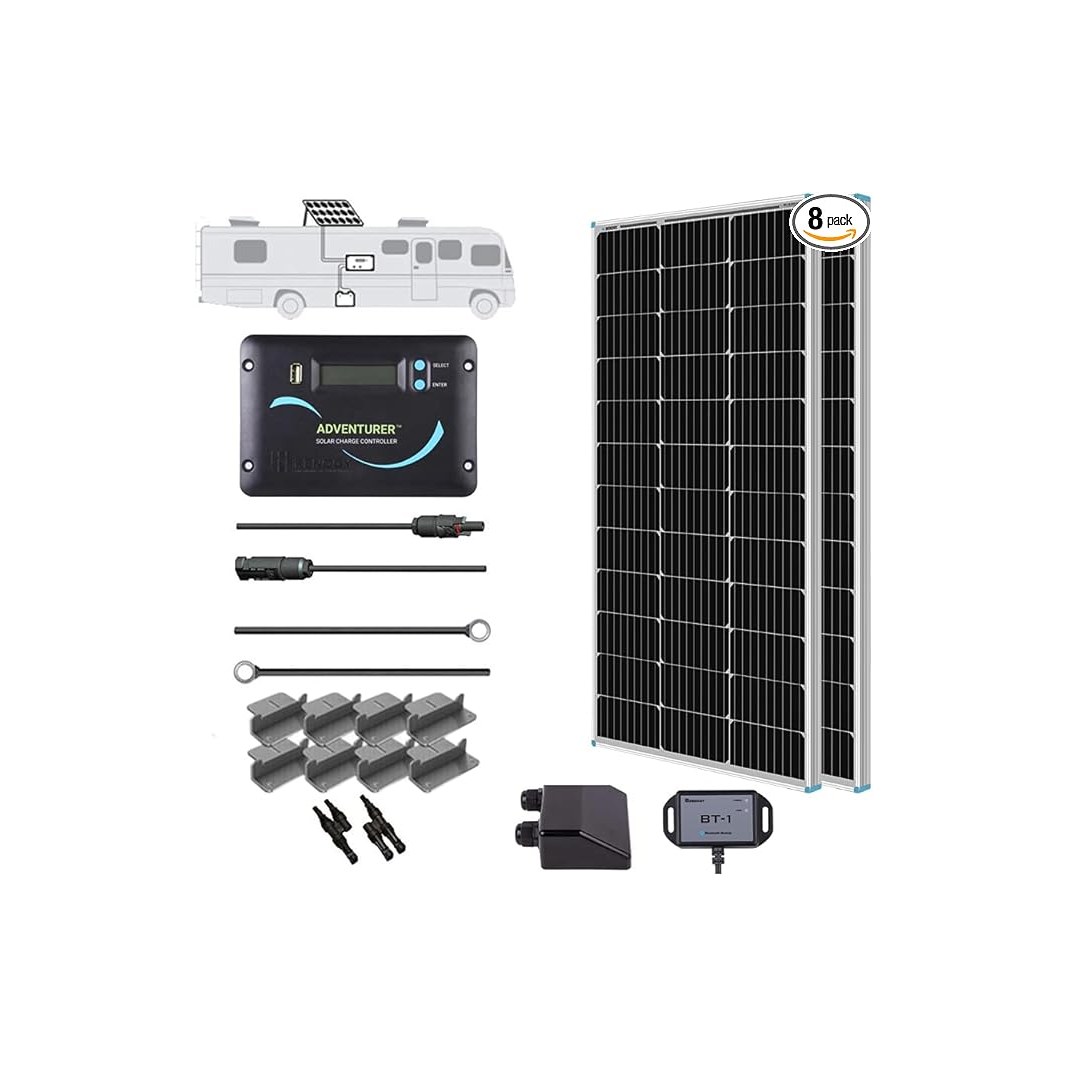
Renogy 200W RV Solar Panel Kit (2x 100W monocrystalline, 30A Adventurer PWM charge controller, brackets, fuses, cabling, ASIN B015DEY2TM)
The right small kit: at 200W, PWM is the correct controller.
Who it's for: The small travel trailer, teardrop, or weekend camper owner whose loads are lights, a roof fan, a water pump, and device charging. This is the rig that does not run a residential fridge, a microwave, or an inverter-fed air conditioner, and does not need to. It is the buyer who wants a proven-brand kit at an entry price to dip a toe into solar, and for whom a 200 watt rv solar panel kit is enough rather than a compromise.
What we found: Its 30A PWM controller is not a corner cut at this size, it is the correct call, because PWM is fine on small one-to-two-panel 12V arrays where panel voltage sits close to battery voltage, and MPPT only pays off above roughly 400 to 600 watts. At the 100W-returns-30Ah rule it delivers roughly 50 to 60 amp-hours a day, enough for LED lights, vent fans, a water pump, and device charging, but not a fridge or an inverter load. This is the right solar panel for travel trailer setups that keep their loads small, and you get Renogy's IP67 boxes, 25-plus-year panels, and US support at the bottom of the range.
Bottom line: ECO-WORTHY's 200W kit (B09RZZHHHM) undercuts it at about $180 with the usual longevity and support trade, so for a rarely-used backup that is defensible, but for most weekenders the extra hundred dollars of Renogy is worth it. And if you think you will grow into a fridge or an inverter later, buy a controller rated above your array so you can add panels without replacing it, or step up to a 400W kit now.
- + 30A PWM is the correct, cost-smart controller at 200W; MPPT only pays off above roughly 400 to 600 watts
- + Renogy IP67 junction boxes, 25-plus-year panels, and US support at an entry price
- + Delivers roughly 50 to 60 amp-hours a day, enough for LED lights, vent fans, a water pump, and device charging
- × PWM, so no controller headroom to grow into a larger array later without replacing it
- × Not enough for a residential fridge, a microwave, or an inverter-fed air conditioner
- × ECO-WORTHY's 200W kit undercuts it at about $180 if absolute lowest price is the only factor
Also worth considering.
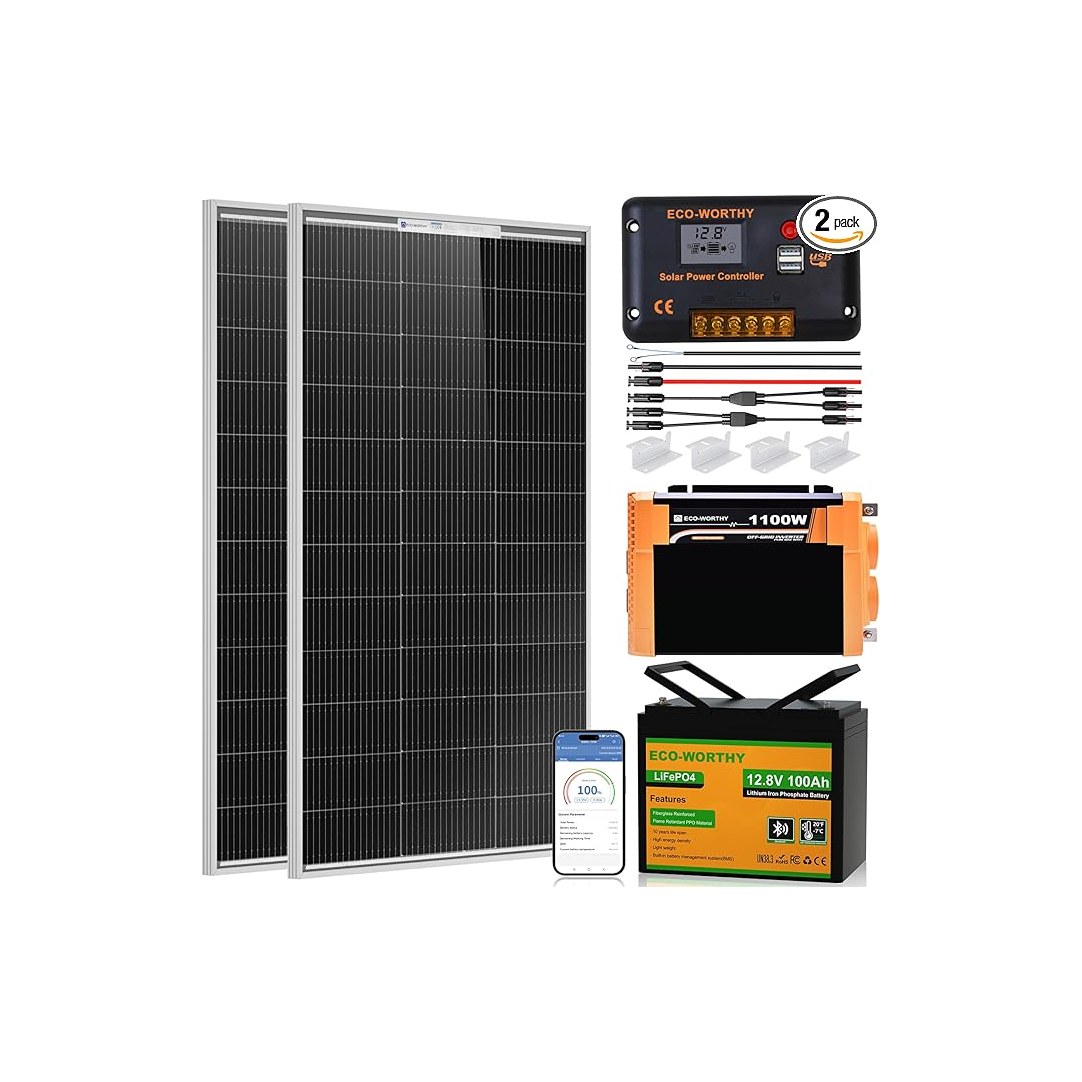
ECO-WORTHY 200W Complete RV Solar Panel Kit with Battery and Inverter (2x 100W panels, 40A MPPT controller, 100Ah LiFePO4 battery, 1,100W pure-sine inverter, Bluetooth, ASIN B0FWRK8JN6)
All-in-one: the battery and inverter already sized for you.
Who it's for: The from-scratch buyer who does not want to spec a battery bank and an inverter separately, the two most expensive and most commonly mis-matched parts of any system. This is the first-timer who would rather buy one box with the hard decisions already made correctly than assemble a battery, an inverter, a controller, and panels that all have to play nicely together, and is willing to pay a little for that certainty.
What we found: This rv solar panel kit with battery and inverter bundles a 100Ah LiFePO4 battery, with real usable depth of discharge rather than a lead-acid you can only half-drain, and a 1,100W pure-sine inverter, the right waveform for laptops, a CPAP, and a TV. Set expectations on the 200W of panel: a 100Ah battery stores about 1.2 kWh and the array refills maybe 0.5 to 0.6 kWh on a good day, so this is a lights-fans-fridge-devices system, not an air-conditioning one, and the inverter runs one big load at a time. ECO-WORTHY owns this complete-kit niche on Amazon because most rivals sell bare panels or sell their systems direct.
Bottom line: The usual budget-tier caveats apply, IP65 boxes and overseas support, but for a correctly-matched small rv solar power system that works the day it arrives, around $600 is a fair price. It is far less than buying a comparable battery, inverter, controller, and panels piece by piece, and it spares a first-timer the mismatch mistakes that sink a DIY build.
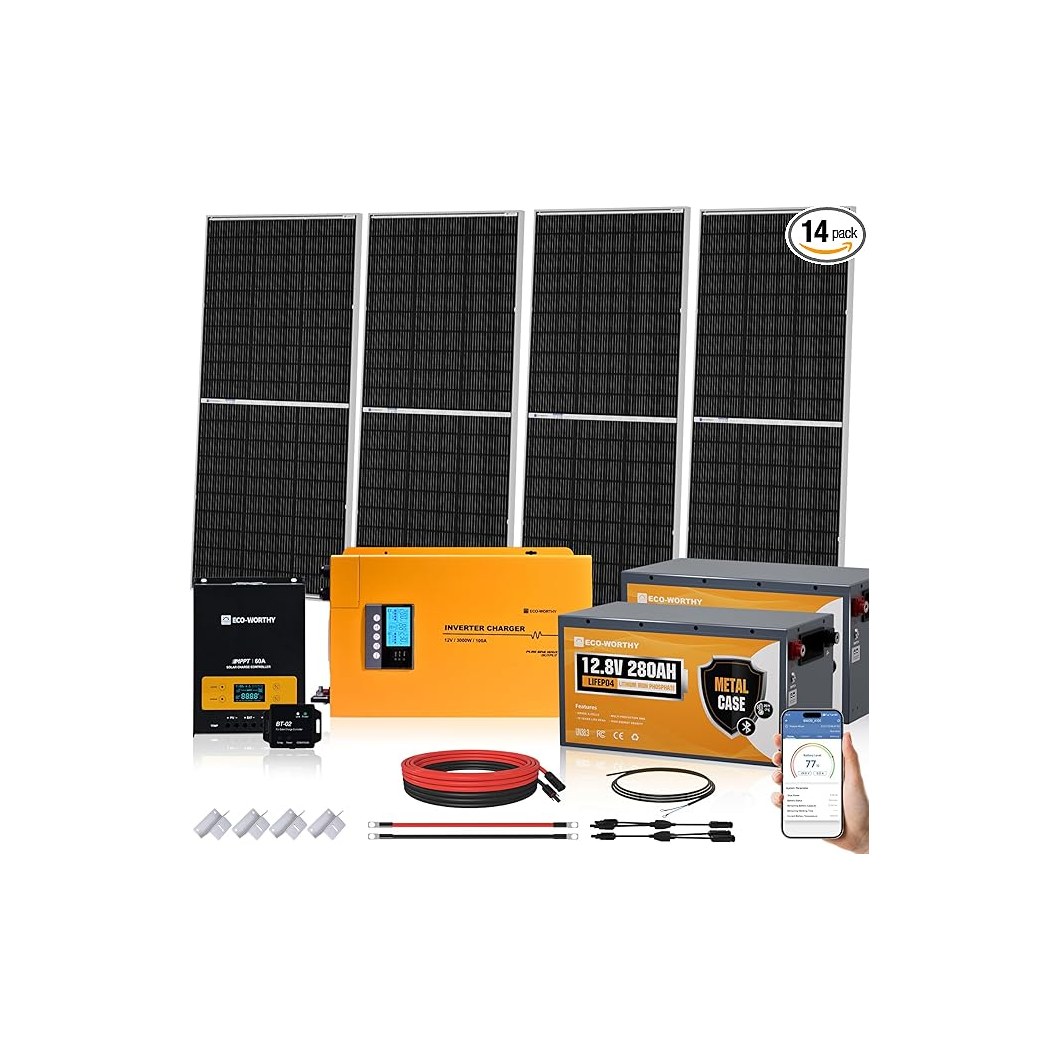
ECO-WORTHY 800W Complete RV Solar Power System (4x 200W bifacial panels, 60A MPPT controller, 7.168 kWh LiFePO4 battery bank, 3,000W inverter/charger, Bluetooth, ASIN B0FH4TMXSY)
The big-rig system, the only one that gets near an A/C.
Who it's for: The full-time off-grid rig that needs serious storage and the closest thing to air-conditioning capability a kit offers. This is the buyer living in the rig and running a real load, a full-timer fridge, an induction cooktop, tools, and devices, who has outgrown a 400W panels-and-controller kit and wants one box that carries the whole electrical system rather than a starter array they will replace within a year.
What we found: Four 200W bifacial panels, a 60A MPPT controller, a 7.168 kWh LiFePO4 battery bank, and a 3,000W inverter and charger. ECO-WORTHY markets it as powering 99 percent of RV appliances including air conditioners, which is technically true but practically misleading, so here is the math: a 13,500 BTU A/C draws 1,200 to 1,500 running watts with a 2,400 to 4,500 watt startup surge. The 7.168 kWh bank divided by about 1,500 watts is under five hours of A/C with nothing else running, and the 3,000W inverter sits right at the edge of that surge, so you would want a soft-start device, which cuts the surge up to 60 percent.
Bottom line: For everything short of all-day air conditioning, a full-timer fridge, induction cooktop, tools, and devices, it is genuinely capable. At about $2,200 it is the most kit-for-the-money on Amazon for a real off-grid load. If you specifically need all-day A/C off solar, no $2,200 kit does that; you are looking at a several-thousand-dollar custom build, and we would say so before you bought.
Skip this guide if...
Skip this guide if you want bare panels rather than a complete kit, or if you want portable solar panels for rv use that you set out on the ground and aim at the sun. Those are different products with different buying logic. If you're outfitting a camper van and want individual panels sized to a small, curved, vent-crowded roof, our Camper-Van Solar Panels guide is the right one, and a campervan solar panel kit follows that guide's bare-panel logic, not this one's complete-system logic. If you want a fold-out portable panel you deploy at camp and stow when you drive, pair a folding panel with one of the units in our Portable Power Stations guide instead, that's the no-drilling, no-wiring path. And if you camp almost entirely at full-hookup parks or park in shade, the payback math on a rooftop kit simply doesn't close, a generator or a power station is the better spend.
Don't bother with.
- × Skip Bare panels sold as a 'kit' with no charge controllerA real RV solar panel kit includes the charge controller, brackets, fuses, and MC4 cabling in the box. Plenty of Amazon listings titled 'kit' are just two panels and a pair of connectors. Without a controller you cannot safely charge a battery, panels output 18 to 22 volts and will cook a 12V battery, and you'll spend the savings (and then some) sourcing a matched controller. If the listing photo doesn't show a controller, it isn't a kit. Every pick in this guide ships a controller.
- × Skip PWM controllers on 400W-plus arrays, and the ECO-WORTHY MPPT-vs-PWM listing trapAbove roughly 400 to 600 watts, a PWM controller throws away 15 to 30 percent of your harvest, more in cold weather. The trap: ECO-WORTHY sells 400W kits in both MPPT and PWM versions on near-identical listings. Always confirm the controller spec reads MPPT before buying a 400W-plus kit, our recommended ECO-WORTHY 400W (B0BPY72B9R) is the MPPT version. PWM is only the right call on small 100 to 200W arrays where it costs less and harvests nearly the same. On anything bigger, MPPT is non-negotiable.
- × Skip Any kit marketed as 'runs your air conditioner' without the battery and inverter to back itRunning an RV A/C off solar is a battery-and-inverter problem, not a panel problem. A 13,500 BTU unit needs 1,200 to 1,500 running watts, a 2,400 to 4,500 watt startup surge, and roughly 10,000-plus watt-hours of battery to run six hours. A 400W panel kit with a small battery cannot do it, no matter what the listing says. Only a large complete system (like the 800W/7.168 kWh pick here) gets close, and only for short windows with a soft-start fitted. Treat 'runs A/C' on a small kit as a red flag.
- × Skip Buying the kit before you've sized your battery bank and your daily loadThe panels are the last decision, not the first. Size your daily watt-hours (fridge, fans, lights, pump, devices), then your battery bank (200 to 300W of solar per 100Ah of LiFePO4), then the controller, then the panels. Buy the panels first and you'll either undersize the array for your real load or oversize it past what your battery can absorb. The sizing section below walks the math; spend ten minutes there before you spend hundreds on hardware.
- × Skip No-name kits with undersized wire and unbranded 'MPPT' controllersThe Amazon SERP for RV solar is full of unbranded kits at tempting prices whose corners are exactly the ones you can't see in a photo: undersized wiring that causes voltage drop and heat, controllers that claim MPPT without delivering it, IP65-or-worse junction boxes, and no warranty path. The two brands that survive owner-forum scrutiny for complete kits in 2026 are Renogy (pricier, long-lived) and ECO-WORTHY (value, shorter-lived but honest). If the brand isn't one cruisers and RVers actually discuss, the cheap kit is the expensive one.
How we picked.
Sources we read and how we picked
We did not pull every kit and run a season of teardown testing, and any site claiming it did for ten complete kits probably didn't either. What we did was read the sources that measure real numbers and the owners who live with these systems: an independent bench review that measured a 400W ECO-WORTHY array at 347 watts and a Renogy at 381 in full sun, EcoFlow's worked math on what it actually takes to run an RV air conditioner, Battle Born's and RELiON's array-sizing formulas, manufacturer spec sheets for every ASIN here, and owner failure-mode threads on Forest River Forums, DoItYourselfRV, and the DIY Solar boards. Then we verified prices and controller specs live on Amazon on June 6, 2026.
Our filter was deliberately narrow: complete kits only, panels plus a charge controller (and for two picks, plus battery and inverter) in one box. Bare panels were excluded, those belong with our Camper-Van Solar Panels guide. That filter is also why the lineup leans on Renogy and ECO-WORTHY: brands like BougeRV and Rich Solar sell mostly bare panels on Amazon, and EcoFlow and Jackery sell their complete systems direct rather than through the Amazon kit channel. Among genuine Amazon-buyable RV solar kits, those two brands are what's left standing, and we say so plainly rather than padding the list with kits we wouldn't recommend.
What size solar kit for RV use do you actually need?
Size the array from your daily energy use, not from a wattage you saw on a forum. The rule of thumb that holds up: a 100W panel returns roughly 30 amp-hours (about 350 watt-hours) per day in decent sun. Divide your daily watt-hours by 350 to get the number of 100W panels you need, then add a buffer for cloudy days. The companion rule for storage: pair 200 to 300 watts of solar per 100Ah of LiFePO4 battery. Lithium accepts a high charge current, which is why every complete kit here ships lithium rather than lead-acid; a lead-acid bank charges more slowly and needs careful, often larger, sizing.
Two worked examples bracket most rigs. A small travel trailer or weekender running LED lights, a couple of vent fans, a water pump, and device charging uses about 500 to 750 watt-hours a day, that's a 200W kit and a 100Ah battery, exactly our budget pick. A full-timer in a motorhome with a 12V fridge, fans, laptops, a TV, a water pump, and the occasional short microwave runs 1,500 to 1,800-plus watt-hours a day, that's a 400 to 600W array and 200Ah of lithium with a 40A MPPT controller, which is why the 400W kits are the heart of this guide. The same math applies whether you call it a motorhome solar panel kit, a camper solar kit, or solar panels for rv trailer use, the labels change, the watt-hours don't.
One more honest note for anyone shopping motorhome solar kits at the big end: roof space is a real constraint. A 100W rigid panel is roughly 21 by 42 inches, and once you account for the A/C shroud, vents, and a walking path, many trailer roofs top out around 400 to 600W of rigid panel. If your load needs more than your roof holds, that's the moment to add a portable panel or a power station rather than force more glass onto the roof.
MPPT vs PWM: the controller is the kit's most important spec
The charge controller, not the panel, is where kits quietly differ. PWM controllers pull the panel down to battery voltage and waste the gap; independent testing puts PWM around 74 to 81 percent efficient against MPPT's 94 to 96, and in cold weather, when panel voltage rises, an MPPT controller produced about 35 percent more daily energy in one sub-freezing test because PWM simply discards the surplus voltage. In plain terms, MPPT harvests 15 to 30 percent more from the same panels.
The practical threshold: PWM is fine, even smart, on a small 100 to 200W array where it costs far less and the panel voltage already sits close to the battery. Above roughly 400 to 600 watts, MPPT pays for itself in months. That's why our 200W budget kit ships PWM without apology and our 400W-plus kits all ship MPPT.
And the trap worth repeating because it's the easiest mistake to make when installing solar panels on rv roofs: ECO-WORTHY sells 400W kits in both MPPT and PWM versions on listings that look almost identical. Our recommended ECO-WORTHY 400W (B0BPY72B9R) is the MPPT version, its title says so. Before you buy any 400W-plus kit, read the controller line and confirm it says MPPT. A PWM controller on a 400W array is the single most common way RVers end up disappointed with output they paid for and never harvest.
Rated watts vs harvested watts: plan for 70 to 80 percent
Panels are rated at lab conditions you'll basically never see on a roof: 25 degrees C cell temperature, perfect sun angle, no dust. In the real world, expect 70 to 80 percent of the rated wattage on a good day, and less in heat, haze, or shade. Silicon loses 0.3 to 0.5 percent of output per degree C above 25, and a hot rooftop in July is well past that. So a 400W kit realistically delivers around 300W at peak and roughly 1.6 to 2.5 kWh across a day depending on conditions.
This isn't theoretical. The independent bench test we leaned on measured a 400W ECO-WORTHY array at 347 watts in full sun (13 to 17 percent under its rating) and a Renogy 400W at 381, a real, measured brand gap that also tracks the longevity difference. The takeaway for sizing: treat a 400W kit as a 320 to 340W kit when you do the daily-amp-hour math, and you'll size storage that actually keeps up instead of a bank that's flat by mid-morning.
What's in a kit, and the all-in-one battery-and-inverter tier
A basic RV solar kit bundles the panels, a charge controller, Z-mounting brackets, MC4 cabling, and inline fuses, the value being that you aren't sourcing six parts and guessing at compatibility. The next tier up, the complete system, adds the two priciest and most-mis-sized components: the battery and the inverter. That's the rv solar panel kit with battery and inverter category, and it exists precisely because beginners mis-match those two parts more than any others.
When you step into the complete tier, two specs matter most. The battery should be LiFePO4, not lead-acid, lithium gives you 80 to 100 percent usable depth of discharge versus about 50 percent for lead-acid, plus faster charging and far longer life. The inverter should be pure-sine, not modified-sine, because laptops, a CPAP, and TVs run hot or buzz on modified-sine. Both of our complete picks (the 200W and 800W ECO-WORTHY systems) ship LiFePO4 and pure-sine, which is the correct combination and not a given at these prices.
Install reality: mounting, wiring, and what to hire out
A flat-mount panels-and-controller kit is a realistic DIY weekend job for a handy owner: Z-brackets bolted to the roof, sealant on every penetration, a cable gland where the wires pass through, and a fused run to the controller and battery. Wire four panels in series-parallel to keep both the cable gauge and the controller amperage sane. The most common mistakes are skipping the sealant, over-torquing screws into the roof, and using the in-box wire on a run longer than about ten feet (upgrade to 10AWG, undersized wire is the number-one cheap-kit complaint, it causes voltage drop and heat).
Where to hire out: the line is roughly at the battery and inverter. Bolting panels and running them to a controller is approachable. Integrating a large LiFePO4 bank, a 2,000 to 3,000W inverter, and a shore-power transfer switch is electrical work where a mistake is expensive or dangerous, that's a good place to pay a pro. One forward-looking tip: buy a controller rated above your current array so you can add panels later without replacing the controller, expandability is cheap to plan for and costly to retrofit.
FAQs.
Q01 What size solar kit for RV use do I need?
+
Q02 Can an RV solar kit run AC?
+
Q03 MPPT or PWM, and does it matter for an RV?
+
Q04 Do I need a battery and inverter, or just the panels and controller?
+
Q05 Is RV solar worth it?
+
Q06 How much does an RV solar kit cost?
+
Q07 ECO-WORTHY vs Renogy: which should I buy?
+
Q08 What about portable solar panels for RV use instead of a rooftop kit?
+
Q09 Can I expand an RV solar kit later?
+
If you, then this.
- IF you want the best overall 400W kit for a motorhome or trailer, a true MPPT controller, the longest panel life, and you're keeping the rig a long timeGET Renogy 400W MPPT Kit (B0FG2VF2V2; true 40A MPPT, IP67, 25-plus-year panels, US support)$637.99 →
- IF you want the same 400W MPPT spec for less and you'll accept shorter panel life and harder warranty support as the tradeGET ECO-WORTHY 400W Kit (B0BPY72B9R; confirm the MPPT version, ~340W effective, the value buy)$449.99 →
- IF you have a small travel trailer or weekender running lights, fans, a pump, and device charging, and don't need a fridge or inverterGET Renogy 200W Kit (B015DEY2TM; 30A PWM is correct at this size; proven brand at an entry price)$285.99 →
- IF you're starting from scratch and want the battery and inverter sized and matched for you in one boxGET ECO-WORTHY 200W Complete (B0FWRK8JN6; 100Ah LiFePO4 + 1,100W pure-sine inverter + 40A MPPT)$599.99 →
- IF you're a full-time off-grid rig that needs serious storage and the closest thing to A/C capability a kit offersGET ECO-WORTHY 800W Complete (B0FH4TMXSY; 7.168 kWh LiFePO4 + 3,000W inverter; add a soft-start for A/C)$2,199.99 →
- IF you want bare panels for a curved van roof, or fold-out portable panels you set out at camp, not a rooftop kitGET our Camper-Van Solar Panels guide (bare panels) or a folding panel paired with a power stationvaries →
RV & Van Gear: The Complete Guide
The whole-rig picture →Every system in a van, RV, or camper, organized in one place, with the safety and weight floor and the one guide we trust for each.
- RV air conditioner solar power requirements (running watts, surge, soft-start math) · EcoFlow
- How much solar do I need for an RV (sizing formulas, panel-to-battery ratios) · Battle Born Batteries
- MPPT vs PWM charge controllers explained · Renogy
- Installing solar panels on a van or RV (mounting, sealing, wiring) · Renogy
- Standard test conditions vs real-world solar output (derating) · A1 SolarStore