Best Diesel Heaters: 5 to Keep a Van Warm and Workable Through Winter (2026)
A diesel heater is the cheapest way to make a van or RV livable through winter: it burns roughly a quarter-liter of fuel an hour and draws about 20 watts, far less than any electric heater. It is also the one piece of van gear that can quietly kill you, and the one buyers most often size wrong. The counter-intuitive truth runs through this guide: the 8kW everyone reaches for is really a 2kW core, and running one too cool is what makes it fail. We read the owners who live with these heaters on the DIY Solar boards, the van forums, and r/vandwellers, then verified every price live on Amazon on June 10, 2026. Because Sorted Gear is for people who work from the rig, we weighed what no other guide does: the fuel-pump tick that ruins sleep also bleeds onto a video-call mic, so a heater quiet enough to run during a meeting is its own category.
- 01 VEVOR 8KW Diesel Heater All-in-One (B0FHCV9298) , top pick, the proven all-in-one most vans should buy, ~$110
- 02 Eberspächer Espar Airtronic S3 D2L (B0BGYH9WVD) , the real deal, near-silent and the work-from-rig pick, ~$1,275
- 03 VEVOR 8KW Auto-Altitude (B0CFQNR4SP) , best value, auto-leans the fuel for mountain camping, ~$117
- 04 WAYSKA 8KW with 15L Tank and Muffler (B08LDV7L1B) , best separate-tank, cleanest permanent install, ~$190
- 05 HCALORY 5L Toolbox Diesel Heater (B0F845B3G3) , best portable, no-drill and quiet, ~$130
How they compare.
| Rank | Product | Best for | Price | Our score |
|---|---|---|---|---|
| 01 | VEVOR 8KW All-in-One (B0FHCV9298)
Top Pick
| best overall, proven all-in-one, easiest to run hot | $109.90
Buy → | 8.6/10 |
| 02 | Espar Airtronic S3 D2L (B0BGYH9WVD) | top-tier, near-silent + auto-altitude, the work pick | $1,275.00
Buy → | 9.0/10 |
| 03 | VEVOR 8KW Auto-Altitude (B0CFQNR4SP) | best value, auto altitude adjustment for the mountains | $116.99
Buy → | 8.4/10 |
| 04 | WAYSKA 8KW, 15L Tank (B08LDV7L1B) | best separate-tank, included muffler, permanent install | $189.99
Buy → | 8.2/10 |
| 05 | HCALORY 5L Toolbox (B0F845B3G3) | best portable, no-drill toolbox, low-noise | $129.99
Buy → | 8.3/10 |
Prices are current Amazon prices at time of publication and can change. Scores reflect our editorial evaluation, not vendor input.
Our #1 pick: VEVOR 8KW Diesel Air Heater All-in-One (integrated tank, LCD switch and remote, Bluetooth app, 12V, ASIN B0FHCV9298).
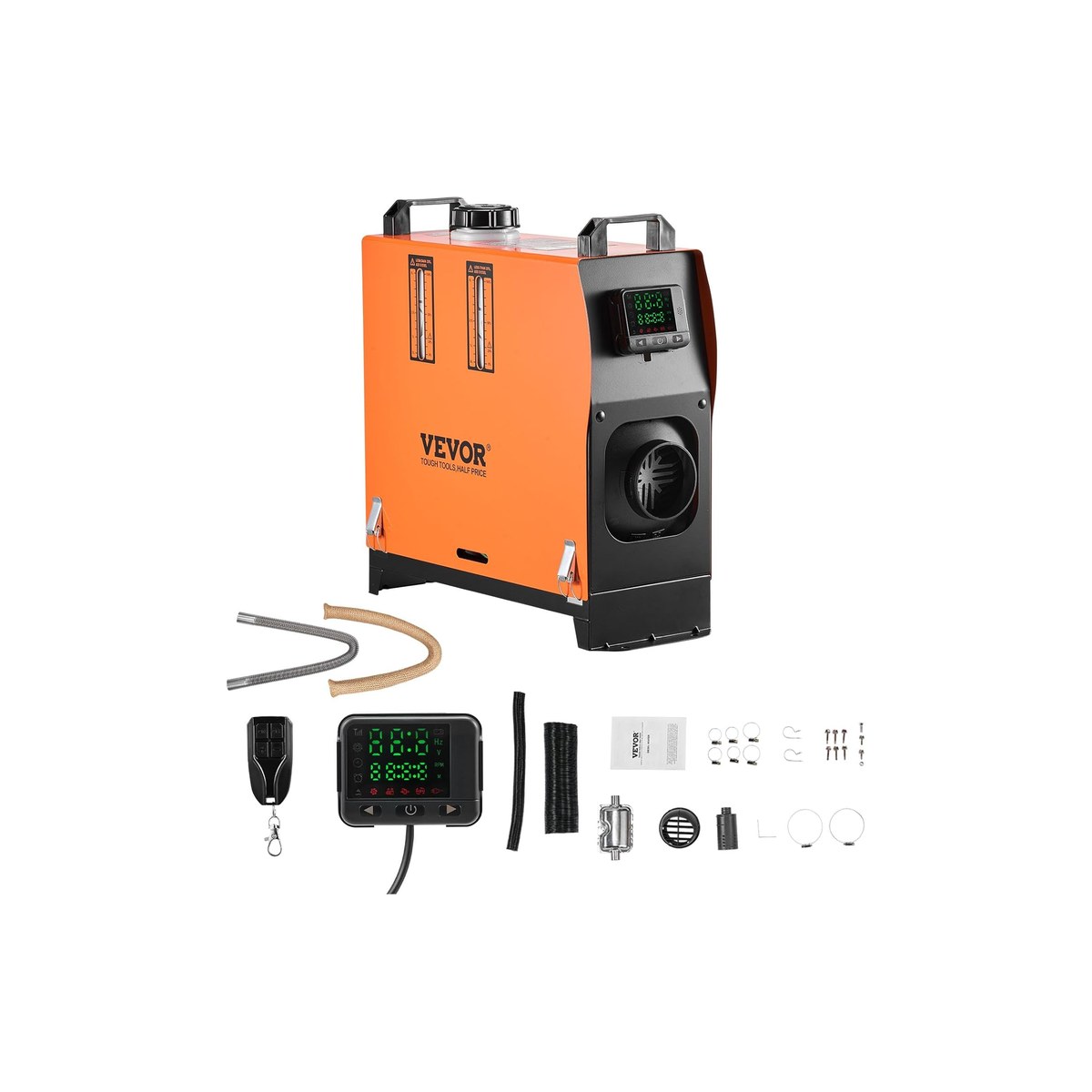
VEVOR 8KW Diesel Air Heater All-in-One (integrated tank, LCD switch and remote, Bluetooth app, 12V, ASIN B0FHCV9298)
The proven, cheap all-in-one most vans should actually buy.
Who it's for: The van or RV owner who wants the cheapest reliable way to heat a cabin all winter and would rather buy one box than design a custom build. This is the buyer installing their first diesel heater, who will give it an afternoon and a careful vent job, run a carbon monoxide alarm without arguing, and accept that a $110 clone is a lottery ticket with very good odds rather than a sealed German unit.
What we found: This is the most-reviewed diesel heater on Amazon by a wide margin, more than 1,900 ratings at 4.1 stars, and that volume is the point: the failure modes are well-documented and almost all of them are install error, not the unit. The honest truth the listing hides is sizing. The 8KW badge is marketing; the core is the same roughly 2kW unit sold as a 2, 5, and 8, and 2kW is correctly sized for a van. Oversizing is what makes these soot up, because a heater run low cycles and fouls its glow plug and exchanger in a season. Run it hot and it lasts.
Bottom line: For most van and RV owners, this is the right first diesel heater: cheap enough to learn on, proven enough to trust, and powerful enough for any well-insulated cabin. The Espar below outscores it on raw quality and quiet, but it costs ten times as much; this is the buy for almost everyone. Two rules make it last: vent the exhaust fully outside and pair it with a CO alarm, and run it on high regularly rather than babying it on low.
- + The most-proven unit in the category: more than 1,900 Amazon ratings at 4.1 stars, far more real-world feedback than any high-end heater here
- + Everything in one box (heater, tank, pump, controls) so a competent owner mounts and vents it in an afternoon
- + About $110, roughly a tenth the price of a genuine Espar, and it puts out the same real-world heat a small van actually needs
- + Bluetooth app, LCD remote, and a low 12V draw of about 10 to 30 watts, so it sips from the house bank
- × Clone quality control is a lottery: some units ship without a fuel filter or with loose fuel lines, so inspect everything before the first start
- × The 8KW rating is marketing; the core is really about 2kW, which is correctly sized for a van but means the big number means nothing
- × The all-in-one box must vent its exhaust fully outside; it is not a portable indoor heater, and running it in a closed space is the kill path
- × Louder than a factory-built unit out of the box; the fuel-pump tick needs a rubber mount and good placement before it is quiet enough to work beside
Runner-up: Eberspächer Espar Airtronic S3 D2L Diesel Heater (about 2kW, near-silent operation, automatic altitude compensation to ~13,120 ft (4,000 m), 12V, ASIN B0BGYH9WVD).
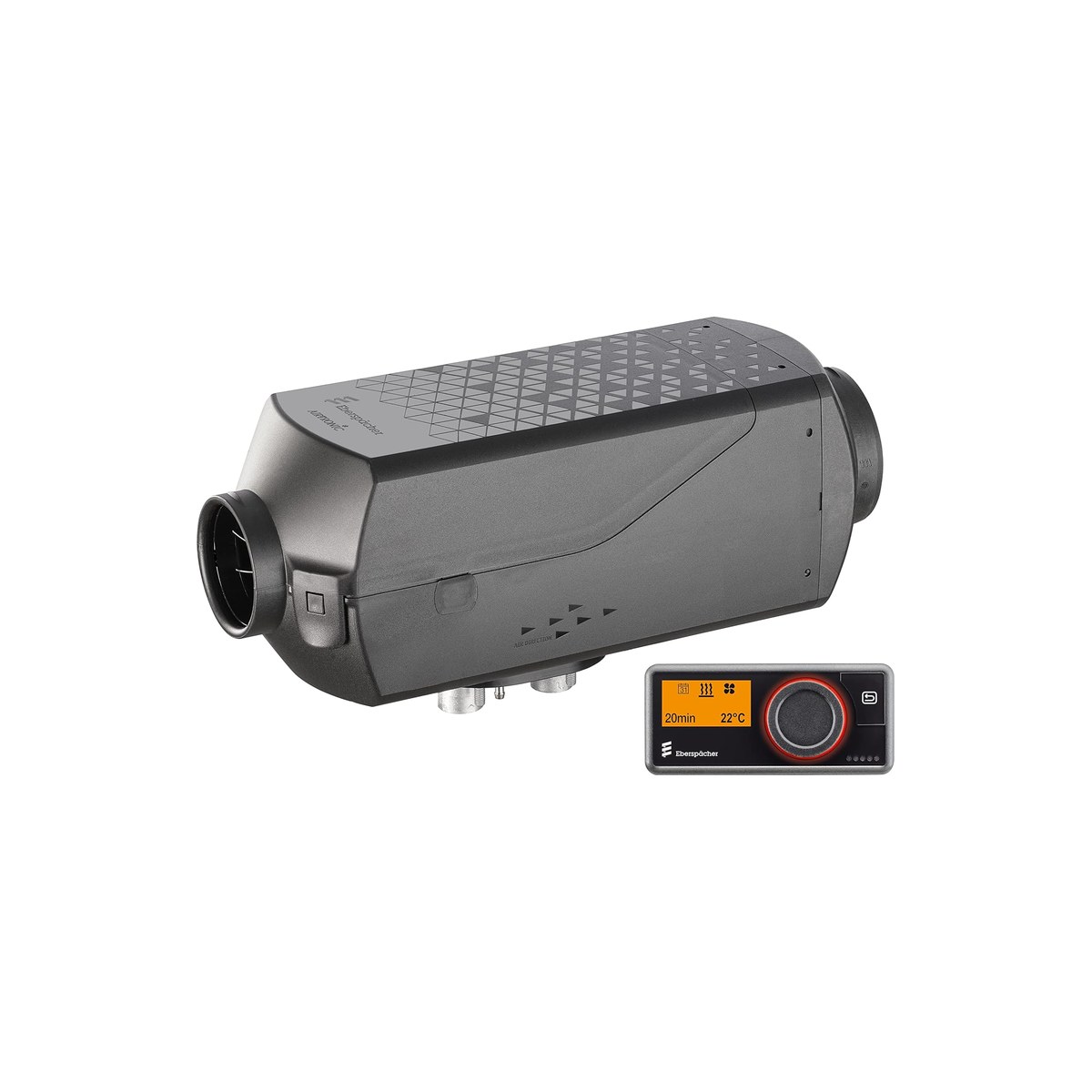
Eberspächer Espar Airtronic S3 D2L Diesel Heater (about 2kW, near-silent operation, automatic altitude compensation to ~13,120 ft (4,000 m), 12V, ASIN B0BGYH9WVD)
The near-silent, German-built heater you can work beside all winter.
Who it's for: The full-timer who lives and works in the rig, not the weekender. This is the remote worker or digital nomad parked somewhere cold who needs a warm, quiet cabin to actually get a day's work done in, takes video calls with the heater running, and would rather buy one unit that lasts a decade than replace a clone every couple of winters. It is also the mountain dweller who is tired of leaning the fuel by hand every time the elevation changes.
What we found: The Espar is the heater the clones are imitating, and the gap is real where it counts. It is near-silent, the quietest unit in this guide by a wide margin, which is the whole reason it leads the work-from-rig case: a clone's fuel-pump tick bleeds onto a video-call mic, and this one does not. It compensates for altitude automatically to about 13,120 feet, so it never soots up in the mountains, and its 2kW of dry heat runs for years rather than a season. At 4.2 stars across 31 ratings it reviews as well as the clones. The catch is sourcing: the Amazon listings are third-party, so the warranty is not the clean factory path.
Bottom line: Buy the Espar only if you live in the rig and the quiet and longevity are worth ten clones to you; for everyone else it is too much heater for the money. If you do buy it, treat the Amazon purchase as gray-market: confirm the seller, keep the invoice and serial, and have it professionally installed. If it is sold out, the Webasto Air Top 2000 is the fallback, though it is louder and only rated to about 5,000 feet stock.
- + Near-silent in operation, the quietest heater here by a wide margin, quiet enough to run through a video call without it reaching the mic
- + Automatic altitude compensation to about 13,120 feet (4,000 m), so it never runs rich and soots up in the mountains the way a stock clone does
- + Genuine German engineering with a long service life; this is the unit the clones are copying, and it earns 4.2 stars across 31 ratings
- + Same low 12V draw as the clones, around 2kW of clean, dry heat, ideal for a sealed, mold-free winter workspace
- × About $1,275, roughly ten times a clone, which only pencils out if you live in the rig and value silence and longevity
- × Sold on Amazon by third-party sellers, so it is effectively gray-market: Espar's warranty routes through authorized installers, so keep the invoice and confirm the seller
- × Professional install is strongly recommended; this is not the unit to learn DIY heater wiring on
- × Stock is thin (only 17 listed at the time of writing); the Webasto Air Top 2000 is the dealer-grade backup if it sells out
Budget pick: VEVOR 8KW Diesel Air Heater with Automatic Altitude Adjustment (Bluetooth app, LCD switch, 12V, ASIN B0CFQNR4SP).
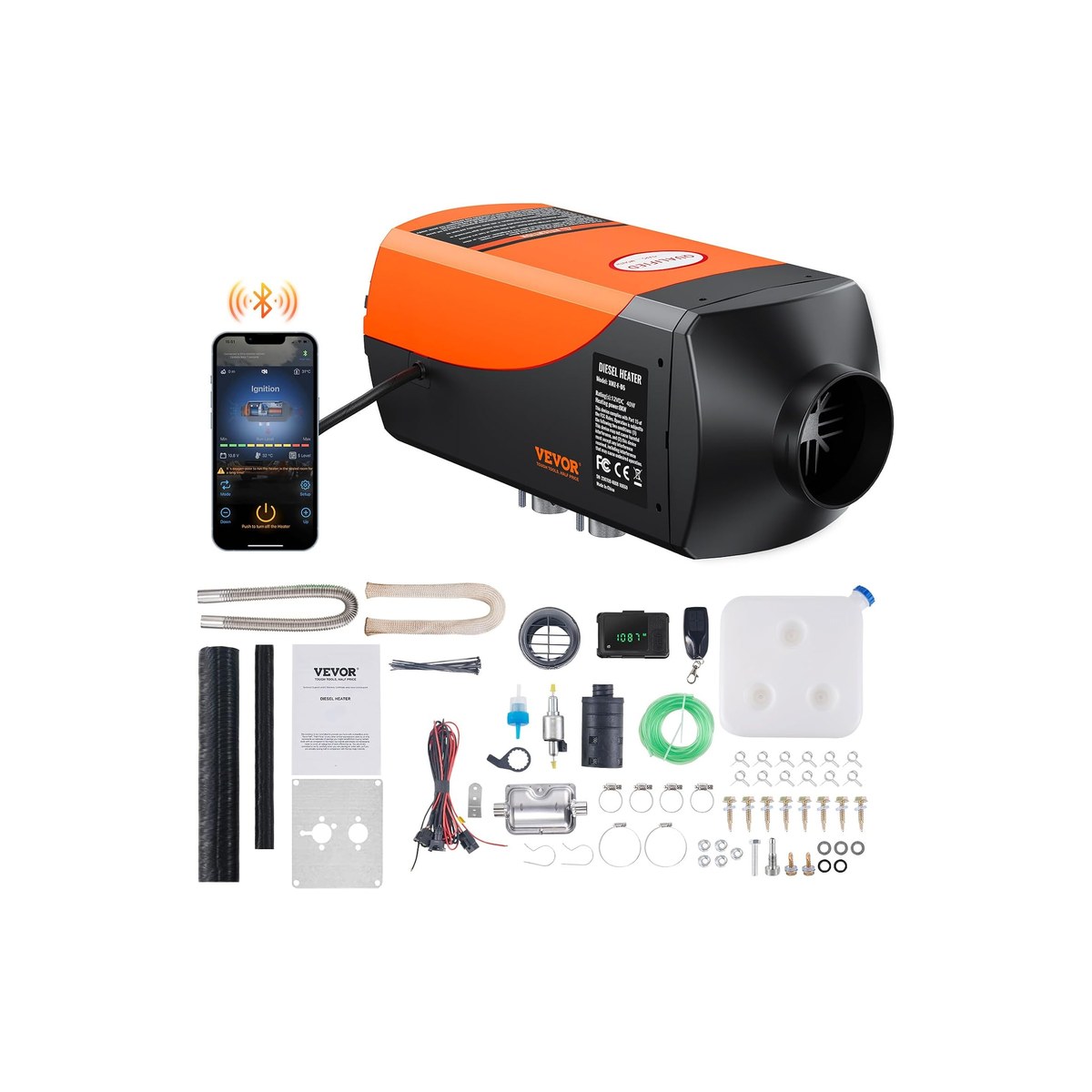
VEVOR 8KW Diesel Air Heater with Automatic Altitude Adjustment (Bluetooth app, LCD switch, 12V, ASIN B0CFQNR4SP)
The one clone feature that matters up high, at a clone price.
Who it's for: The mountain camper, skier, or boondocker on a budget who actually changes elevation, parking at 3,000 feet one night and 8,000 the next, and has read enough to know that altitude is what makes a cheap clone soot up. This is the buyer who wants the single feature worth caring about up high, automatic altitude compensation, but cannot justify spending Espar money to get it, and is comfortable with a standard separate-component install.
What we found: Most clones run rich above about 5,000 feet, dumping unburned fuel that cakes the glow plug and exhaust, which is the real reason mountain users report early failures. This VEVOR is the rare budget unit that leans the mixture automatically as you climb, so it keeps burning clean where a standard clone fouls. At 4.2 stars across 329 ratings it is the best-reviewed VEVOR here after the all-in-one, and at about $117 it costs only a few dollars more than the basic model for a feature that genuinely protects the heater. It is still a clone, so the same quality lottery and inspect-before-start rules apply, and the auto-compensation helps rather than replaces running it hot.
Bottom line: If you camp at elevation and the budget is tight, this is the smart clone to buy: the one feature that actually prevents mountain failures, on the proven VEVOR platform, for about $117. If you never leave low ground, save the few dollars and buy the plain all-in-one instead; auto-altitude does nothing at sea level. Either way, run a CO alarm, vent fully outside, and give it a weekly full-burn to keep the exhaust clear.
- + Automatic altitude adjustment, rare at clone prices, leans the fuel mixture for you so it does not run rich and soot up above about 5,000 feet
- + 4.2 stars across 329 ratings, the best-reviewed VEVOR clone here after the all-in-one, at about $117
- + Bluetooth app and LCD control, the same low 12V draw, and the proven VEVOR clone platform
- × Same clone-quality lottery as any VEVOR: inspect for a missing fuel filter or loose lines before the first start
- × Separate components rather than an all-in-one box, so it is a slightly longer install with a fuel-tank decision to make
- × Auto-altitude is not Espar-grade; it helps a lot but you still run it hot and check the exhaust on long high-elevation trips
Also worth considering.
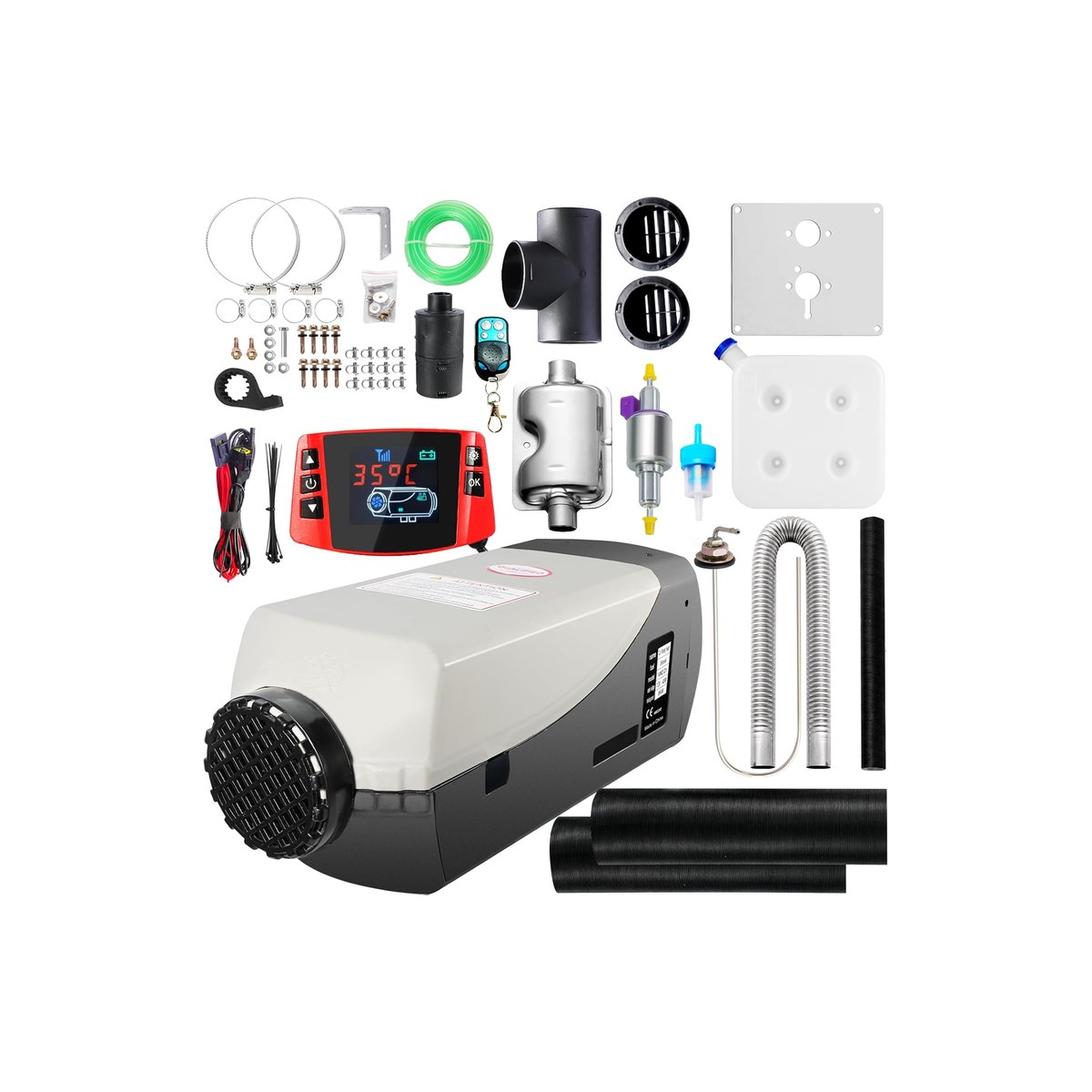
WAYSKA 8KW Diesel Air Heater, 12V with 15L Tank and Exhaust Muffler (LCD switch and remote, separate components for permanent install, ASIN B08LDV7L1B)
The clean permanent-install kit, muffler and big tank included.
Who it's for: The builder committing to a permanent, hidden install rather than a box that lives in the cabin. This is the owner mounting the heater under the floor or in a bench, running the exhaust through the underbody, and feeding it from a dedicated tank, who wants the parts to route cleanly and quietly out of sight. The generous 15-liter tank and the included muffler are exactly what this buyer would otherwise be sourcing separately, so the kit saves a parts-list headache.
What we found: WAYSKA is another clone, but a well-chosen one for this job: 4.1 stars across 312 ratings, a large 15-liter tank that means far fewer refills on a long cold stay, and an exhaust muffler in the box, which matters because the exhaust note is part of what neighbors and a quiet campsite hear. The separate-component layout is the right architecture for a permanent build, letting you isolate the pump on a rubber mount, run the fuel line away from sleeping areas, and tuck everything out of the living space. It is still a clone, so inspect the fuel filter and connections before powering on, and the same buy-small, run-hot, vent-outside rules carry over unchanged.
Bottom line: For a permanent van build, this is the most sensible clone in the lineup: the big tank and included muffler are real value, and the separate layout is what you want for a clean, quiet, hidden install. Skip it if you want a grab-and-go box or a first heater to learn on; the all-in-one is simpler and cheaper for that. Budget a couple of hours for a proper mount, and treat the muffler as a starting point, not a finish line, on noise.
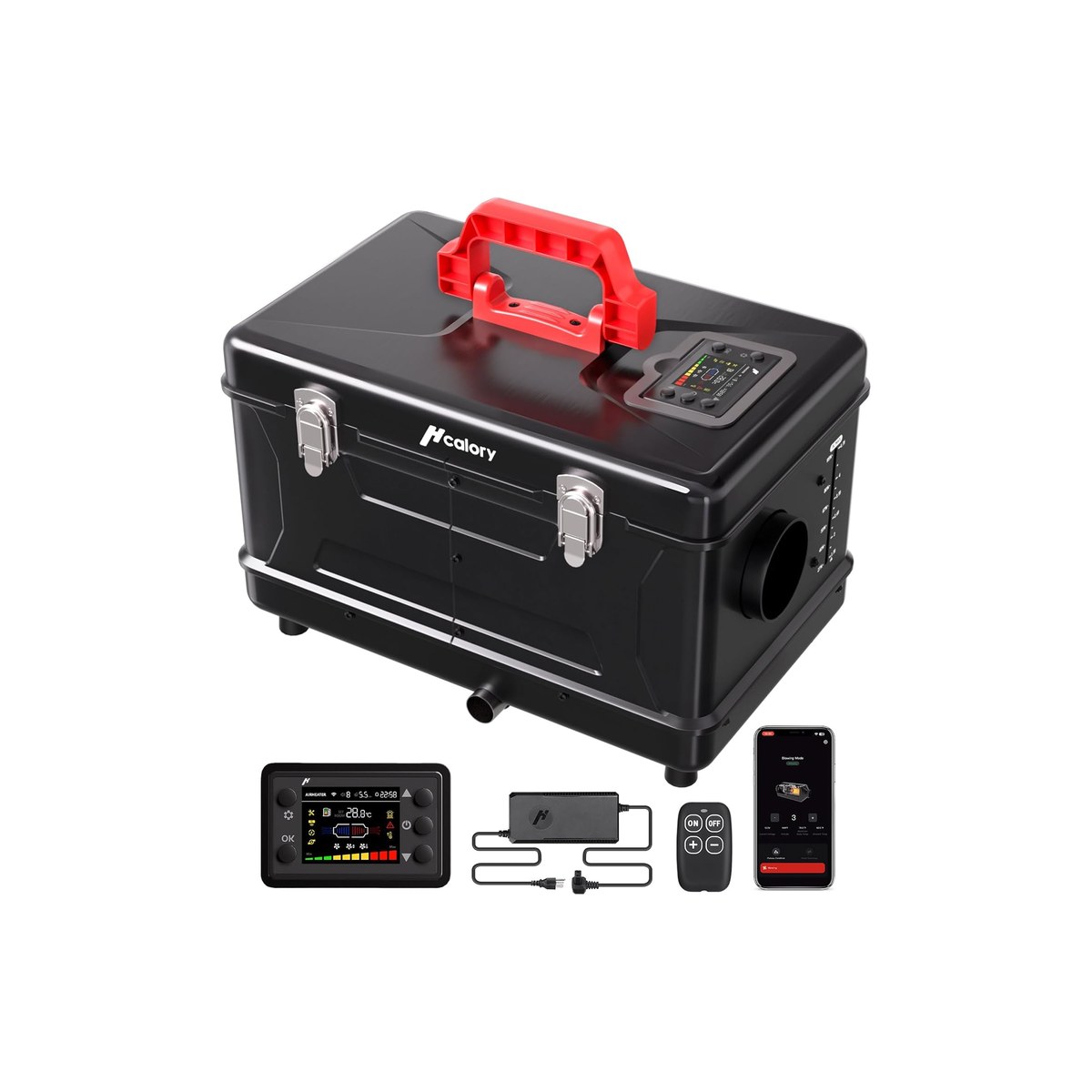
HCALORY 5L Toolbox Diesel Air Heater (compact all-in-one, low-noise pump, altitude mode, app control, 12V, ASIN B0F845B3G3)
The no-drill toolbox you can move, and barely hear.
Who it's for: The truck-camper owner, overlander, or part-timer who does not want to cut a hole in the floor. This is the buyer who needs a self-contained unit they can set in a corner, move between a van and a truck bed, or stow when it is warm, and who runs it in a small enough space that pump noise would otherwise ruin sleep or a work session. The portability and the low-noise design are the whole reason to choose it over a cheaper bare clone.
What we found: HCALORY's listing leads on the two things this buyer cares about, and they hold up reasonably: a compact toolbox body you can carry with one hand and a quieter pump than the bargain clones, with the marketing claim of no tick aimed at the noise problem. It adds an altitude mode and app control, and reviews at 4.0 stars across 68 ratings, a smaller but solid record. The honest caveat is that it is still an all-in-one, so its exhaust must vent fully outside through a hose; portable does not mean you can run it sealed in the cabin, which remains the one mistake that kills people. As a clone, the usual inspect-before-start and run-hot rules apply.
Bottom line: Buy the HCALORY when you cannot or will not drill the floor and want to move the heater around, or when a quiet unit for a small sleeping-and-working space is the priority. For a fixed van build, the WAYSKA's bigger tank and muffler are the better permanent buy, and the plain VEVOR is cheaper if portability and noise do not matter to you. As with every all-in-one, route the exhaust fully outside, never run it sealed indoors, and keep a CO alarm running.
Skip this guide if...
Skip this guide if a diesel heater is the wrong tool for how you actually camp. If you only get out a few warm-weather weekends a year, a $40 propane Mr. Buddy heater is simpler and cheaper, as long as you crack a window for the moisture and carbon monoxide and never run it while sleeping. If you only ever stay on shore power, a small electric ceramic heater is silent, maintenance-free, and free of any combustion risk, though it will trip a 15-amp pedestal if you push it. If you want hot water as well as cabin heat in a high-end rig, look at a built-in unit like a Truma Combi rather than a standalone air heater. And if your real problem is that the van is freezing because it is uninsulated, spend the heater money on insulation first; no heater fixes a tent.
Don't bother with.
- × Skip Running any all-in-one box inside a closed cabinThe portable all-in-one heaters are the most dangerous mistake in this category, because the design tempts you to treat them like an indoor space heater. They are not. The combustion chamber produces carbon monoxide that must be piped fully outside through the exhaust, and the unit needs combustion air from outside too, not from the cabin you are breathing. A misrouted exhaust, a loose coupler, or an intake pulling cabin air is the documented kill path. Vent it outside, seal every joint, run the exhaust tip well past the bodywork and away from windows and vents, and keep a CO alarm by the bed. Every time.
- × Skip Paying extra for a 'bigger' kW numberThe most common money-waster in the category. The clones are sold as 2kW, 5kW, and 8kW, but teardowns show the same roughly 2kW core in most of them, so the big number is marketing, not more heat, and the well-reviewed '8kW' box you see everywhere is that 2kW core with a louder label. Do not pay extra chasing a bigger figure, and do not assume it will warm a larger space. The genuine sizing mistake is different: buying a truly larger unit and running it on low, which cakes the glow plug and heat exchanger with soot. A 2kW core handles most insulated vans and many small RVs. Pick the best-reviewed listing, ignore the kilowatts, run it hot, and only go genuinely bigger if you regularly camp below about 20 degrees in a poorly insulated rig.
- × Skip Skipping the carbon monoxide alarm to save twenty dollarsThis is the one accessory that is genuinely non-negotiable. A well-installed, well-vented diesel heater is safe, but the failure modes, a cracked exhaust, a loose joint, a clogged pipe forcing exhaust back, are invisible and odorless, and they happen to careful people. A 12V RV-rated carbon monoxide alarm mounted near head height by the bed costs about $20 to $30 and is the only thing standing between a slow exhaust leak and not waking up. Buy it at the same time as the heater, not later, and test it before the first cold night.
- × Skip The cheapest no-name clone with a handful of reviewsThere is a floor below which a clone stops being a bargain. The picks here, VEVOR, WAYSKA, and HCALORY, have hundreds to thousands of reviews and at least a nominal support path, which is how you know the failure rate and can get a replacement part. The bottom-tier white-label listings with a few dozen reviews save maybe fifteen dollars and give you no track record, no parts, and no recourse when one arrives with disconnected fuel lines. In a product that burns fuel inside your living space, that is the wrong place to economize.
- × Skip A propane heater as primary heat if you live in the rigPropane heaters like the Mr. Buddy are a fine backup and a reasonable choice for occasional warm-weather trips, but they are the wrong primary heat for a full-timer, and the reason is moisture. Burning propane releases water vapor into the cabin, which on a cold night condenses on every window and cold metal surface and feeds mold, the chronic problem of living in a small sealed space. A diesel air heater burns its fuel in a sealed chamber vented outside, so it adds heat without humidity and actually dries the cabin. For a livable, mold-free winter workspace, that dry heat is the point.
How we picked.
Sources we read and how we picked
We did not bench-test ten heaters in a climate chamber, and most sites that claim to have are reworking vendor spec sheets. What we did was read the people who live with these units: install threads and failure reports on the DIY Solar boards, the Sprinter, ProMaster, and Transit van forums, and r/vandwellers, plus long-term teardowns and the rare honest comparison. Then we verified every price, rating, and review count live on Amazon on June 10, 2026.
The honesty problem in this category is that almost everything Amazon-buyable is a Chinese clone of the same handful of designs, while the brand-name units are mostly sold through installers. So our filter was simple: which clones have the review volume and the one or two features that actually matter, and is the top tier worth its price for the buyer who can use it. That is why VEVOR fills two slots, since it has by far the most real-world feedback, and why the Espar earns a place despite costing ten times the clones. We named the gray-market warranty catch rather than hiding it.
The clone truth: your 8kW heater is really 2kW
The most useful thing we can tell you is counter-intuitive: the kilowatt number on the box is mostly fiction, so ignore it and run whatever you buy hard. The clones are marketed as 2kW, 5kW, and 8kW, but teardowns repeatedly show the same roughly 2kW core in most of them; the bigger numbers sell units, they do not deliver proportional heat. Oddly, the SKUs actually labeled 2kW often cost more and carry fewer reviews than the 8kW-badged version of the same core, so there is no reason to hunt for the honest label; pick the best-reviewed listing and ignore the kilowatts. A 2kW core is genuinely enough for most insulated vans and many small RVs, and insulation matters far more than the rating. Only step up to a genuinely larger unit if you regularly camp below about 20 degrees Fahrenheit or your rig is poorly insulated.
Running one too cool is not just inefficient; it slowly destroys the heater. A unit idling on low leaves unburned fuel to soot the glow plug and heat exchanger, and a genuinely oversized heater spends most of its life doing exactly that. One owner's VEVOR sooted its exhaust port nearly shut in about 80 hours of low-output running, the kind of slow fouling everyone blames on cheap quality when the real cause is never letting it burn hot. The fix is built into how you run it: a full-bore burn for a few minutes before every shutdown, and a 15-to-20-minute full burn once a week, keeps the chamber clean.
Carbon monoxide and exhaust: the rules that keep it safe
A diesel heater is safe when it is installed right, and lethal when it is not, so this is the section not to skim. The combustion happens in a sealed chamber, and its exhaust, which contains carbon monoxide, must be piped fully outside: sealed joints, the exhaust tip extended past the bodywork and several feet from any window, door, or roof vent, and a downward or rearward angle so it cannot pool under the rig. The combustion-air intake must also draw from outside, never from the cabin air you breathe.
Get that right and the cabin air stays clean; get it wrong, with a loose coupler, a cracked pipe, or an intake pulling cabin air, and the exhaust still carries carbon monoxide, which is the documented way people die in their sleep. Two non-negotiables follow. First, a 12V carbon monoxide alarm mounted near head height by the bed, tested before the first cold night. Second, never run a portable all-in-one box inside a closed space without its exhaust routed outside; the fact that it is portable does not make it an indoor heater. One more hazard beyond the gas: the exhaust pipe and muffler run red-hot, so keep them clear of anything flammable and never set a running box over dry grass or leaf litter.
Quiet enough to work beside: the noise fix
If you only sleep in the rig, heater noise is a nuisance; if you work in it, it is a real constraint, and almost no other guide treats it that way. The loudest part of a clone is not the fan, it is the fuel pump, which ticks once per injection, and that tick carries: owners describe it as borderline maddening when trying to sleep, and it bleeds straight onto a laptop microphone on a video call. A heater you have to switch off to take a meeting is a heater that is not really heating your workday.
The high-end answer is the Espar, which is near-silent by design and the reason it leads our work-from-rig case. The clone answer is install technique, and it works better than people expect: mount the fuel pump on a rubber isolator rather than bolting it to flat metal, which acts like a soundboard, set the pump at roughly a 30-degree outlet-up angle, isolate the fuel line from panels, and add a second muffler to the exhaust. Done well, owners report barely any sound inside the van. That is the difference between a heater you run all day while you work and one you only run at night.
Running it parked: fuel and 12V power
The reason a diesel heater suits people who live and work off-grid is that it costs almost nothing to run. It burns roughly a quarter-liter of fuel an hour on medium and about half a liter on high, which works out to somewhere around seven to eight hours of heat per gallon, and it does it without idling the engine. For a full day of warmth while you work, that is a few dollars of diesel, not a propane bottle swapped every couple of days.
Electrically it is just as gentle, which is what makes it practical on a house bank. Expect a brief startup surge of roughly 11 amps for a couple of minutes while the glow plug fires (enough that it will not run off a small 10-amp power-station port), then a steady draw of only about 10 to 31 watts from low to high. A 100Ah lithium battery will run one for roughly a full day and night. That low, steady draw is why the heater pairs naturally with the house power these guides cover: see our RV lithium batteries, DC-DC chargers, and RV solar kits guides for the bank that feeds it.
Install basics and the dealer-only reality
Budget a real afternoon, not ten minutes, for a proper job. A fixed install means a floor penetration for the exhaust, intake, and fuel line, a fuel pickup either tapped into the vehicle tank or fed from a dedicated tank, and a mount somewhere with airflow and away from where you sleep. Two clone gotchas to know: many ship without the inline fuel filter or intake mesh, and at least one has arrived with the fuel lines disconnected, so inspect and prime the fuel line before the first start to avoid a glow-plug overheat and a cloud of white smoke.
The dealer-only reality is worth stating plainly, because it shapes what you can buy on Amazon. Webasto and Espar are the genuine articles, and both now have real Amazon listings (the Espar around $1,275, the Webasto Air Top 2000 around $1,295), but they are third-party sales, so the factory warranty that normally runs through an authorized installer does not cleanly apply. Autoterm and Planar, the well-regarded Latvian mid-tier with a three-year warranty, are mostly sold off Amazon through specialist dealers. If you want genuine-brand reliability with a clean warranty, buying from a dealer rather than Amazon is the honest route.
FAQs.
Q01 Are cheap Chinese diesel heaters safe?
+
Q02 Do I really need a carbon monoxide detector with a diesel heater?
+
Q03 What size diesel heater do I need for a van?
+
Q04 Will a diesel heater work at high altitude?
+
Q05 Can I run a diesel heater while working or on a video call?
+
Q06 How much fuel does a diesel heater use?
+
Q07 Diesel heater vs propane heater: which is better for a van?
+
Q08 How does a diesel heater actually work?
+
If you, then this.
- IF you want the cheapest reliable heater for a van or RV and it is your first installGET VEVOR 8KW All-in-One (B0FHCV9298; proven, easy, run it hot)$109.90 →
- IF you live and work in the rig and want a near-silent heater that handles altitude on its ownGET Espar Airtronic S3 D2L (B0BGYH9WVD; near-silent, auto-altitude, gray-market warranty)$1,275.00 →
- IF you camp at real elevation on a budget and want automatic altitude compensationGET VEVOR 8KW Auto-Altitude (B0CFQNR4SP; leans the fuel for you up high)$116.99 →
- IF you are doing a clean permanent van build and want a big tank and muffler includedGET WAYSKA 8KW with 15L Tank (B08LDV7L1B; separate components, fewer refills)$189.99 →
- IF you want a portable, no-drill heater you can move between vehicles and barely hearGET HCALORY 5L Toolbox (B0F845B3G3; self-contained, low-noise, altitude mode)$129.99 →
- IF you only camp a few warm weekends a year, stay on shore power, or the van is uninsulatedGET a propane Mr. Buddy or a small electric ceramic heater, and insulation first, not a diesel heatervaries →
RV & Van Gear: The Complete Guide
The whole-rig picture →Every system in a van, RV, or camper, organized in one place, with the safety and weight floor and the one guide we trust for each.